

Inflation means the overall price level is rising. Deflation means it is falling. Stagflation describes the uncomfortable combination of persistent inflation and weak economic activity, usually with a deteriorating labor market. They affect households and investments differently, and none can be understood simply by looking at the price of one item.
The answer to whether they are all economically bad is more nuanced than the labels suggest. Low, stable inflation can coexist with rising real incomes and a healthy economy. Some falling prices reflect improving productivity. Stagflation is particularly difficult because policies that restrain prices can also weaken growth. The cause, scale and duration matter, as does who carries the cost.
Start with the price level and the rate of change
A price index summarizes changes across a basket of goods and services. It combines items using weights that reflect the methodology and population covered. Consumer indices, producer-price indices and measures of domestic output prices answer different questions. A country's inflation rate is therefore not a literal measure of every household's personal experience.
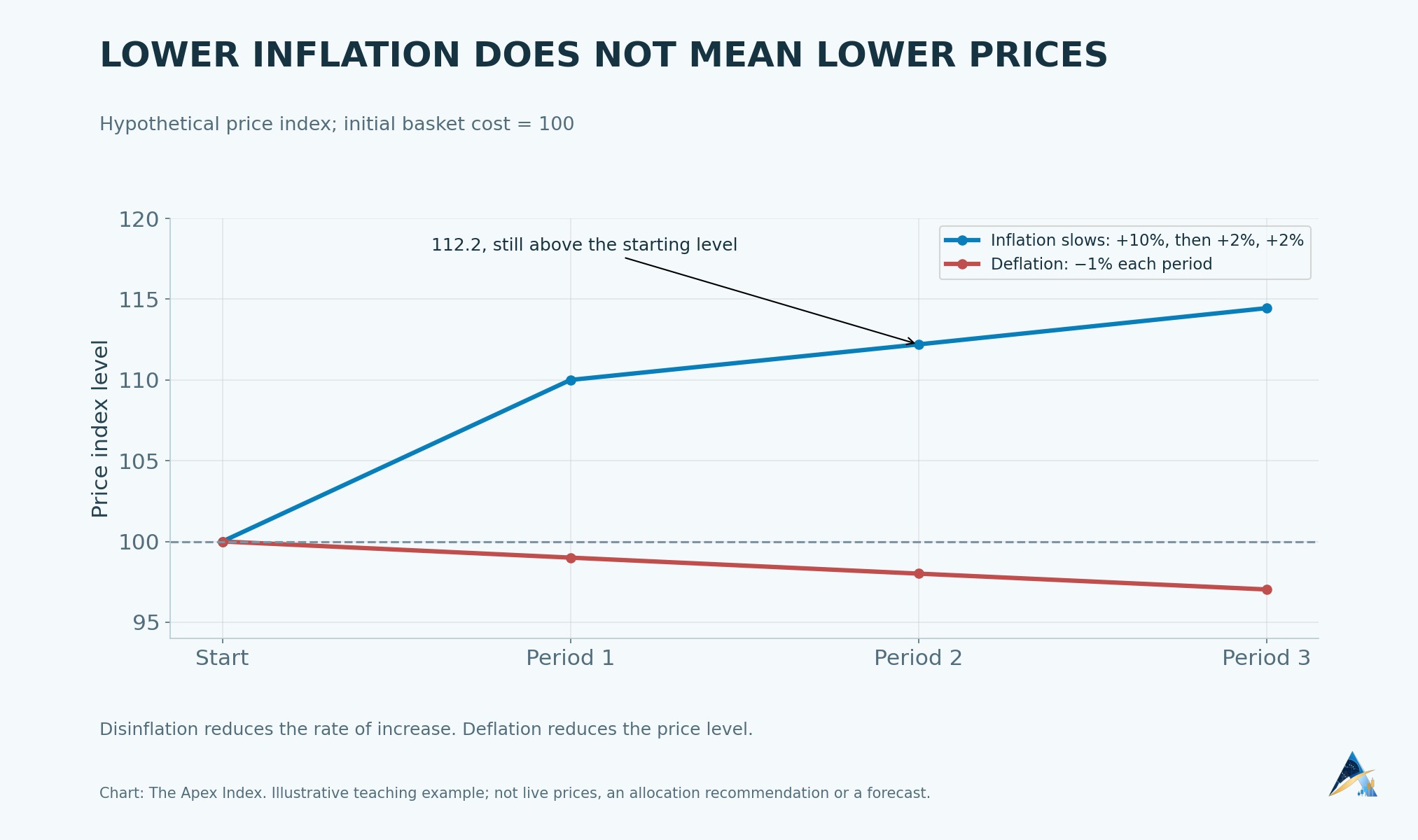
The IMF's explanation describes inflation as the increase in prices over a period, often measured over a year. If an index rises from 100 to 110, prices have increased 10%. If it subsequently rises from 110 to 112.2, the second increase is 2%. Prices are still rising, but more slowly.
That slowdown is disinflation. It does not restore the earlier price level. Households can hear that inflation has fallen while still paying substantially more than they did before. The headline concerns the pace of change; the checkout bill reflects the accumulated price increases. Confusing those two measures creates unnecessary disagreement about whether an improvement is real.
Deflation is different. An index falling from 100 to 99 records a 1% decline in the overall price level. A fall in one category, such as televisions, does not establish economy-wide deflation if other prices rise enough to offset it. Likewise, a lower monthly reading does not automatically establish a lasting deflationary period.
Month-to-month and year-over-year rates also differ. A yearly rate compares the current index with its value twelve months earlier. A monthly rate compares adjacent months and may be seasonally adjusted. A high or low reading can partly reflect what happened in the comparison period, which is known as a base effect.
What the latest release can and cannot tell you
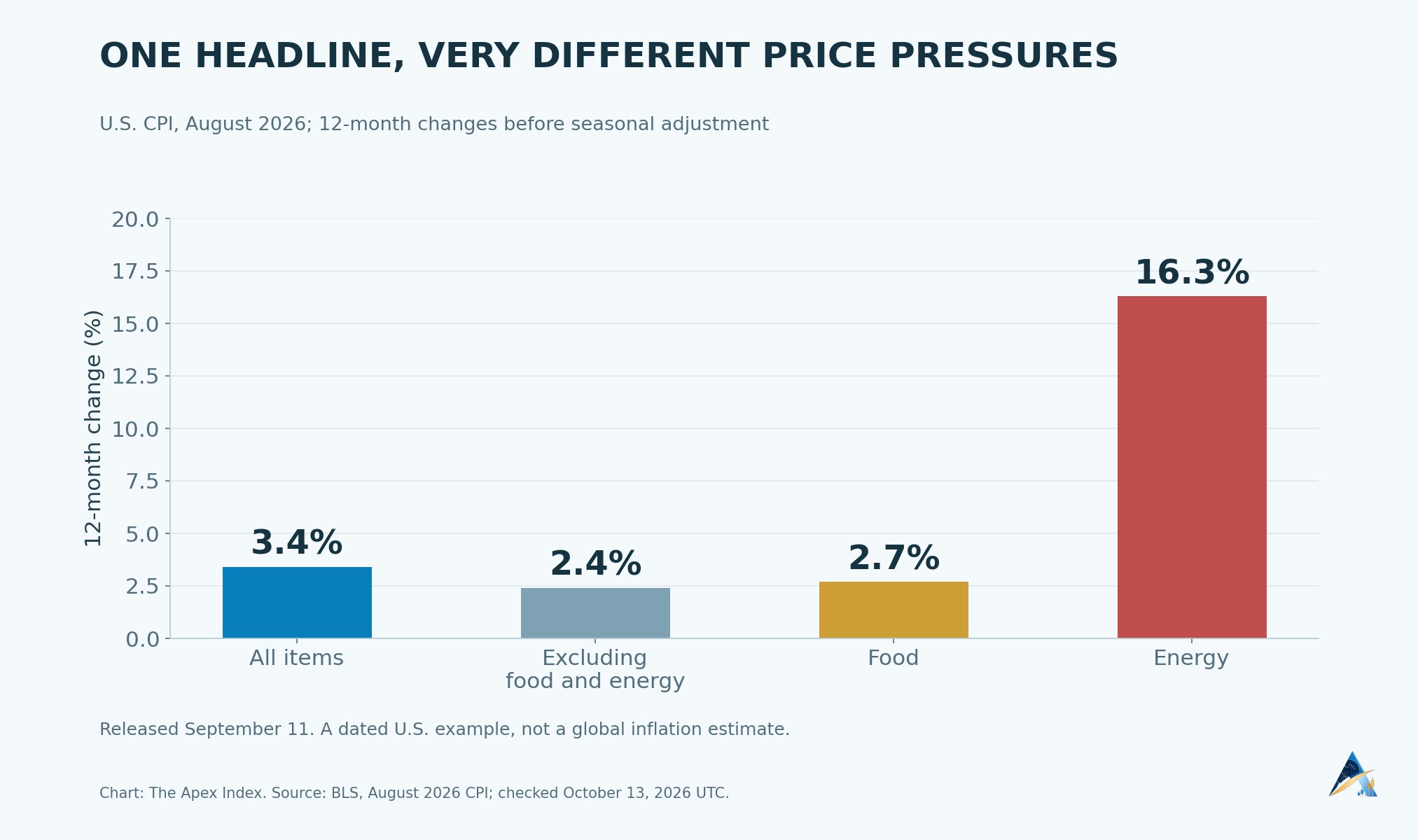
As of October 13, the latest published U.S. consumer-price release covers August 2026. The BLS reported an annual headline increase of 3.4%, while the index excluding food and energy rose 2.4%. Energy prices increased 16.3% over the year and food prices 2.7%. The headline monthly increase was 0.4%, seasonally adjusted.
Those are different measures from one dated release, not current-day prices or forecasts. The contrast between headline and core helps identify where pressure is concentrated. It does not make food or fuel unimportant to households. Excluding volatile categories is an analytical choice, rather than a claim that consumers can stop paying for them.
A global assessment needs comparable releases from the relevant economies. Inflation in Europe, China or Japan can differ because of energy exposure, exchange rates, demand and domestic policy. Even similar headline rates can conceal different patterns. Compare definitions and periods before concluding that one country's experience describes the world economy.
Statistical agencies periodically revise methods, weights or seasonally adjusted series. A reading is therefore best understood with its release date, measurement period and methodology. An investor should also distinguish an actual published figure from a survey forecast or a market-implied expectation. Those sources serve different purposes and should not be presented as interchangeable observations.
Why low inflation can be useful
Many central banks aim for a small positive inflation rate rather than zero. The European Central Bank's current strategy, for example, targets 2% over the medium term for the euro area. That is a jurisdiction-specific policy objective, not a universal acceptable rate for every economy in every situation.
A small inflation buffer reduces the likelihood that ordinary fluctuations produce persistent deflation. It can also make relative wage adjustments easier when nominal wages are resistant to outright cuts. The important qualification is stability: households and businesses can plan more effectively when inflation is predictable and when incomes and productivity have a chance to keep pace.
Low inflation is not automatically harmless. A household with fixed income can still lose purchasing power. A nominal interest rate can appear attractive while providing little return after price increases and tax. Whether an individual is better off depends on wages, benefits, savings returns and spending needs, not only the national headline.
Inflation also redistributes value between borrowers and lenders when it differs from expectations. Unexpected inflation reduces the real burden of fixed nominal debt, while reducing the real value of repayments received by lenders. The benefit to a borrower may disappear if their own income does not rise, or if the loan's interest rate resets upward.
Why high inflation becomes destructive
Rapid price increases make contracts and investment decisions harder to evaluate. Businesses may struggle to distinguish stronger demand from a change in money's value. Households have less certainty about future expenses. Long-term lenders demand compensation for the risk of being repaid in currency with lower purchasing power, increasing financing costs.
The burden is uneven. People with limited savings have less room to absorb higher food, rent and transport bills. Those with bargaining power may negotiate wage increases, while others cannot. Holders of certain real assets may benefit, but their gains do not erase the difficulties faced by people whose income adjusts slowly.
Very high inflation can encourage short-term behavior. Firms may change prices frequently, households may bring purchases forward, and confidence in the currency can weaken. These responses can make stabilization harder. The process is not explained by a single slogan about printing money; supply capacity, fiscal choices, expectations and institutional credibility all affect the outcome.
Inflation caused by scarce energy or disrupted production creates an additional problem. Paying more does not immediately create more fuel, housing or industrial capacity. Monetary tightening can restrain demand, but cannot instantly repair a pipeline or harvest. Policy needs to consider the source of the pressure rather than treat every price increase as the same event.
When falling prices are welcome
A product can become cheaper because technology improves and production becomes more efficient. Consumers may receive better quality at a lower price while the producer still earns a profit. That kind of relative price decline can improve living standards. It is very different from widespread price cuts caused by weak demand and financial distress.
Historical research by the Bank for International Settlements found that consumer-price deflation was not uniformly associated with weak growth across every period it examined. The relationship was particularly severe around the Great Depression. That historical finding does not establish that modern deflation is harmless; it shows why the economic context matters.
A broad decline in prices can nevertheless create serious difficulties. Existing debt is usually fixed in nominal terms. If wages and revenues fall, those repayments become harder to meet even though the amount owed has not increased. Borrowers may reduce spending or sell assets, putting further pressure on activity and collateral values.
Businesses facing weaker sales may cut investment and employment. Households can postpone some purchases if they expect lower prices, although people still need necessities. If debt stress, falling incomes and declining demand reinforce one another, the problem becomes a damaging cycle rather than a pleasant reduction in the cost of living.
Deflation limits some policy options
When inflation is low or negative, a modest nominal interest rate can still imply a high real borrowing cost. A zero nominal rate with falling prices does not necessarily make borrowing cheap in purchasing-power terms. That can weaken the incentive to invest precisely when demand already needs support.
Central banks can lower rates, purchase assets or use other tools within their mandates. Fiscal authorities can support demand and repair financial problems. The effectiveness depends on bank balance sheets, borrower confidence and the nature of the shock. An announced policy change does not automatically cause households and firms to borrow or spend.
Targeted measures can also address debt and financing pressure. The challenge is to improve economic functioning without creating a new unstable borrowing boom. Persistent deflation is a problem of prices, income and balance sheets interacting, which is why treating it as the mirror image of inflation can miss the practical difficulties.
Stagflation creates a harder trade-off
Stagflation is not simply inflation that feels unpleasant. It combines elevated price pressure with stagnating activity and weak labor-market conditions. A supply shock can produce that combination: energy becomes more expensive, production costs rise, real household income falls and output slows. Different economies can experience the shock with different intensity.
Policymakers face conflicting pressures. Raising interest rates can reduce demand and restrain inflation, but deepen the slowdown. Stimulating demand can protect activity in the short term, but worsen price pressure if the economy cannot supply more goods and services. The appropriate balance depends on inflation expectations, spare capacity and the persistence of the disruption.
Improving supply can help, but often takes time. Infrastructure, energy diversification, productivity investment and better-functioning markets can reduce bottlenecks. Support for vulnerable households may also be necessary. The design matters because broad subsidies and targeted relief have different fiscal costs and effects on incentives, demand and the visibility of price signals.
There is no universally accepted single numerical threshold for declaring stagflation. Analysts need to examine prices, output, employment and the relevant period together. A high inflation release followed by one weak economic report is evidence to investigate, rather than sufficient proof that every part of an economy has entered the same regime.
Read household finances alongside the headline
A national price index is a useful common measure, but households spend differently. A tenant exposed to a rent increase, a commuter buying more fuel and a retiree with high medical expenses can experience different pressures. Their situation also depends on changes in income, benefits and debt payments. A falling national inflation rate does not establish that every household's budget has improved.
For the same reason, wage growth should be compared with a relevant price measure over a matching period. A large pay increase after several years without an adjustment can partly restore purchasing power rather than create a new gain. Gross earnings also differ from disposable income after taxes and compulsory payments. Looking at one percentage in isolation can conceal the actual change in living standards.
Businesses face their own version of this problem. The prices they receive may not rise as fast as their costs. A firm can report higher nominal revenue while selling fewer units and earning less profit. Conversely, a productive company can reduce prices and improve profitability if its costs fall faster. Comparing quantities, margins and financing conditions helps explain why the same inflation environment produces different outcomes across industries.
What these conditions mean for investments
Stocks do not provide an automatic inflation hedge. Companies with pricing power may protect margins, while others face higher wages and input costs they cannot pass on. Higher discount rates can also reduce the value investors assign to future profits. A nominal rise in share prices is not necessarily a rise in real investment returns.
Fixed-rate bonds are vulnerable to unexpected inflation and rising required yields. During a demand-driven deflationary shock, high-quality government bonds may benefit from lower yields, while weaker corporate borrowers face greater default risk. Inflation-linked bonds adjust specified payments to an index, but their market prices still respond to real yields and other investment risks.
Commodity exposure depends on the cause of the shock. Scarce energy can raise prices even as growth weakens, while reduced industrial demand can weigh on other raw materials. Crypto assets have no contractual promise to track consumer inflation. Scarcity claims and network narratives do not guarantee protection from tighter financing conditions or a rush to reduce risk.
Cash provides flexibility but can lose purchasing power during inflation. During deflation its real value may rise, provided the institution or instrument holding it remains sound. Currency movements add another layer for international investors. The best response begins with the investment's actual economic exposure and the investor's liabilities, rather than choosing an asset solely because a familiar label sounds protective.
The useful question is therefore not whether every form of price change is bad. Ask what is driving the change, whether incomes and production are improving, and where the financial strain is accumulating. Low, stable inflation, productivity-led price declines and debt-driven deflation are different conditions. Stagflation is difficult precisely because it combines problems that do not respond neatly to the same remedy.