

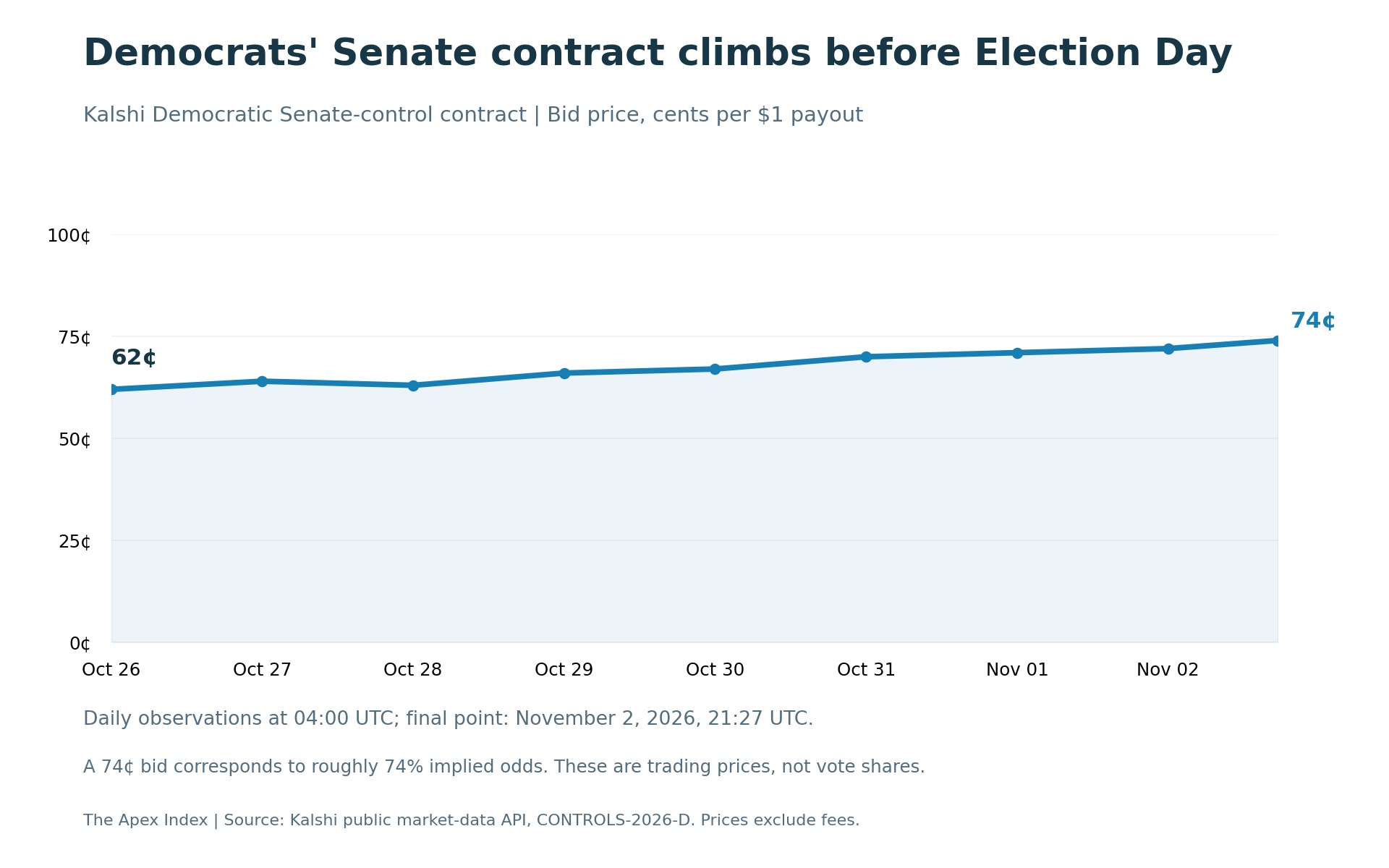
President Donald Trump's Republicans head into Election Day facing the prospect of losing both chambers of Congress, with Democrats' Senate victory odds reaching 74% on Kalshi and their House chances sitting near 94%.
The prices put a Democratic takeover well ahead of another Republican majority in traders' calculations. They are market-implied probabilities, not vote shares or election results, with Americans still due to finish voting on November 3.
At 21:27 UTC on November 2, the Democratic Senate-control contract had a 74-cent bid and a 75-cent asking price for a potential $1 payout. The gap between the bid and ask reflects the prices buyers and sellers were offering at that moment. The Democratic House contract was quoted at 93.7-93.8 cents.
The move has been building. Historical data put the Senate contract's bid at 62 cents at 04:00 UTC on October 26. By the latest observation, it was 12 percentage points higher, after reaching 70 cents on October 31 and 72 cents early on November 2.
The Senate is the harder part of the sweep
Democrats need to defend their Senate seats and flip four Republican-held seats to take control, according to NBC News' latest battleground tracker. Losing one of their own would raise the number of Republican seats they need to win.
Michigan is one of those defensive tests, with Democrat Abdul El-Sayed facing Republican Mike Rogers. Texas, Maine, Ohio, Iowa and Kansas are among the contests giving Democrats opportunities to gain seats.
Kalshi's November 2 midterm dashboard favored James Talarico over Ken Paxton in Texas and Troy Jackson over Susan Collins in Maine, putting each Democrat at 72%. It also gave Kansas Democrat Adam Hamilton a 62% chance against Republican Roger Marshall. Those individual races show how the Senate trade extends into states Republicans are defending.
Apex had earlier reported that some election traders were going door to door to gather information for their wagers. The activity underlines how much effort is going into finding an advantage before the votes are counted.
The House starts from a narrow Republican hold. The House Press Gallery currently lists 218 Republicans, 214 Democrats, one independent and two vacancies. Every House seat is up in the midterms, giving the parties a different contest from the staggered Senate elections.
Trump's final pitch leans on turnout
Trump was still arguing that his supporters could deliver a big Republican win as the markets leaned the other way. In his November 2 closing speech at the Lincoln Memorial Reflecting Pool, he said Republicans would win in a landslide if a good portion of the people who backed him in the last election turned out.
He also acknowledged the historical difficulty facing a president's party in midterms. NBC News highlighted his assessment of the campaign:
We gave this a very strong shot.
The appearance followed a 28-rally campaign swing that ended outside Washington on November 1. Trump traveled for 25 days in the campaign's final month, visiting 19 states, and held his final rallies in Kansas and Iowa, both with competitive Senate races.
The significance of a Democratic sweep would extend beyond the campaign. House control brings control of that chamber's legislative agenda and committees, while the Senate also has a central role in confirming presidential nominees. Losing both would leave Trump facing Democratic majorities during the final two years of his term.
For traders, the contract rules also matter after voting ends. The Senate market can resolve early on a consensus of media calls projecting control. Without that consensus, its fallback is the party identification of the Senate's president pro tempore on February 1, 2027. A close race can therefore leave the bet unsettled well beyond election night.