

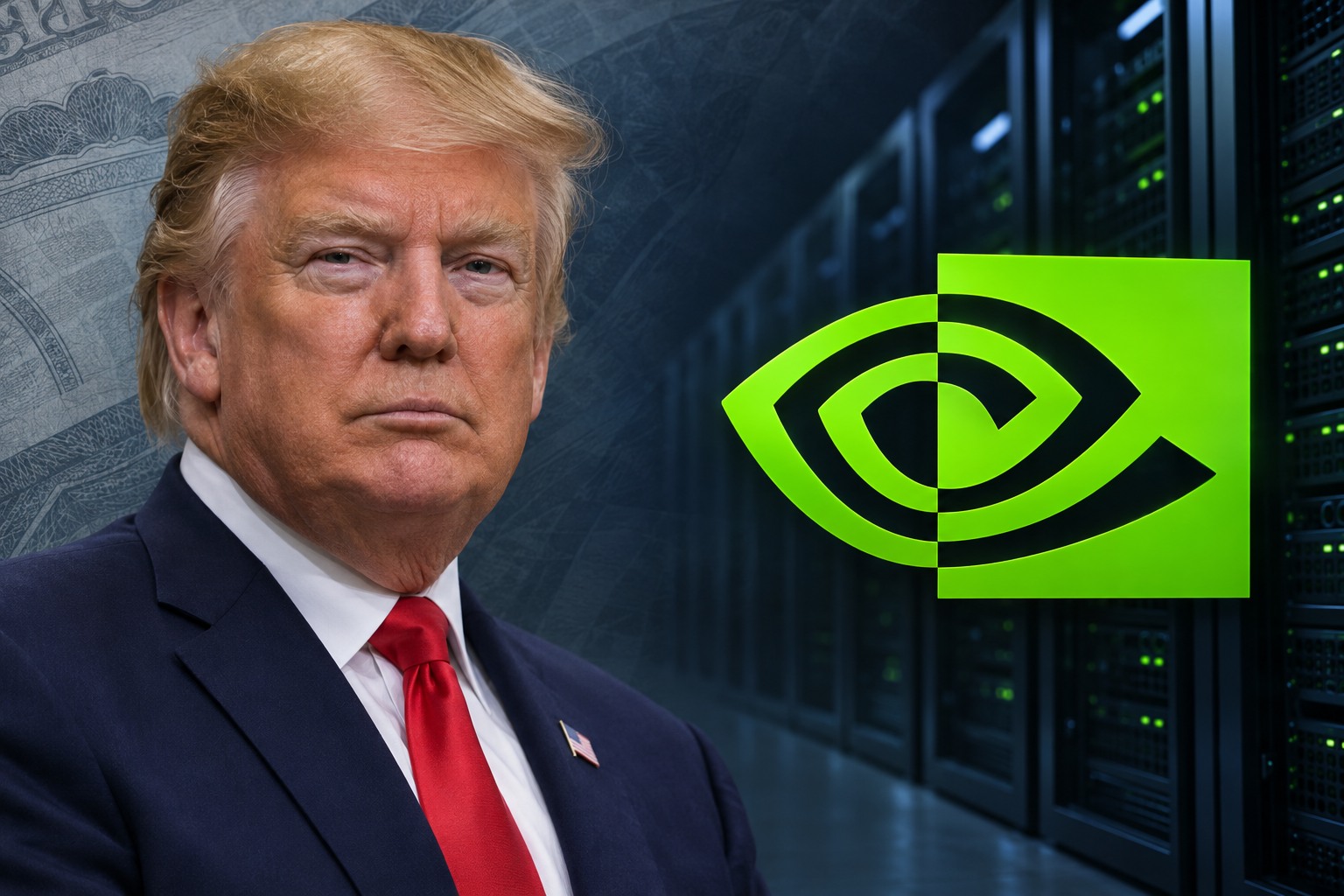
Donald Trump's Nvidia holdings expanded from a disclosed range topping out at $1.3 million at the end of 2024 to an estimated range reaching $62 million by the end of August 2026, according to a review of his financial disclosures published Monday.
The increase gives the president a much larger financial interest in a company whose access to China has depended on decisions made by his administration. It also puts his investments under fresh scrutiny as Nvidia deals with the departure of co-founder Jensen Huang and questions about its chip exports.
The disclosures put the stake in a wide range
The Washington Post's analysis estimated that Trump held between $13 million and $62 million in Nvidia shares at the end of August. His position at the end of 2024 had been reported at $615,000-$1.3 million.
Those figures describe holdings, not an investment return. The comparison does not tell investors how much of the increase came from additional purchases and how much came from rising share prices. The upper limit also isn't an exact account balance.
Reporting delays leave another gap: the disclosures examined did not yet show transactions from September and October. The newspaper said the actual value was probably higher than its estimate because Nvidia's price had risen between the end of 2025 and the end of August.
The White House said in a statement to the paper:
The President does not pick or trade individual stocks. Independent financial managers handle his portfolio.
Its previous explanations have described both a trust managed by Trump's children and third-party institutions that independently handle investments. Spokesman Davis Ingle has said those institutions copy recognized indexes, including the Schwab 1000, and make the investment decisions themselves.
Nvidia is a major company in those indexes, so portfolios following them would be expected to hold it among their largest positions.
The investment overlaps with export-policy decisions
The administration has allowed Nvidia to sell some advanced chips to approved Chinese customers. In December 2025, Trump announced that sales of its H200 chips could proceed with 25% of the revenue going to the US government.
As previously reported by Apex in its earlier coverage, Democrats have challenged the administration's handling of advanced chip exports and demanded answers from Commerce Secretary Howard Lutnick about national security concerns.
The disclosure review adds a personal financial interest to that policy debate. It reported that Trump bought as much as $1 million in Nvidia stock on January 6, a week before Commerce formalized an easing of export restrictions affecting the company.
Sen. Elizabeth Warren asked Treasury Secretary Scott Bessent in June whether the Securities and Exchange Commission should investigate that purchase. Bessent responded that Congress should start with lawmakers if it wanted to ban individual stock trading.
Ethics scrutiny carries different legal rules
The president is treated differently from Cabinet officials under federal conflict-of-interest rules. Federal law excludes the president from the criminal financial-conflict statute that restricts other executive-branch officials from participating in government matters affecting their financial interests.
Ethics attorneys nevertheless raised concerns about the overlap between official decisions and personal investments, while cautioning that the reporting did not establish that conflict-of-interest laws had been broken.
Zach Everson, research director for Public Citizen's Trump Accountability Project, put the issue in terms of public trust:
The American people should never have any doubt that government officials are acting in their best interest and not the best interest of the officials’ portfolios.
The scrutiny comes during Nvidia's own leadership upheaval. As Apex previously reported, Huang resigned on November 12 as president, CEO and a director. Colette Kress became interim chief while retaining her finance responsibilities, and the company is due to report quarterly results on November 17.