

AI-assisted editorial illustration of a Gulf oil tanker.
President Donald Trump says Iran wants expensive oil to become an election problem for Republicans. On Thursday, he accused Tehran of inventing reports of attacks and mines to push prices higher before the November 3 midterms.
The accusation arrived as Brent crude futures traded above $110 a barrel. That is the international benchmark behind the figure in the headline; Trump did not give a price in his statement. U.S. drivers, meanwhile, are still paying far more for fuel than they did a year ago.
In a Truth Social post on October 22, Trump wrote:
"Iran is doing everything they can to drive up the price of Oil prior to the U.S. Midterm Election."
He followed with a sharper claim:
"They are even making up fake hits, mines, and everything else, because more Oil is coming through the Hormuz Strait now than it did even prior to the beginning of the Conflict."
Neither the claim that incidents were fabricated nor the assertion about traffic through Hormuz was supported with data in his post. The shipping numbers he appeared to be citing tell a more complicated story.
The oil is moving, but which way?
Trump shared a Wall Street Journal report shortly after his statement. Its headline said more oil was leaving the Persian Gulf than before the war. That is true of the total reported in the article, but it includes oil transported around Hormuz through pipelines as well as oil carried through the strait.
Kpler data cited by the Journal put combined regional flows above 24 million barrels a day in the week through October 18, up from 23.3 million before the war. Flows through Hormuz itself, including transfers near Oman, were about 14 million barrels a day, or 82% of their prewar level.
Saudi Arabia and the United Arab Emirates have helped close that gap with pipelines that bypass the waterway. Kpler estimated that about 40% of non-Iranian crude exports from the Gulf avoided Hormuz in September, compared with 17% before the war. Higher total exports do not mean more oil is passing through the strait.
There is a dispute over the latest reported attacks. Iranian state television said seven tankers were hit or damaged by mines overnight. The Associated Press could not independently confirm those seven incidents, while Lloyd's List Intelligence counted 28 ship attacks in October. Trump offered no evidence that a particular reported strike or mine was fabricated.
Why the midterms are in the oil story
Brent futures were at $112.00 a barrel at 16:42 UTC on October 22, according to a Yahoo Finance market snapshot. U.S. West Texas Intermediate futures were at $98.91. Oil prices have also reacted to fears of renewed fighting: Iran's security chief threatened on Thursday to target Gulf energy facilities if the United States and Israel attack again, The Guardian reported. Saudi Arabia said it intercepted a drone aimed at Aramco's Shaybah field on Wednesday. Debris killed two people, although the energy ministry reported no impact on operations.
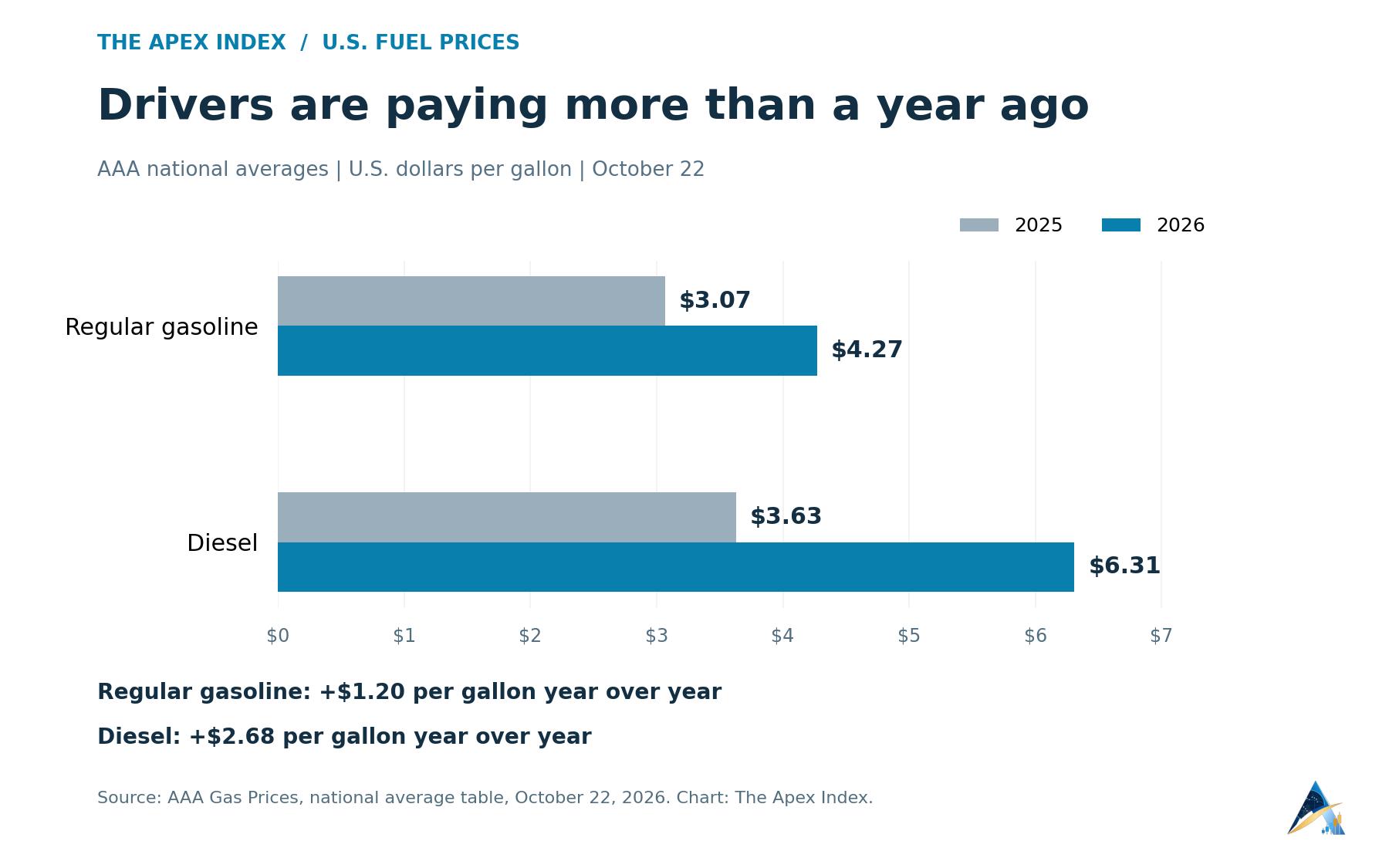
At the pump, the political stakes are easier to see. AAA listed the U.S. average for regular gasoline at $4.27 a gallon on October 22, up from $3.07 a year earlier. Diesel averaged $6.31, up from $3.63. Both prices had eased from a month earlier but remained high enough to strain drivers and businesses that move goods by truck.
The Guardian spoke to voters in Ohio and Missouri this week who described cutting other spending to afford fuel. Trump has announced measures aimed at diesel prices, including a temporary opening to Russian imports and help for farmers. Energy analysts interviewed by the paper said those steps were unlikely to produce much relief before Election Day.
Iran's motives are harder to measure than a fuel bill. Reuters reported earlier this week that unnamed Iranian officials wanted to deny Trump a pre-election diplomatic victory by prolonging talks. That account concerns the negotiations, while Thursday's post makes a separate allegation about attacks at sea.
The next test is whether tankers can keep sailing and whether either side acts on its threats. A new disruption would reach oil traders quickly. For Republicans asking voters to look past the price on the gas station sign, November 3 is much closer.