

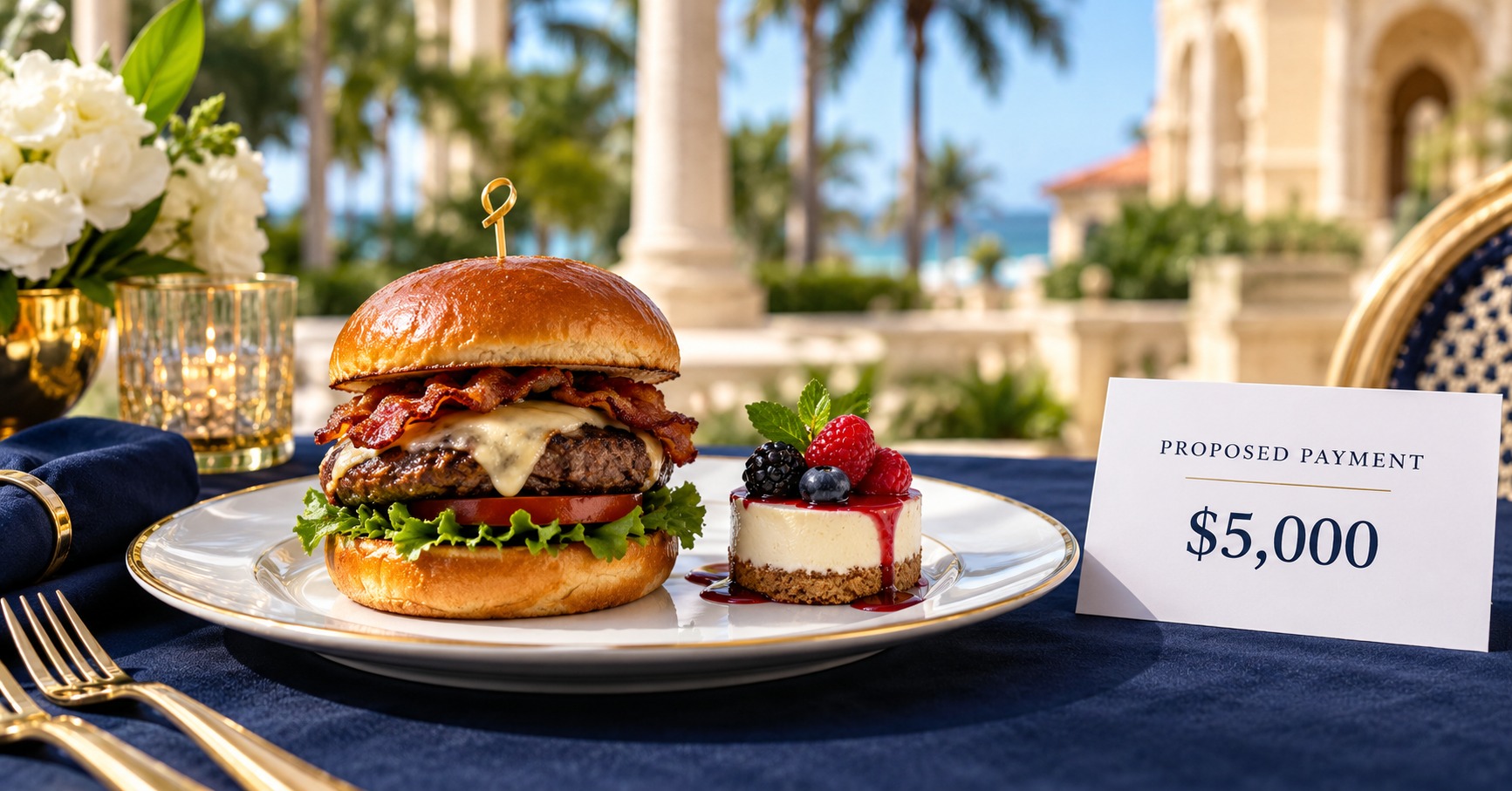
President Donald Trump joked that his promised $5,000 payments would barely buy a hamburger and dessert at Mar-a-Lago, according to an October 28 report by Newsweek. The remark comes as he pitches the checks to voters worried about household costs ahead of the November 3 midterms.
The money remains a proposal. Trump has tied the payments to Republicans keeping control of both the House and Senate, and Congress has not authorized them. Final eligibility rules, an application process and a payment schedule have not been announced.
A luxury-club joke during a campaign about prices
At his October 27 rally in Corpus Christi, Texas, Trump invited supporters to visit his Florida club as his guests. The report quoted him saying:
"for $5,000, the most you’ll be able to buy is a hamburger and maybe a small dessert."
He then questioned whether even that would be covered and said the club was not a good destination for people who were price conscious. Newsweek reported that the audience laughed. The comparison was a joke about his luxury property, rather than a published price for that meal.
For voters, the proposed payment is being offered against a much less glamorous set of expenses. A national NPR/PBS News/Marist poll released October 27 found that 34% of likely voters named the cost of living as the issue most on their minds when considering their vote. Another 38% said their family finances had worsened over the past year.
That survey interviewed 1,289 registered voters on October 19-20. Results for its likely-voter group had a margin of error of 3.8 percentage points. On the finances question, 15% said they were better off, while 44% reported no change.
The $1.25 trillion funding question
Trump and Vice President JD Vance have pointed to tariff revenue as a way to fund the payments. The scale of the proposal leaves a substantial gap, according to a September 10 analysis by Tax Foundation senior economist Erica York.
Using an assumption of 250 million recipients, York estimated that one round of $5,000 payments would cost $1.25 trillion. Income restrictions or a narrower eligible population could reduce that amount, but those details have not been settled.
The foundation projected about $125 billion in net federal revenue from the new tariffs in 2027, assuming the policies stayed in place. That is a revenue forecast for one year, compared with the estimated cost of a one-time payment program.
York wrote:
"By our estimates, the revenue raised by the new tariffs in 2027 would cover only about one-tenth of the cost of the promised $5,000 dividend payment."
Its net estimate also accounts for effects beyond the customs payments themselves. Tariffs reduce imports, cutting some existing duty receipts, and affect the income and payroll tax bases. Gross tariff collections therefore cannot simply be treated as the same amount of additional federal revenue available for checks.
Consumers report some relief, but prices still hurt
The latest confidence figures offer a mixed picture. The Conference Board's October 27 release showed its Consumer Confidence Index rising to 91.7 from an upwardly revised 84.2 in September. Assessments of current conditions and expectations both improved.
Senior economist Fergus McCormick linked the recovery to better views of business conditions and easing retail gasoline prices between September and October. He also said confidence remained on a longer-term downward trend.
In written responses, consumers continued to complain about rising costs, including food, groceries, oil and diesel. Concerns about jobs also increased, although less sharply. The preliminary survey covered October 1-21.
Consumers planned less spending on services and durable goods over the next six months. McCormick said:
"This likely reflected higher price levels and persistent inflation, which eroded consumers’ purchasing power."