

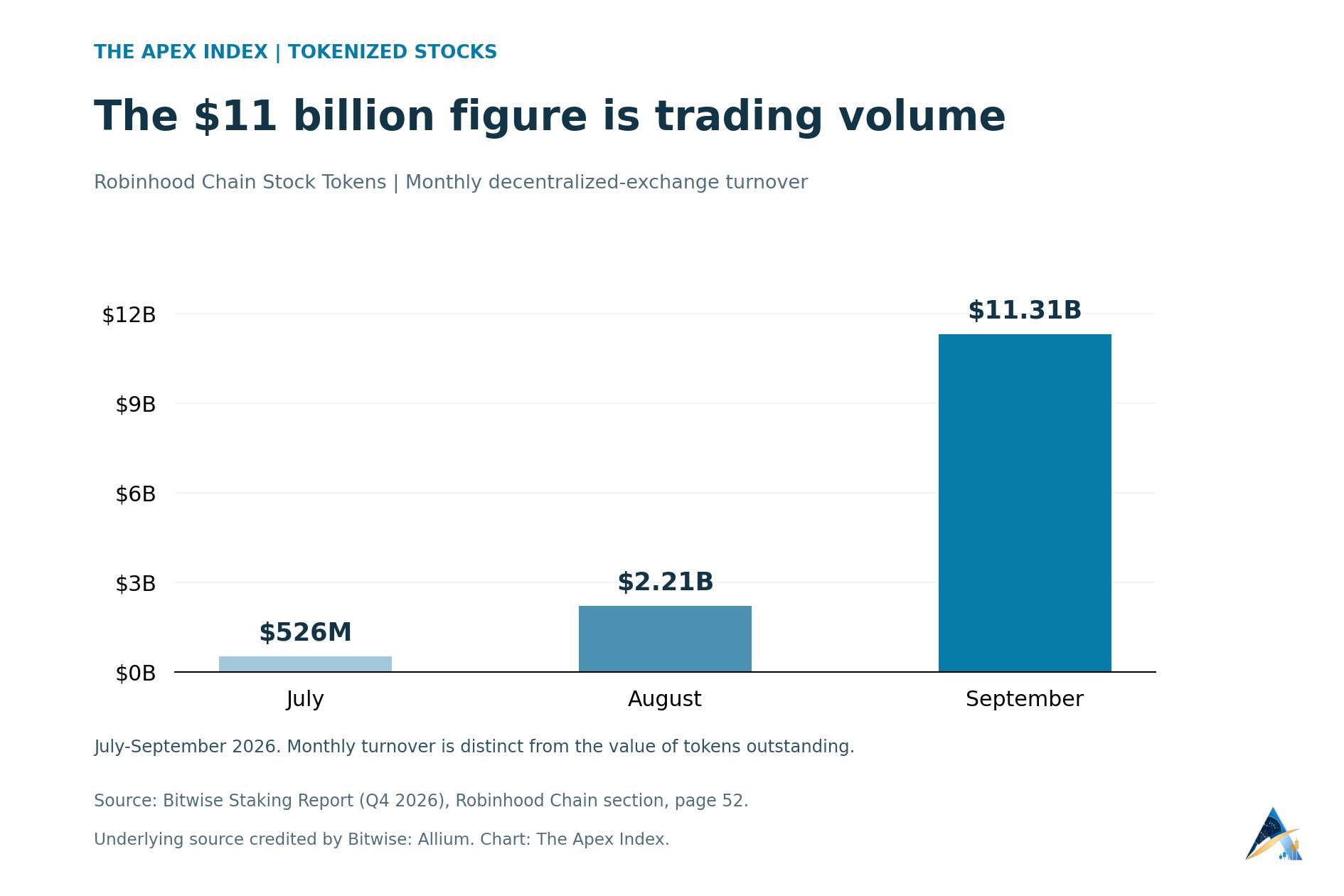
Robinhood Chain recorded $11.31 billion in stock-token trading in September. As the industry tries to bring more blockchain-based stock trading into the U.S., major companies including Goldman Sachs, Microsoft and Alphabet are pushing back against a proposed venue for tokenized shares.
The objections concern OKXICE, a separate venture owned equally by crypto exchange OKX's U.S. holding company and Intercontinental Exchange, the parent of the New York Stock Exchange. Its latest notice lists 16 objecting companies. ICE's involvement makes this an argument running through traditional finance as well as between Wall Street and crypto.
The growth figures come from Bitwise, whose October 20 staking report tracks Robinhood Chain's Stock Tokens. Monthly decentralized-exchange volume rose from $526 million in July to $2.21 billion in August before September's surge. Its Stock Tokens category also includes ETFs and other asset exposures. The $11 billion headline figure describes trading activity on that network, rather than the value of the entire tokenized-stock market.
The companies want a say
OKXICE's October 19 public notice names Goldman, Microsoft, Alphabet, Qualcomm, Caterpillar, McDonald's and Western Digital among the objectors. The list grew from nine companies in the previous notice, according to Decrypt's October 20 reporting. Individual companies' reasons are not given.
The SEC's September order gives those objections practical force. Under its temporary innovation exemption, a venue proposing to trade shares tokenized by an unaffiliated third party must notify the underlying company. Trading cannot begin until at least 30 calendar days after the company receives that notice. A written objection within that window prevents the venue from offering the relevant tokenized stock under the exemption.
The five-year framework also requires qualifying tokens to preserve the rights and privileges of the equivalent conventional shares. Companies therefore have a way to influence how their stock enters this market, even when another business handles the tokenization.
A token can offer exposure without ownership
For buyers, the product's legal structure matters as much as the trading app. Robinhood Stock Tokens provide exposure to stocks and funds through a blockchain wallet, with securities held by a custodian, according to the Bitwise report.
Its researchers spell out the ownership distinction:
"Investors follow the performance of the underlying asset, but they do not own the shares directly or receive voting rights (though this may change in the future)."
OKXICE proposes a different arrangement. Its notice says an unaffiliated tokenizer would hold underlying shares one-for-one through an SEC-registered broker-dealer. Each token would represent a security entitlement to a share, with equivalent dividends, voting rights and rights to residual assets on liquidation.
That difference affects what a buyer can vote on, what income reaches them and what claim they have when something goes wrong. Products carrying a familiar company's name can give their holders different rights.
Around-the-clock access has a pricing catch
OKXICE plans to use Uniswap v4 liquidity pools on XLayer, with tokenized shares paired against stablecoins. Trades would settle in a single blockchain transaction. The venue's notice also says it is outside Regulation NMS, the rules governing the U.S. national market system.
Its pricing disclosure is direct:
"Prices are set by the AMM Liquidity Pools according to the ratio of the quantities of the two assets in each pool, not by reference to the market for the underlying NMS stock."
The notice warns that token prices may differ from conventional share prices, particularly outside regular trading hours, during halts or when a pool has little liquidity. A large trade can move the price sharply or fail.
The SEC itself identifies shareholder-recordkeeping problems and potential price dislocations as concerns an issuer might weigh before allowing trading. For investors, the prospect of easier access comes with concrete questions: who holds the shares, which rights travel with the token and what price the trading pool can actually deliver.