

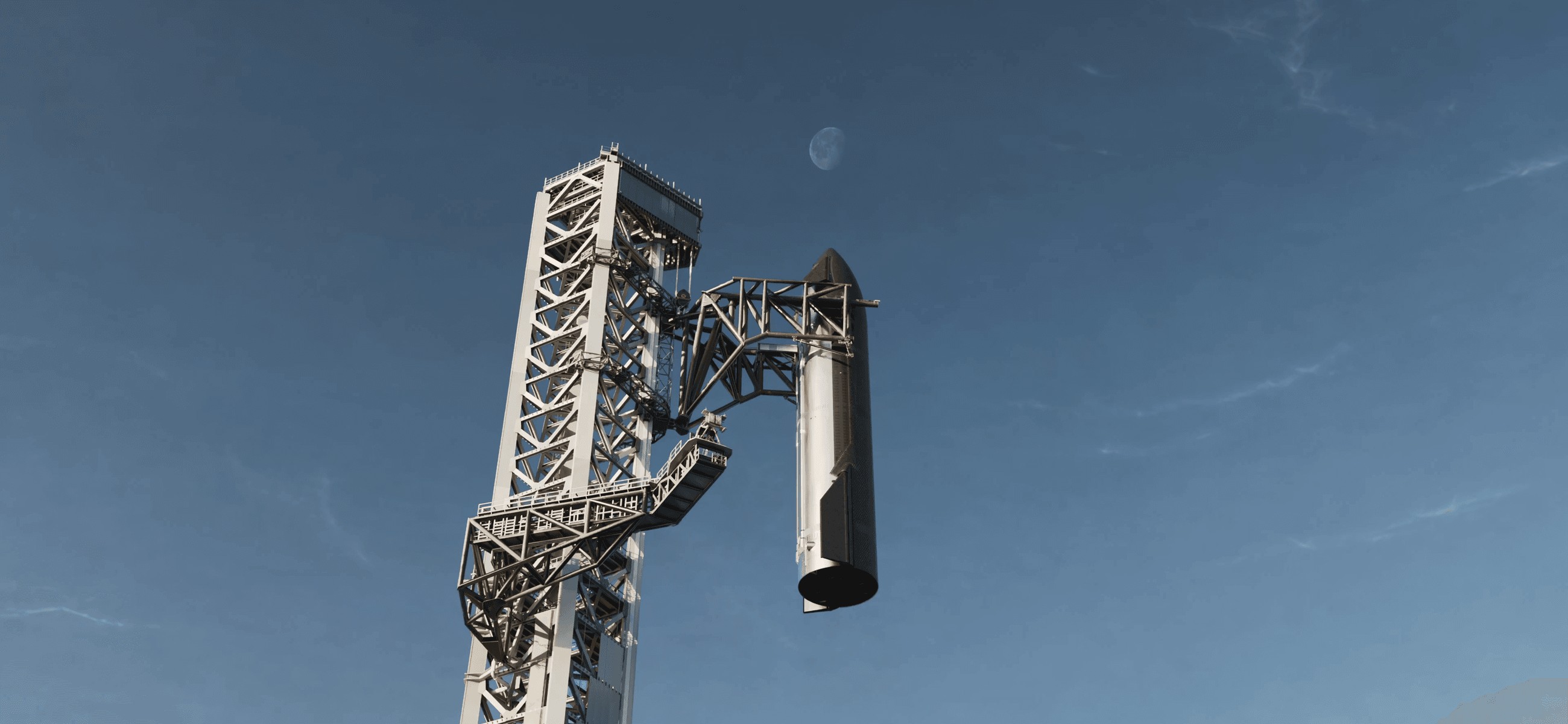
SpaceX caught Starship's upper-stage spacecraft at its Texas launch tower on November 14 after more than 22 hours in orbit, completing the vehicle's first return from space to the place it launched. Giant mechanical arms secured the stainless-steel ship as it lowered itself upright toward the pad.
The catch was the breakthrough Elon Musk's company had been chasing with Flight 15. The 407-foot Starship system launched from Starbase on November 13, but only the upper stage made it home. Its Super Heavy booster diverted offshore and exploded shortly after liftoff.
The AP reported that the spacecraft completed 14 laps around Earth before returning. It was the second orbital flight of a full-scale Starship and the first successful tower catch of the spacecraft itself.
A long flight ends back at the tower
Before coming home, Starship released 26 advanced Starlink satellites, giving the mission a commercial payload alongside its recovery test. Views of the spacecraft and Earth streamed back through the company's satellite network during the flight.
The return tested the heat shield, reentry maneuvers, engine-controlled descent and final approach to the tower. Company officials said the spacecraft's systems, including the heat shield, appeared to work well.
The preflight plan from SpaceX made the conditions for a return explicit:
Starship will only execute a return to launch site if the flight control team has ensured that the vehicle systems critical for reentry maneuvers and final landing burn and tower approach are healthy.
Three of the Starlink satellites carried modified cameras to inspect the heat shield and send images to operators. That inspection was one of several sources of information used to assess whether the ship could safely attempt the catch.
The spacecraft also carried heat-shield changes from the previous flight, including improved tile retention and curved tiles designed to reduce heating in the gaps. The mission had alternative ocean-return options if the team decided against bringing it back over land.
The booster abort still needs answers
The upper-stage recovery came after the attempt to catch both halves of the rocket fell short. The company had previously caught three boosters, but the upgraded Super Heavy V3 has yet to complete a successful return.
SpaceX commentator Kate Tice said the booster's engines stopped firing too soon during its descent. Its guidance system detected that the vehicle wasn't in the right position and initiated an offshore diversion and self-destruction. Engineers are investigating the cause.
Dan Huot also corrected an earlier description of the abort during the company's webcast, according to Spaceflight Now:
I did a disservice to our booster GNC guys last night. It was not a GNC issue that caused us not to come back.
GNC means guidance, navigation and control. Huot explained that the system triggered the abort after detecting the booster was out of position, rather than identifying that system as the underlying failure.
NASA's Moon missions need more tests
As previously reported by Apex in the coverage linked above, NASA is relying on a Starship variant for future Artemis lunar missions. Recovering the spacecraft advances the reuse program, while orbital refueling and operations with astronauts remain major steps ahead.
The agency's November 4 plan calls for four astronauts to spend about 14 days in Earth orbit on Artemis III in 2027. They would test rendezvous, docking and operations with lander test vehicles from SpaceX and Blue Origin.
The sequence would have Orion dock with Blue Origin's Blue Moon test vehicle first, then with a Version 3 Starship. Artemis IV is targeted for a crewed lunar landing as early as 2028.
For that lunar mission, Starship must refuel in Earth orbit, meet Orion and carry it toward the Moon. Saturday's catch brings the spacecraft back within reach of engineers, who can examine hardware that has now survived launch, an extended orbital flight and the return through Earth's atmosphere.
Image: SpaceX rendering of a planned Starship tower catch, supplied on its Flight 15 mission page.