

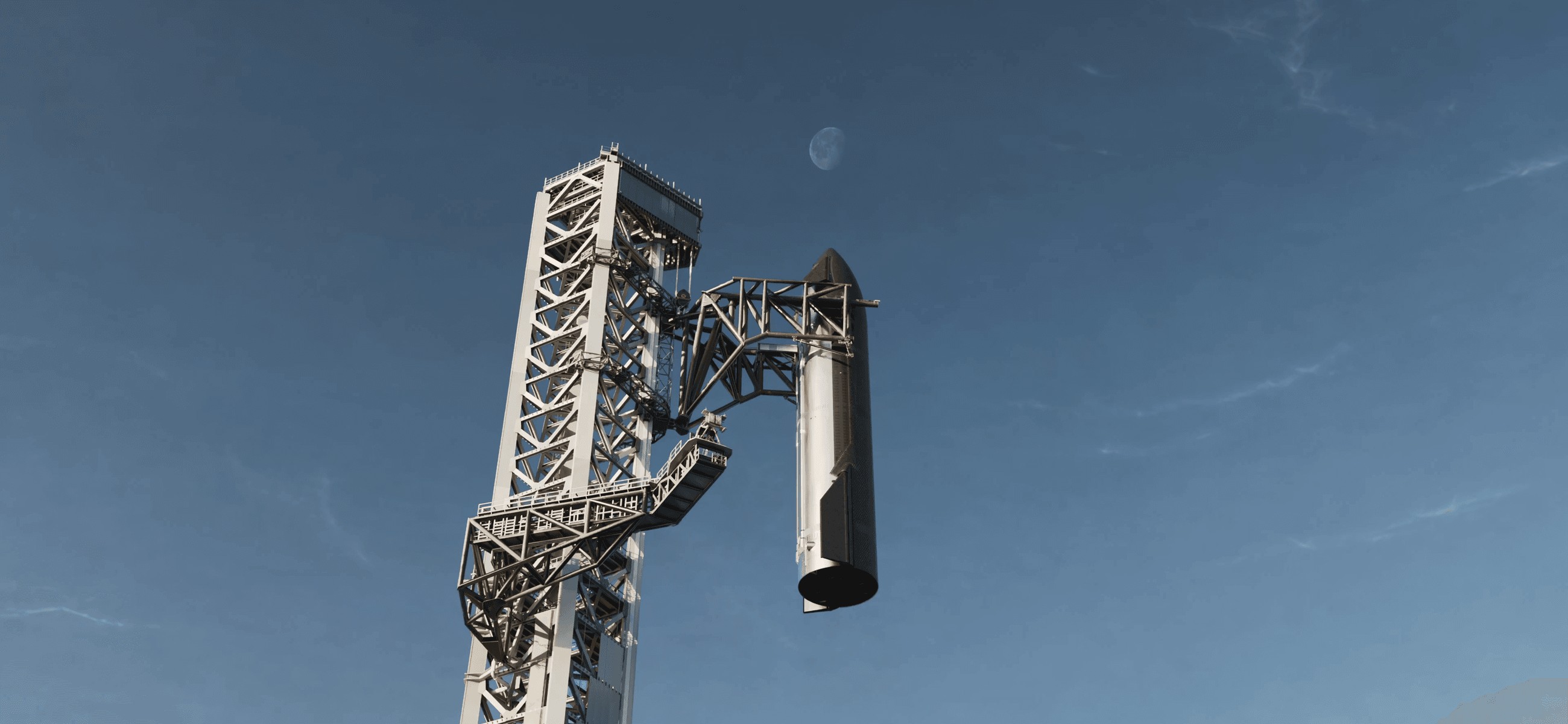
SpaceX is attempting to bring Starship back from orbit to its Texas launch tower for the first time, a test of the reusable rocket NASA is counting on for future Moon missions. The spacecraft reached orbit on November 13 and deployed 26 Starlink satellites ahead of its planned return on November 14.
The mission has already lost one half of its recovery attempt. The Super Heavy booster diverted offshore instead of returning to Starbase and exploded, leaving the upper-stage spacecraft to attempt the tower catch on its own.
The flight plan published by SpaceX calls for roughly 14 orbits at an altitude of about 275 kilometers, or 171 miles, during a journey lasting more than 22 hours. Mechanical arms on the launch tower would catch the spacecraft after it descends under engine power.
A safety check before the tower catch
The company says the return to Starbase will proceed only if the spacecraft's critical systems are healthy:
Starship will only execute a return to launch site if the flight control team has ensured that the vehicle systems critical for reentry maneuvers and final landing burn and tower approach are healthy.
The trajectory includes options to bring the spacecraft down over the ocean instead. Spaceflight Now's on-site coverage reported that possible alternatives include splashdowns near Hawaii and Chile if a return over Mexico and South Texas is judged unsafe.
In a November 14 webcast update, company commentator Dan Huot corrected his earlier description of the booster diversion:
I did a disservice to our booster GNC guys last night. It was not a GNC issue that caused us not to come back.
GNC refers to guidance, navigation and control. Huot said that system triggered the abort after detecting the booster was out of position. Three earlier boosters were caught at the launch tower, but the upgraded Super Heavy V3 has yet to complete a successful return.
Starlink satellites help inspect the heat shield
Flight 15 also carries a practical test of how to inspect Starship before it comes home. Three of its 26 Starlink V3 satellites have cameras modified to scan the spacecraft's heat shield and send images to operators on the ground.
Those pictures are one of several sources of information used to decide whether the ship can safely return to the launch site. The company says it has tested the inspection method on previous flights.
The heat shield also incorporates changes from Flight 14, including stronger tile retention in vulnerable areas and measures to stop hot plasma getting behind tiles. A large portion uses curved tiles designed to reduce heating in the gaps.
September's flight was the first Starship mission to reach orbit and deploy operational satellites. It ended with an ocean splashdown rather than a tower recovery. This mission's goal is to bring the spacecraft back intact to the place it launched from.
NASA still needs refueling and docking tests
The lunar stakes reach well beyond catching a rocket. In its November 4 update, NASA outlined an Artemis III test mission in Earth orbit in 2027, followed by an Artemis IV Moon landing mission targeted for 2028.
For Artemis III, four astronauts would fly in Orion on a planned 14-day mission to test rendezvous, docking and operations with lander test vehicles from Blue Origin and SpaceX. The sequence calls for Orion to dock first with Blue Moon, then with a Version 3 Starship.
The lunar mission requires another difficult capability: refueling Starship in Earth orbit. Under the agency's current plan, Starship would then rendezvous with Orion and carry it toward the Moon. Blue Origin is developing a separate approach using transfer stages and a rendezvous in lunar orbit.
Both lander providers are targeting readiness for a crewed landing in 2028. A successful tower catch would advance SpaceX's recovery program, while the refueling and crewed docking work remain separate milestones on the road to that mission.
Image: SpaceX rendering of a planned Starship tower catch, supplied on its Flight 15 mission page.