

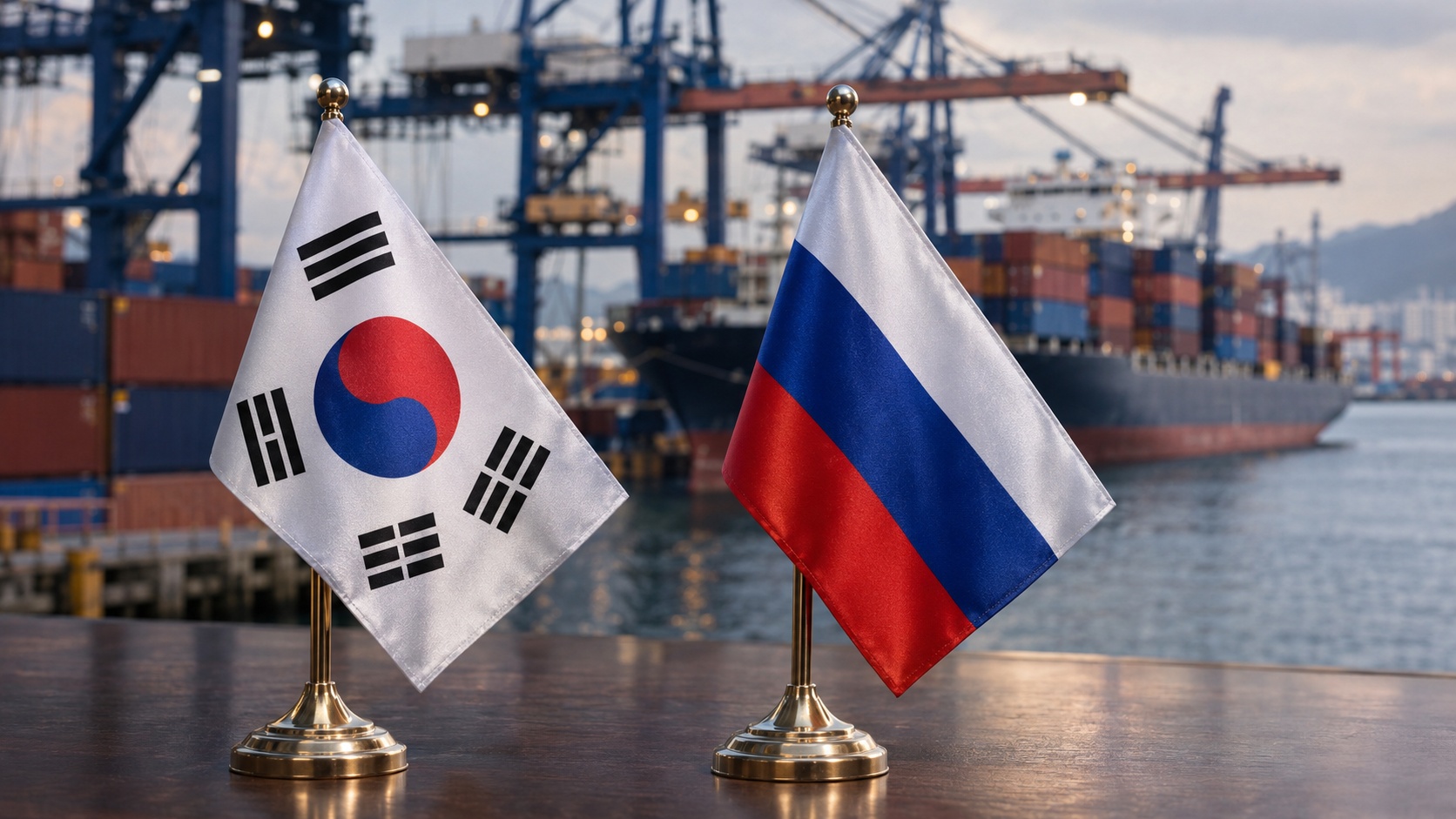
A senior adviser to South Korean President Lee Jae Myung is pressing for closer economic ties with Russia, arguing that sanctions have left Korean companies carrying costs that diplomacy should address. Song Young-gil made the case at a November 11 policy forum at the National Assembly, pointing to stalled ship deliveries and Arctic shipping opportunities.
The push comes from a presidential adviser and lawmakers discussing policy proposals. It is not an announcement that Seoul has lifted its restrictions on Russia. Song said the alliance with Washington should remain central to South Korean foreign policy while the government also protects its economic interests.
Exports have lost nearly $6 billion a year
UN Comtrade's data put South Korean goods exports to Russia at $9.98 billion in 2021 and $4.04 billion in 2025. The difference is $5.94 billion in annual export sales, a decline of 59.5%. The comparison runs from the last full year before Russia's invasion of Ukraine to the most recent completed calendar year.
The contraction also shows up in the number of companies serving the market. An August 2025 study by the Korea International Trade Association counted 4,003 exporters in December 2021 and 1,861 in June 2025. Its recommendations included maintaining non-sanctioned exports, spreading payment risks and preserving local distribution networks while preparing for a possible recovery.
Ship deliveries bring the costs into focus
According to the original report by Financial News, Song singled out Hanwha Ocean's work on six icebreaking liquefied natural gas carriers. He said sanctions were preventing the vessels from being delivered and called the situation a serious problem.
The newspaper's English translation quoted him as saying:
We’re struggling to find a way to resolve this, and that’s a diplomatic challenge.
His complaint put a specific industrial contract at the center of a much broader foreign-policy argument. He wanted diplomacy to address the disruption facing a Korean shipbuilder involved in a Russian Arctic LNG project, rather than leave the company waiting for relations to improve.
He also identified cooperation on the Arctic shipping route as a reason to maintain relations with Moscow. Energy and shipping were central to his argument for keeping economic channels open, even while South Korea preserves its strategic relationship with the United States.
Song said Seoul needed to keep persuading Washington and make sure Korean interests were reflected in the relationship. He presented the two diplomatic relationships as interests that required active management.
The proposals go beyond one contract
The forum followed a policy campaign by the Solidarity for Peace and Reunification, a civic group seeking to restore dialogue between Seoul and Moscow. Its proposals included reviewing whether restrictions could be removed from some export items designated independently by South Korea.
The group's broader plan called for renewed diplomatic channels, consideration of direct flights between Incheon and Vladivostok, and economic cooperation involving Russia's Far East. It also proposed developing Busan as a major base for Arctic shipping.
An earlier account by Korea NGO News of the proposals said the group wanted cooperation involving Primorye and Sakhalin, more opportunities for private companies, and a presidential body to coordinate Eurasian diplomacy and economic policy. Those were recommendations submitted through a public campaign, rather than measures already adopted by the government.
The forum was organized with the participation of Song's office and that of fellow lawmaker Kim Joon-hyung. The campaign also sought a regular South Korea-China-Russia cooperation forum, with possible North Korean participation in a longer-term multilateral arrangement.
Europe remains a diplomatic obstacle
Song acknowledged that rebuilding relations with Russia could bring friction with Europe. He argued that European governments were taking a harder line toward Moscow than Washington and said South Korea could face criticism as it tried to resolve bilateral problems.
He saw President Donald Trump's efforts to improve relations with Russia as a possible opening for Seoul. His assessment was that Trump wanted to use closer Russian ties to counter China. Song also argued that the Ukraine war would ultimately require compromise and urged South Korea to consider opportunities in postwar reconstruction.
Russia's ambassador to South Korea, Georgy Zinoviev, offered a welcoming response in remarks read on his behalf at the event. He attributed the difficulties in bilateral relations more to external factors than to fundamental conflicts of interest.
The English-language report quoted his message:
Russia will remain ready to engage in dialogue with all of South Korea’s constructive cooperation partners.