

Russia and Iran have returned to high-level talks over a gas pipeline link, with Tehran saying the project came up in a November 5 meeting between Vladimir Putin and Iranian security chief Mohsen Rezaei. The discussions revive a supply proposal that Putin previously said could eventually deliver up to 55 billion cubic meters of Russian gas a year.
Rezaei said the two sides discussed ways to address Iran's gas shortage alongside regional security and efforts to end the war. The latest account describes discussions, rather than a newly signed construction or supply contract.
Tehran puts gas shortages on the agenda
In remarks after the Kremlin meeting, Rezaei said he had delivered a message from Iranian Supreme Leader Mojtaba Khamenei. He said the talks covered security arrangements for the region after the war and that Putin had offered help toward ending the conflict.
That account places the energy project inside a wider diplomatic relationship. Iran is looking for help with an immediate supply problem, while the proposed link would give Russia another potential outlet for its gas.
Rezaei said Khamenei had asked him to deliver the message to Putin as soon as possible. His description of the meeting linked an economic problem at home with discussions about the region's security after the conflict.
Where the 55 billion cubic meter figure comes from
The large annual volume is part of an earlier proposal. At a January 17, 2025 press conference with Iranian President Masoud Pezeshkian, Putin said Russian supplies could start at up to 2 billion cubic meters and eventually increase to as much as 55 billion a year.
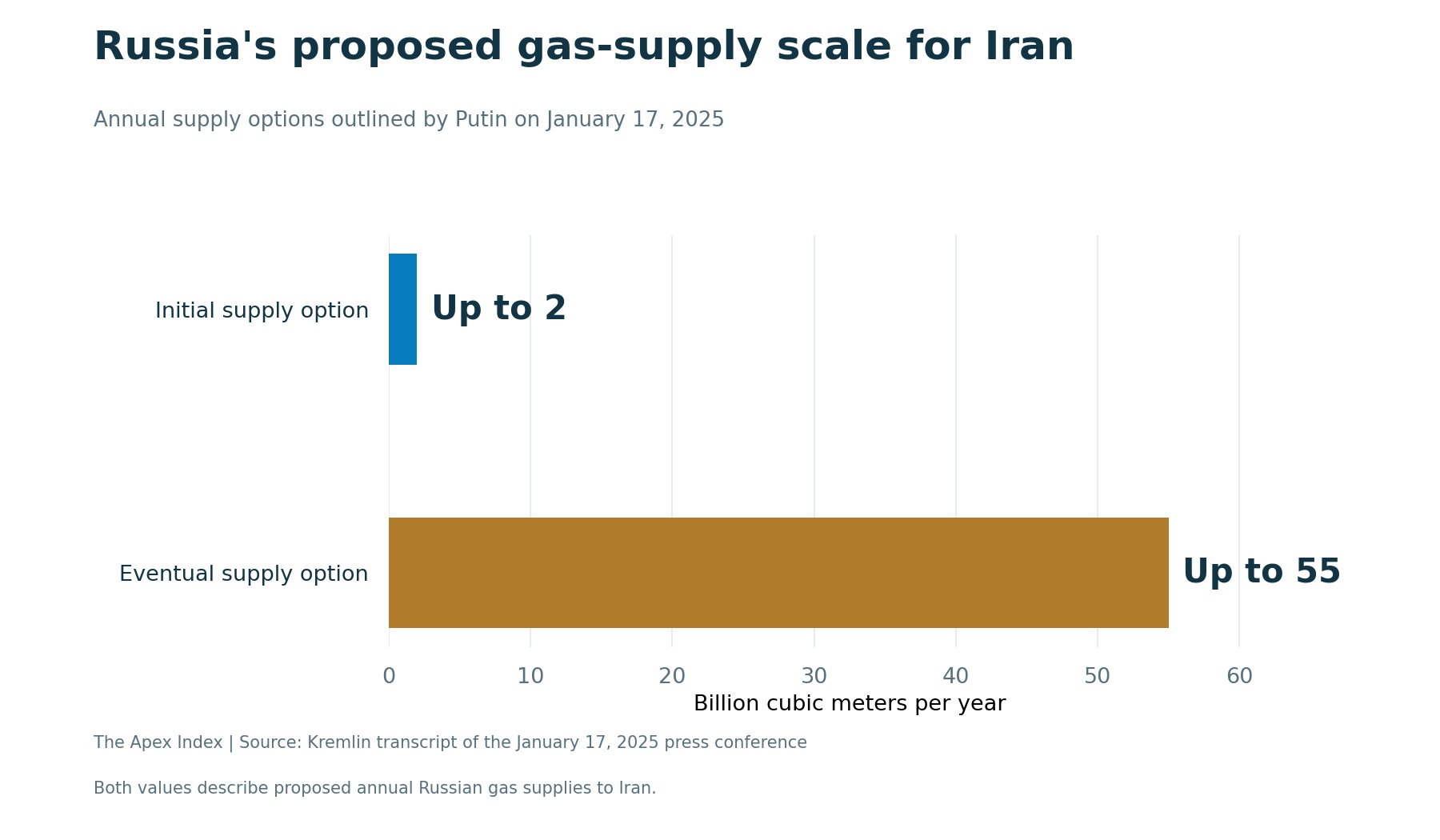
Those were two different stages of a potential supply relationship. The smaller starting volume and much larger eventual option help explain why a headline-sized gas deal can involve years of negotiations and infrastructure work before reaching its full scale.
Putin also acknowledged that the commercial details needed agreement. Discussing the gas project and a separate transport corridor, he said:
There are many issues to address, including price negotiation.
He pointed to technical matters, including the energy content of the fuel, that would need to be settled. For a buyer, the volume alone does not establish the final bill: gas quality, pricing terms and the cost of moving it all matter.
Sanctions complicate the financial side
The project is being discussed against a backdrop of U.S. restrictions on both countries. One relevant constraint is the international banking system through which large energy transactions are financed and settled.
The U.S. Treasury sanctioned Gazprombank and six foreign subsidiaries in November 2024, alongside dozens of other Russian financial institutions. The action subjected the designated banks to U.S. blocking sanctions and added to the risks for banks dealing with Russia's financial system.
Washington also maintains a broad Iran sanctions program, including restrictions affecting financial transactions. These measures make the choice of banks and payment arrangements a central commercial issue for any prospective deal. Under the U.S. blocking rules, designated entities' property within U.S. jurisdiction is frozen, and U.S. persons are generally barred from transactions involving it. The restrictions also extend to entities owned 50% or more by the designated banks.
Banking channels are part of the negotiation
Treasury's November 2024 action also warned foreign financial institutions about joining Russia's System for Transfer of Financial Messages, known as SPFS. Russia developed the system as an alternative to the SWIFT financial messaging network.
U.S. officials described participation as a sanctions risk and said joining after the warning would be a red flag. The issue reaches beyond the physical pipeline: companies need a workable way to arrange financing, send payment instructions and settle bills for the gas they buy.
That makes the commercial structure important alongside the proposed volume. A bank's willingness to handle a transaction, the counterparties involved and the applicable restrictions can all affect whether a large energy agreement gets beyond political discussion.