


Crypto exchanges want customers to keep trading, even when interest in trading tokens is fading. A growing number are adding prediction markets, hoping bets on elections, sports and interest rates will bring in business while token trading slows.
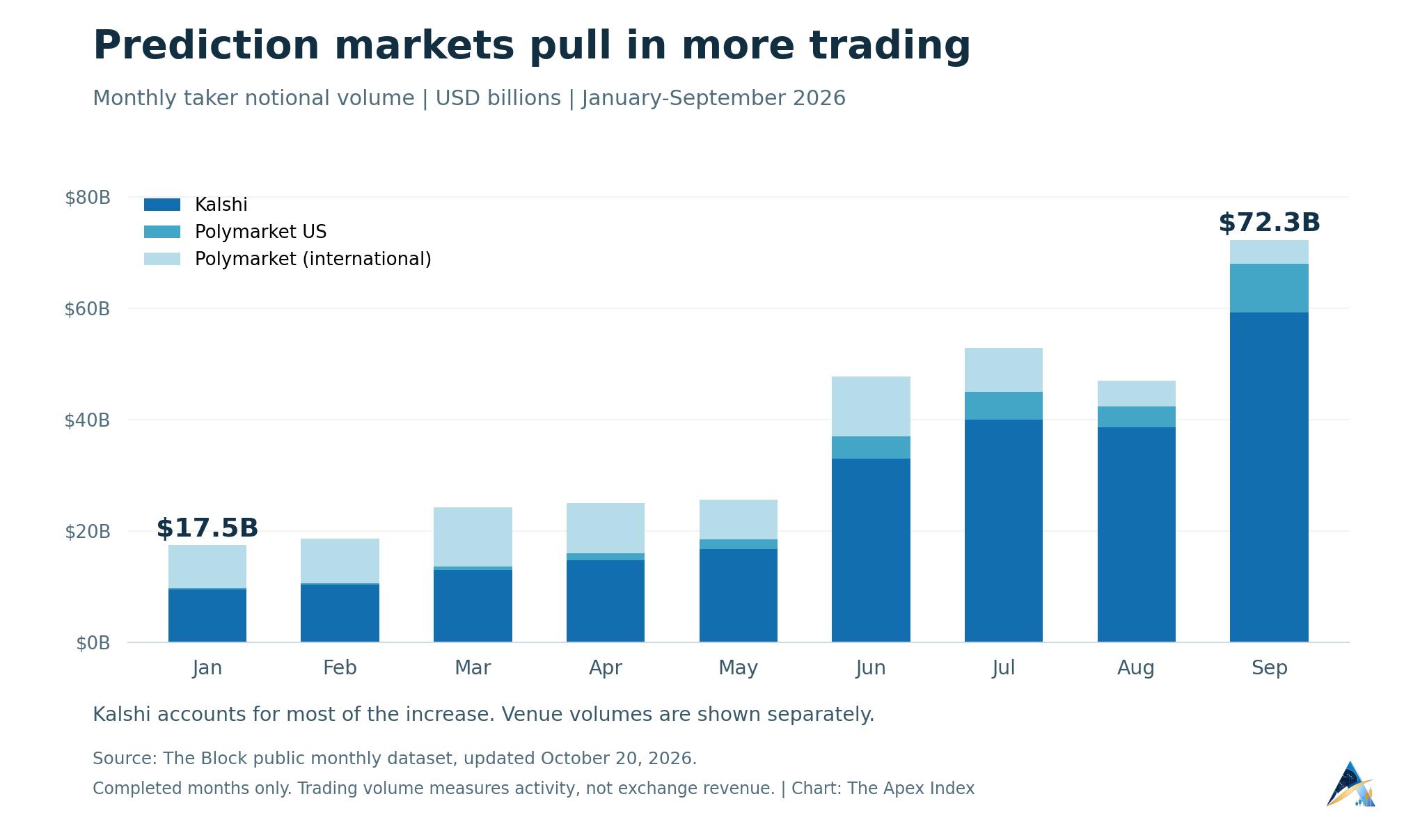
There is a big audience to chase. The Financial Times reported that spot crypto trading volumes fell 18% between January and September. Over those same months, activity across Kalshi and Polymarket's international and U.S. venues more than quadrupled.
The newspaper's October 21 report said Binance.US had recently applied for U.S. regulatory approval to offer prediction markets, citing a person with knowledge of the matter. Blockchain.com announced its own applications on October 13. Bullish is also seeking a U.S. license, according to the report.
The Block's public monthly figures, updated October 20, put combined trading across the three venues at about $17.5 billion in January and $72.3 billion in September. That is an increase of roughly 313%. These are trading volumes; exchanges collect only a portion of activity as fees.
Patrick Moley, a senior research analyst at Piper Sandler, described the business problem to the newspaper:
"Retail-facing platforms are all trying to expand their product offerings so they can retain and attract new and existing traders."
He added:
"It helps them weather the storm when there's a crypto winter in providing other products for customers."
Blockchain.com wants customers to stay in one app
Blockchain.com's applications cover registration as a futures commission merchant and designation as a contract market under the Commodity Futures Trading Commission. Approval would let it offer U.S. customers crypto futures, options and event contracts.
The company already offers self-custodied prediction markets and perpetual futures in eligible overseas markets. The U.S. filings would extend its regulated product range to American retail and institutional customers. Both registrations remain subject to approval.
Peter Smith, Blockchain.com's CEO, explained the pitch in its announcement:
"Users should be able to manage their digital assets, trade derivatives, and take positions on real-world events easily, without jumping between different apps."
For an exchange, that gives customers another reason to open the app when crypto markets are quiet. Prediction contracts also come with their own calendar: a football game, an election or an economic release can generate trading interest independently of a token rally.
There are several ways to enter. Coinbase has brought Kalshi-powered prediction markets into its app. Crypto.com built a regulated event-contract business that now operates through the independent OG.com platform. Gemini also offers prediction trading. Some companies are building the exchange infrastructure; others are giving customers access to somebody else's markets.
Robinhood's September 8 agreement with Crypto.com and OG.com shows how those businesses can fit together. Robinhood began routing selected football contracts to OG.com and agreed to hold equity stakes in both companies following OG.com's spin-off. It continued routing contracts to other venues as well.
The latest push targets institutional traders
On October 20, Crypto.com Exchange and OG.com signed a memorandum of understanding with prime broker River Markets. Their announcement said eligible U.S. institutional clients would soon gain access to OG.com's event contracts alongside Crypto.com Exchange's digital-asset liquidity.
The intended customers include hedge funds and quantitative trading desks. River supplies execution, risk management and portfolio tools, allowing those clients to trade across prediction venues through one platform. The announcement described access as forthcoming.
The volume figures also show how uneven this expansion has been. Kalshi's monthly activity rose from about $9.6 billion in January to $59.3 billion in September. Polymarket's international venue fell from roughly $7.7 billion to $4.3 billion, while its U.S. venue grew from $282 million to $8.7 billion.
Robinhood had already reported 13.6 billion event contracts traded during the second quarter. Its September announcement also put World Cup trading at more than 5 billion contracts. Those counts measure individual contracts rather than dollar trading volume.