

Qualcomm shares fell sharply in premarket trading after a surge in automotive chip sales failed to make up for a much larger decline in its phone business. The company's earnings outlook also left investors looking at another quarter of pressure on profits.
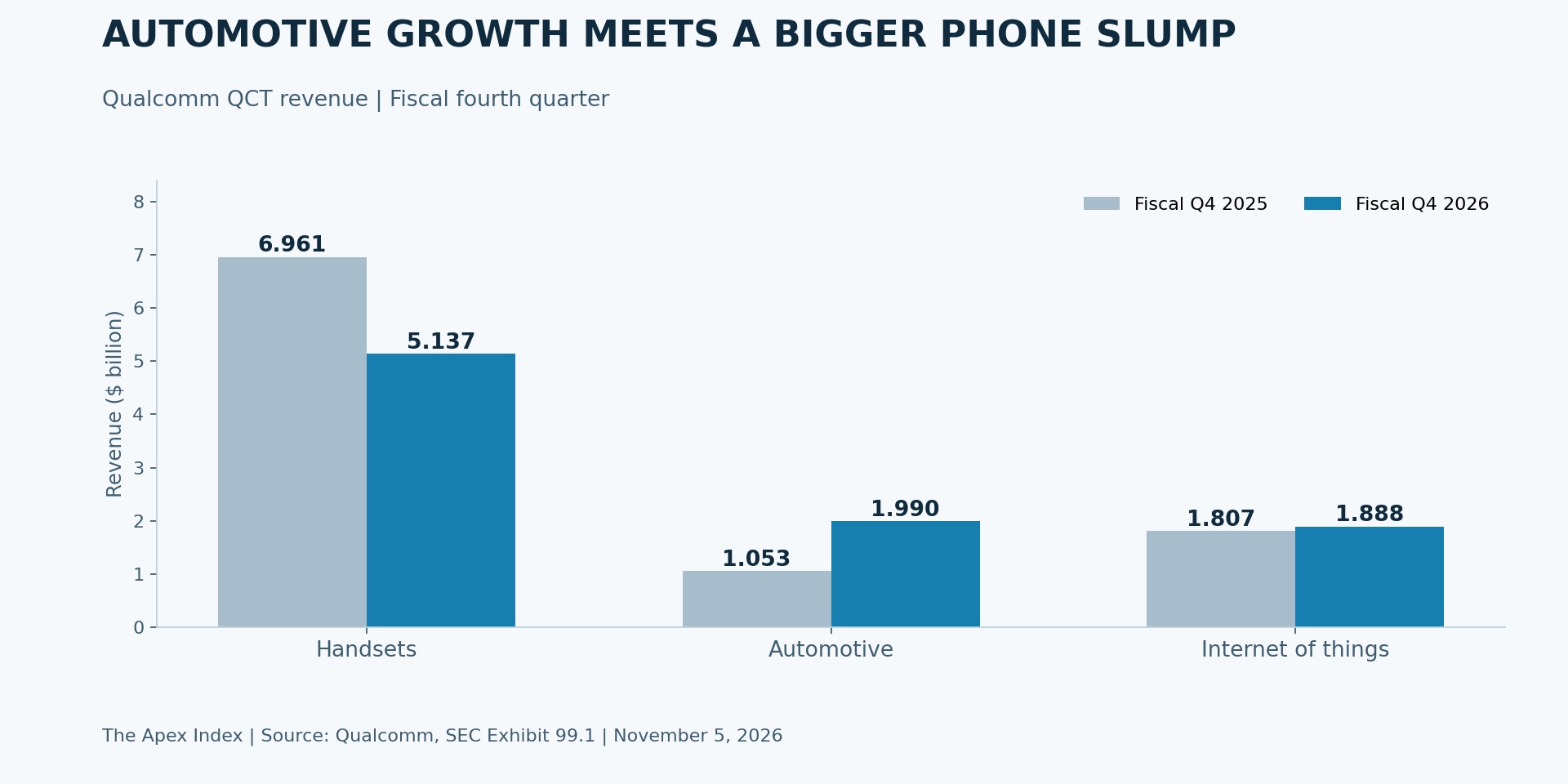
At 10:31 UTC, QCOM traded at $156.44, down 9.67% from its November 4 close of $173.19. The fall followed fiscal fourth-quarter results showing handset revenue down 26%, even as automotive revenue jumped 89% to a record $1.99 billion.
The phone business still carries more weight
The problem is the size of each business. Handset chip revenue fell to $5.137 billion from $6.961 billion a year earlier, a loss of $1.824 billion. Automotive added $937 million, while internet-of-things revenue increased by $81 million to $1.888 billion.
Together, the automotive and IoT gains covered only part of the handset shortfall. Revenue at QCT, the semiconductor division, fell 8% to $9.015 billion. Its earnings before tax declined 26%, and its pretax margin narrowed to 24% from 29%.
The handset slowdown also became steeper late in the year. Calculating from the company's annual and fourth-quarter figures, phone-chip revenue fell about 9.1% across the first nine months of fiscal 2026. The final quarter's 26% drop was substantially worse.
In the release, CEO Cristiano Amon pointed to the diversification effort:
"We are pleased to deliver fourth quarter non-GAAP revenues at the high end of our guidance, along with 36% year-over-year growth in combined QCT Automotive and IoT revenues."
For the quarter ended September 27, companywide GAAP revenue fell 8% to $10.322 billion. Adjusted earnings declined 28% to $2.17 a share. Qualcomm's patent-licensing division, QTL, also weakened, with revenue down 7% to $1.304 billion.
The outlook explains the stock's problem
For its fiscal first quarter, Qualcomm forecast revenue of $10.4 billion to $11.2 billion and adjusted earnings of $2.15 to $2.35 a share. The earnings midpoint is $2.25, below the $2.32 Bloomberg consensus cited by Quartz.
The midpoint of revenue guidance, $10.8 billion, was above the $10.55 billion estimate in the same report. That combination leaves a clear issue for shareholders: sales can beat expectations while the earnings delivered on those sales still disappoint.
Higher costs are part of the near-term challenge. Qualcomm said wafer fabrication, assembly, testing, advanced packaging, memory and other inputs have become more expensive. It is raising product prices to reflect those costs, but expects the full benefit to reach QCT gross margins in the second half of fiscal 2027.
A closer look at QCOM
At the $156.44 premarket price, QCOM was trading at roughly 14.8 times fiscal 2026 adjusted earnings of $10.54 a share. That is a multiple of last year's earnings, which themselves fell 12%. GAAP earnings also included a $5.32-a-share tax benefit from reversing a valuation allowance.
The recovery case rests on the newer businesses growing fast enough to reduce that dependence on phones. Amon said:
"Fiscal 2027 marks the start of our non-handset revenue inflection, including the ramp of our Data Center business. Non-handset revenues are projected to grow by more than 60% year-over-year, and we are reiterating our fiscal 2027 Data Center revenue target of $5B."
For the stock, the useful checks are progress toward that data-center target, a smaller handset decline and improvement from QCT's latest 24% pretax margin. If automotive and data-center growth arrive while phone sales stabilize, Qualcomm would have a stronger earnings base. Continued handset losses or delayed margin recovery would weaken that case.
Shareholder payouts remain substantial. During fiscal 2026, Qualcomm spent $7.817 billion buying back stock and paid $3.854 billion in dividends. It also renewed long-term patent-license agreements with Apple, Huawei and Transsion and announced a multi-generational AI data-center collaboration with Amazon.