


Anthropic's quarterly revenue has jumped to nearly $17 billion, giving the Claude developer a much bigger business to help pay for an extraordinary infrastructure buildout. Its purchase and lease commitments now total about $895.4 billion, almost all tied to computing and infrastructure.
The figures come from an updated IPO filing submitted on November 2. Revenue reached $16.956 billion in the three months ended September 30, up 1,127% from $1.382 billion a year earlier. That is revenue earned in one quarter, rather than an annual sales forecast or a run rate.
There is a long timetable behind that nearly $900 billion figure. The commitments include agreements entered into as of and after September 30, with roughly half expected before the end of 2030 and substantially all the rest between 2031 and 2045.
The updated filing gives investors a closer look at how quickly demand is growing, and what Anthropic is paying to keep up.
Sales race ahead, but capacity gets expensive
Third-quarter sales rose from $11.555 billion in the previous quarter, an increase of about 47%. Anthropic attributes the growth to successive model and product releases that brought higher usage and broader adoption, across both subscriptions and consumption-based services.
Its larger customer base has grown sharply, too. More than 11,900 customers generated at least $100,000 each in revenue over the trailing 12 months as of September 30. That compares with approximately 400 at the end of March 2025.
Higher usage also had to absorb lower prices. New model pricing and contractual discounts reduced the quarter-to-quarter revenue increase by approximately $600 million, the company said.
Computing and infrastructure expenses reached $9.863 billion in the third quarter, up 382% from a year earlier. That was slower than revenue growth, but the comparison with the previous quarter was less comfortable: computing costs climbed to 58% of revenue from 48%.
Anthropic received $5 billion of computing capacity under short-term commitments during the quarter. It says that capacity currently costs significantly more than comparable resources secured through multiyear agreements.
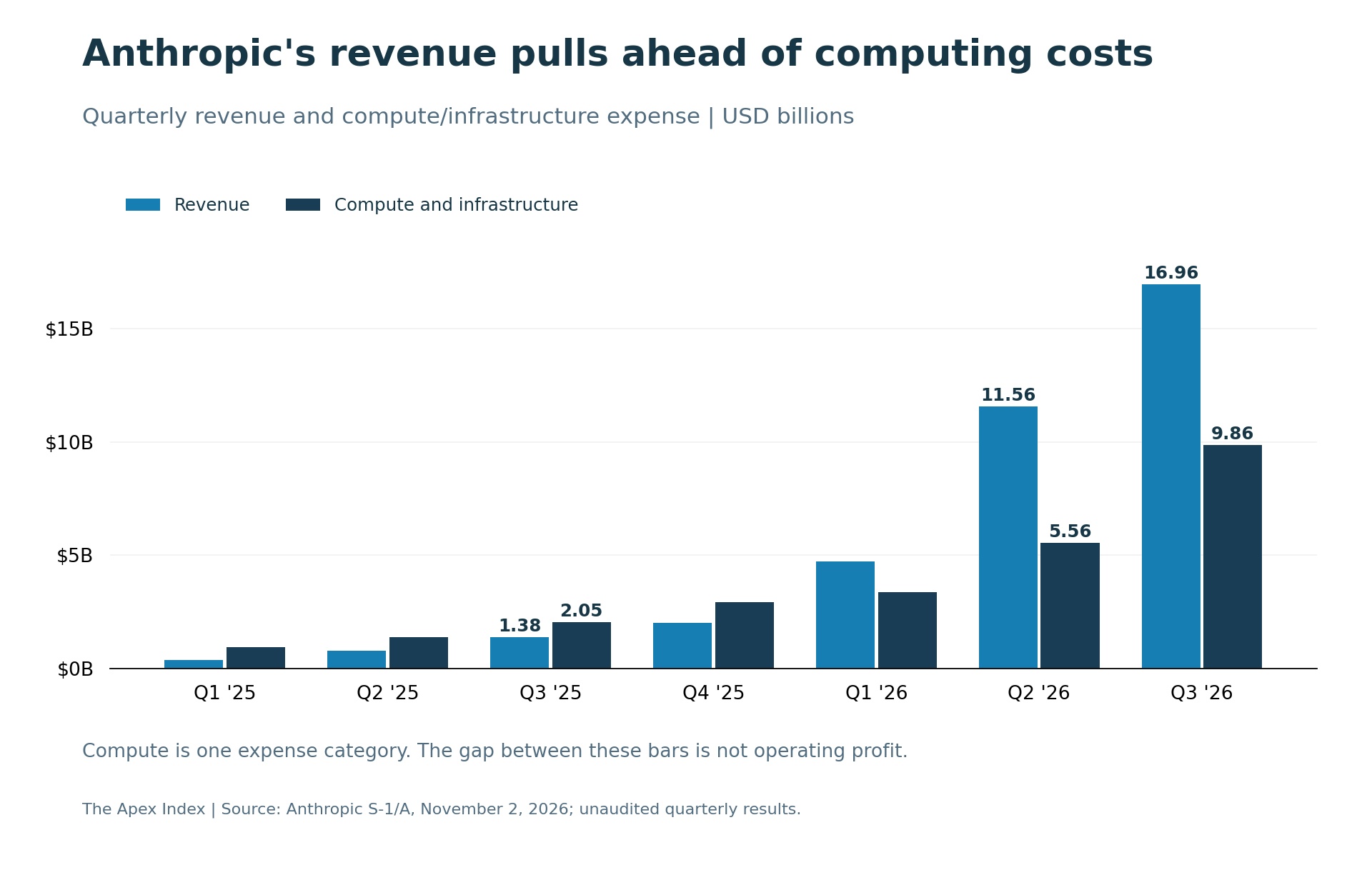
The company generally orders computing resources 12-18 months before they become available. Once capacity arrives, those expenses are largely fixed in the near term, leaving revenue growth to do much of the work of covering them.
That helps explain why bigger sales did not produce a quarterly operating profit. Anthropic recorded a $567 million operating loss, following a $974 million operating profit in the second quarter. Alongside the expensive short-term computing capacity, it cited about $2 billion of noncash charges connected to its donation matching program.
On its adjusted measure, Anthropic reported operating income of $2.463 billion, with a 15% margin. That calculation excludes $1.070 billion of stock-based compensation and $1.960 billion of noncash charitable contributions. Those exclusions account for the difference from its loss under generally accepted accounting principles.
The bills extend far beyond this quarter
Of the $895.4 billion committed, approximately $447.5 billion is expected to be incurred before December 31, 2030. Within that amount, $69.8 billion falls due in the 12 months following September 30, 2026. These are overlapping portions of the same total, rather than additional bills to add together.
Some agreements require payments even when Anthropic does not use all the capacity it has reserved. Its warning is direct:
These commitments represent substantial fixed obligations.
There is also a mismatch between how Anthropic buys capacity and how customers pay for Claude. Infrastructure contracts can last years, while much of its revenue depends on actual usage without equivalent long-term customer commitments.
We must grow our customer base and expand revenue rapidly in order to generate the cash flows necessary to satisfy these commitments.
If demand falls short, the company could end up paying for underused resources. Fast-moving hardware creates another risk: equipment booked today could become less competitive before the agreement runs out.
Anthropic has substantial financial resources behind those obligations. As of September 30, it held $95.6 billion in cash and cash equivalents, plus $36.3 billion in short-term investments. It had raised an aggregate $141.1 billion in capital by that date.
The amended prospectus remains preliminary, with the offering price and share count still blank. Meanwhile, Anthropic warns that failing to meet certain commercial obligations could trigger cross-default provisions in borrowing agreements, potentially accelerating debt repayments just when access to computing capacity is most at risk.