
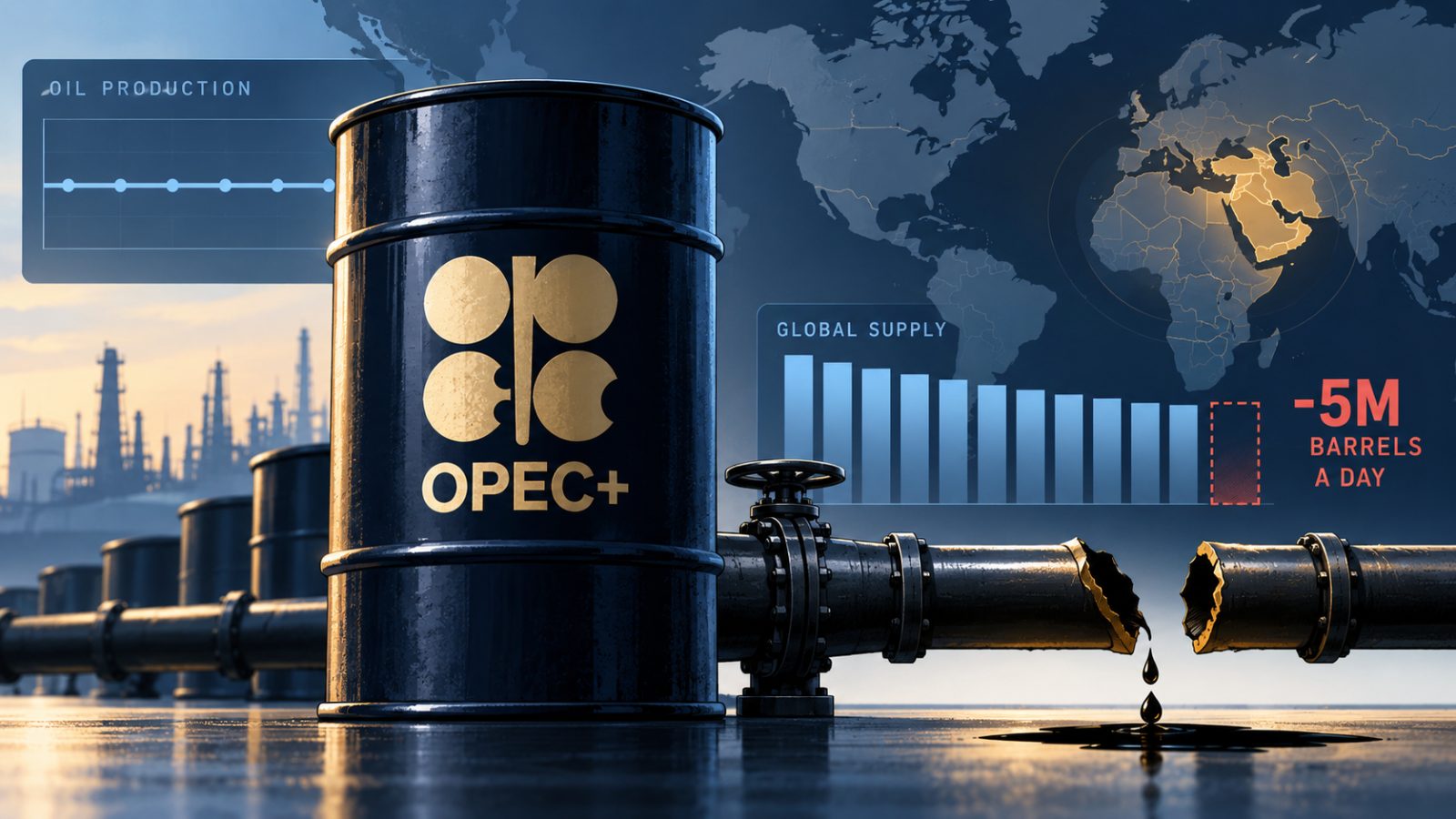
OPEC+ will hold November oil output targets where they are, choosing not to add another planned increase while the Iran war keeps a huge chunk of Gulf supply off the market. The decision came Sunday after a short virtual meeting involving Saudi Arabia, Russia, Iraq, Kuwait, Algeria, Kazakhstan and Oman. Those seven producers are pumping roughly 5 million barrels a day less than before the war, making another quota increase mostly symbolic.
OPEC+ freezes November quotas while Gulf exports remain heavily restricted
Gulf producers have struggled to ship normal volumes because trade routes remain disrupted. Exports have been running at only 60% to 80% of usual levels for months as the U.S.-Israeli war with Iran continues to interfere with tanker traffic. That gap matters more than OPEC+ ceilings. A producer can be allowed to pump more crude, but barrels that cannot reach buyers do little for refiners or fuel markets.
The freeze caps a year in which OPEC+ repeatedly raised production targets after years of supply restraint. Most of those increases never fully reached the market because the conflict kept disrupting flows. OPEC data shows the seven core members produced about 25 million barrels per day in August, up 630,000 barrels per day from July. Even then, output remained around 5 million barrels per day below February levels, before fighting began.
The alliance still has about 2 million barrels per day of cuts covering most members. It also needs results from a production-capacity review before deciding how increases should be divided. Because members have very different abilities to raise supply, further policy changes are not expected before 2027.
Oil remains expensive despite Friday’s drop. Brent settled 6 cents lower at $102.25 per barrel, while West Texas Intermediate fell $1.76 to $91.11. Brent was near $73 before the Iran war started in late February.
G7 reserve release hits prices but cannot replace missing production
Friday’s decline followed a G7 agreement to release 100 million barrels of emergency oil stocks over four months. The plan includes a large diesel release during the first 20 days after Donald Trump asked European governments to tap reserves as fuel costs surged.
France, Canada, Germany, Italy, Japan, the United Kingdom and the United States said the coordinated barrels would move through the International Energy Agency. The announcement followed a video conference chaired by French President Emmanuel Macron.
The G7 condemned Iran’s attacks on neighboring countries and accused Tehran of damaging international trade, energy security and the world economy. Leaders demanded the full restoration of navigation through the Strait of Hormuz and said they would intensify efforts to protect shipping. They also backed U.S. efforts to keep commerce moving through the waterway.
The bloc separately said sanctions on Russia would remain while members work with the IEA and other partners to limit spillovers across fuel, gas and other commodity markets.
The reserve release gives consuming countries temporary supply, especially diesel, but Gulf output remains far below prewar levels. OPEC+ will meet again on November 1.