

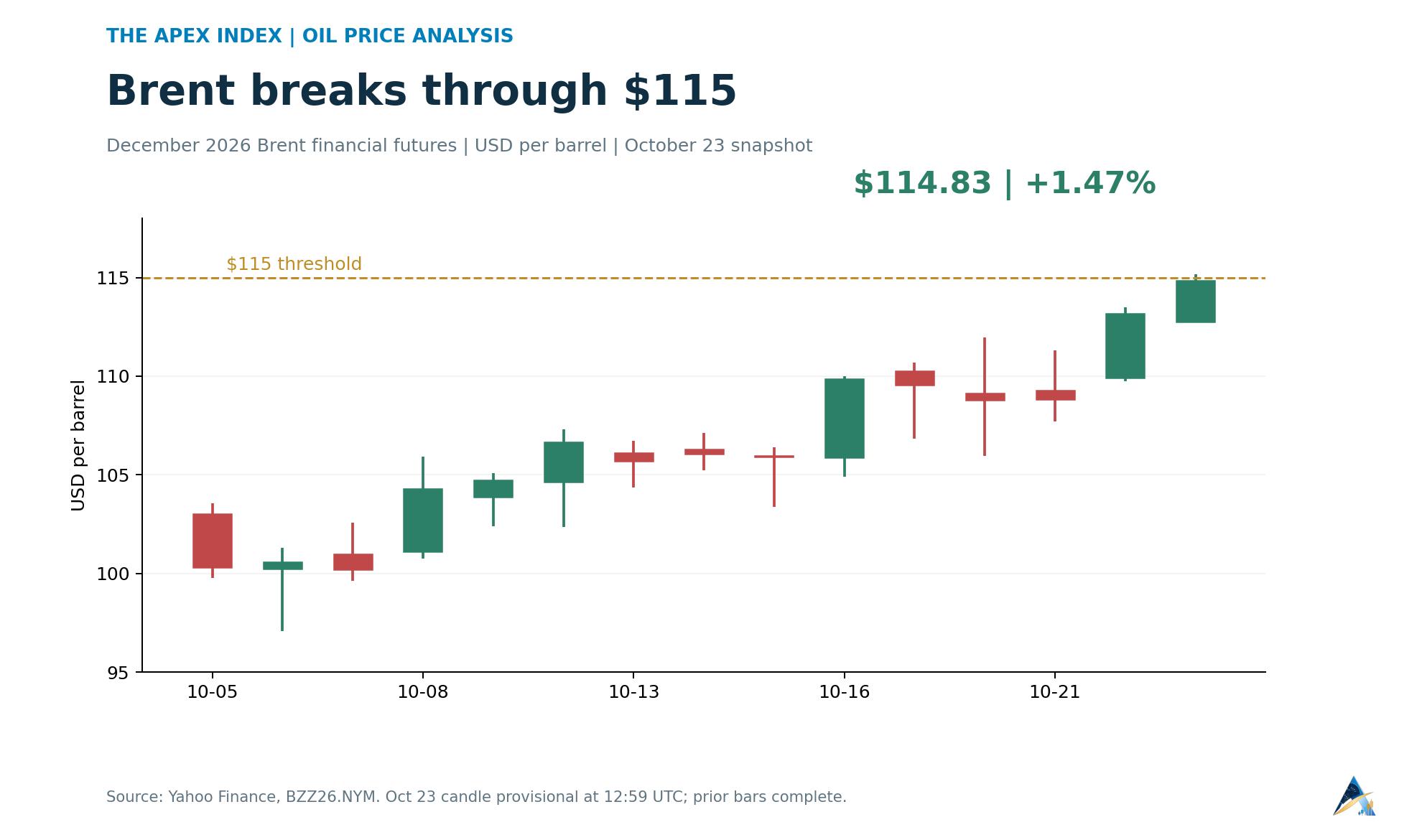
Oil has crossed $115 again, and the timing could hardly be worse for households hoping their bills would settle down. December Brent futures reached $115.16 on October 23 before easing to $114.83, still up 1.47% from Thursday's settlement. Renewed threats to Middle Eastern supplies are keeping buyers nervous about what comes next.
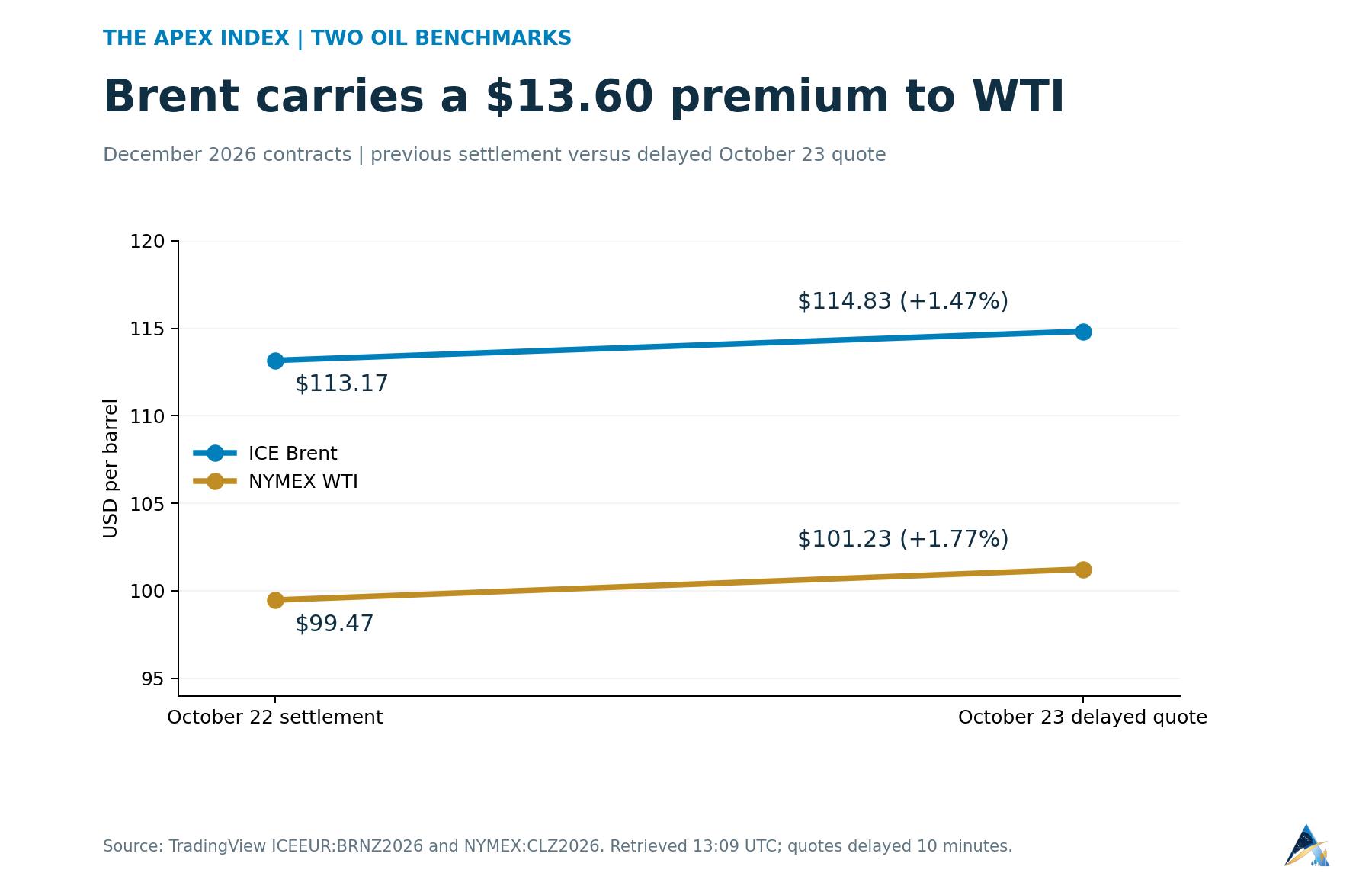
U.S. benchmark WTI was $101.23, up 1.77%, leaving Brent $13.60 more expensive per barrel. Those December-contract quotes were retrieved at 13:09 UTC from a feed delayed by 10 minutes. The gap matters: the international and U.S. benchmarks are both rising, but they are pricing different regional supply conditions.
Why oil is climbing again
The immediate pressure comes from Saudi Arabia and the shipping routes around it. Friday's Reuters report said Aramco had ordered an evacuation of its Dhahran headquarters on Thursday as fighting with the Houthis intensified. Clashes near Bab el-Mandeb have added to concerns about moving energy through the Red Sea.
Apex had earlier reported that debris from an intercepted drone killed two workers near Aramco's Shaybah oilfield on October 21. Production there was unaffected. Traders are nevertheless having to weigh the risk of another attack reaching a facility or disrupting exports.
There is also the possibility of renewed U.S.-Israeli strikes on Iran. AFP reported on Friday that speculation about military action after the U.S. midterms was helping lift oil to five-month highs. Such an operation remains a risk being priced by investors, rather than an announced attack in progress.
Danni Hewson, AJ Bell's head of financial analysis, told the agency:
"Escalating tensions in Ukraine and the prospect of increased energy demand as the northern hemisphere heads into the winter months are only adding to the upward pressure on oil and gas prices."
Russia's agreement to lift its diesel-export ban offers a possible source of relief for fuel markets, according to Friday's reporting. Extra diesel could ease a shortage of that product. How much it helps will depend on actual deliveries and what happens to supplies elsewhere.
Inflation already has an energy problem
The latest U.S. consumer-price figures show why another oil jump deserves attention. September inflation reached 3.7% from a year earlier, up from 3.4% in August. Prices rose 0.6% during the month, double the 0.3% increase in the measure excluding food and energy.
The Bureau of Labor Statistics said in its October 14 release:
"The index for gasoline rose 9.1 percent in September, accounting for over half of the monthly all items increase."
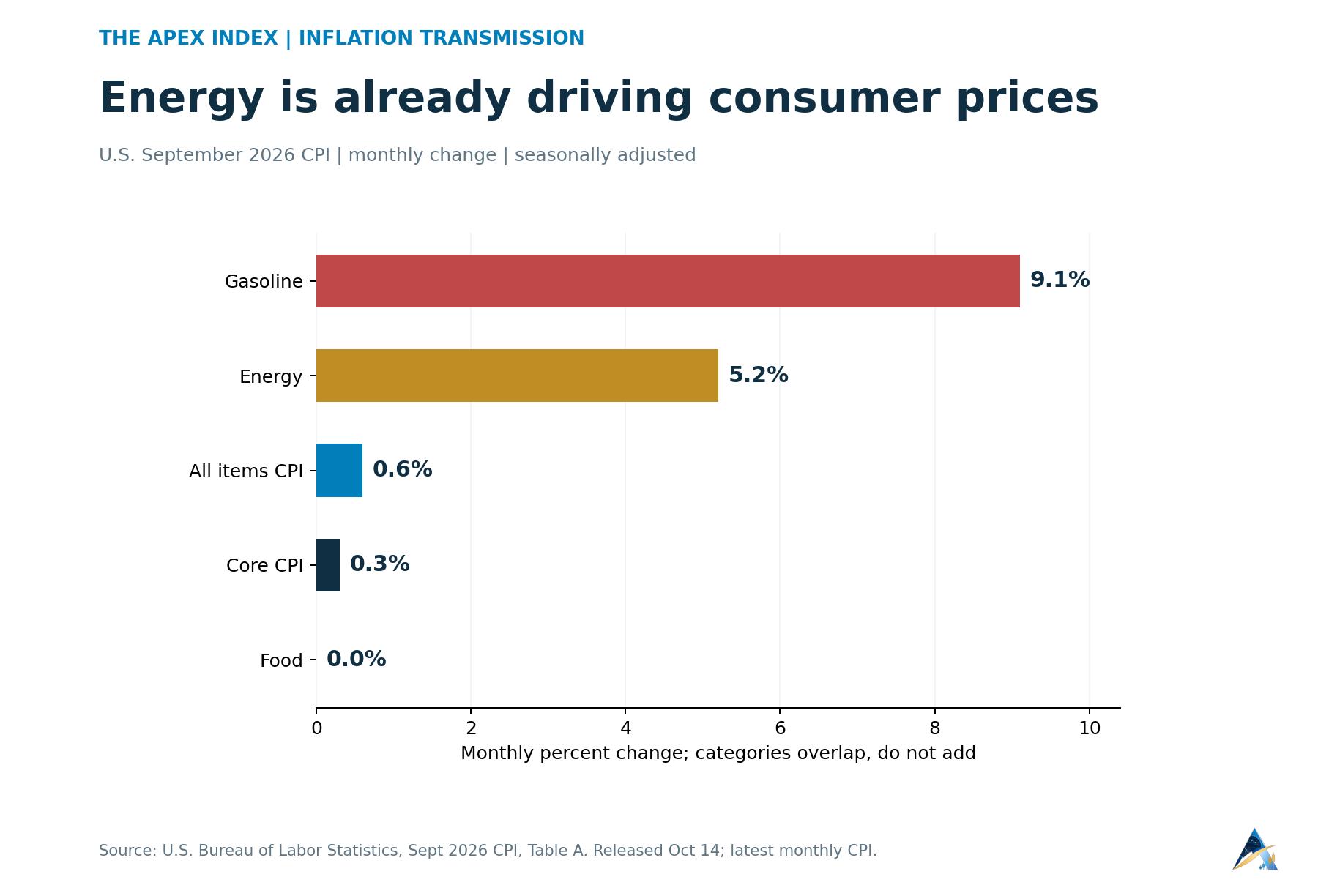
Energy prices overall rose 5.2% during September and 20.4% over the year. Food prices were unchanged for the month. That contrast is useful: the immediate surge was concentrated in energy, even though other household expenses continued to rise.
Crude reaches consumers through several routes. Refineries buy it to make gasoline, diesel and jet fuel. More expensive diesel can raise trucking costs; jet fuel affects airlines; shipping costs feed into the price of imported goods. Businesses then decide whether to absorb those bills or charge customers more.
The impact varies across countries. An oil importer with a weakening currency faces a bigger local-currency bill, while subsidies or fuel-tax cuts can delay the increase at the pump and shift costs onto government budgets. Oil exporters may gain revenue even as their residents face more expensive transport.
Central banks face an awkward choice if energy stays expensive. Raising interest rates cannot repair a damaged terminal or reopen a shipping lane. But sustained increases that spread into wages, services and inflation expectations can make policymakers less comfortable easing borrowing costs.
Brent technical analysis: what happens around $115?
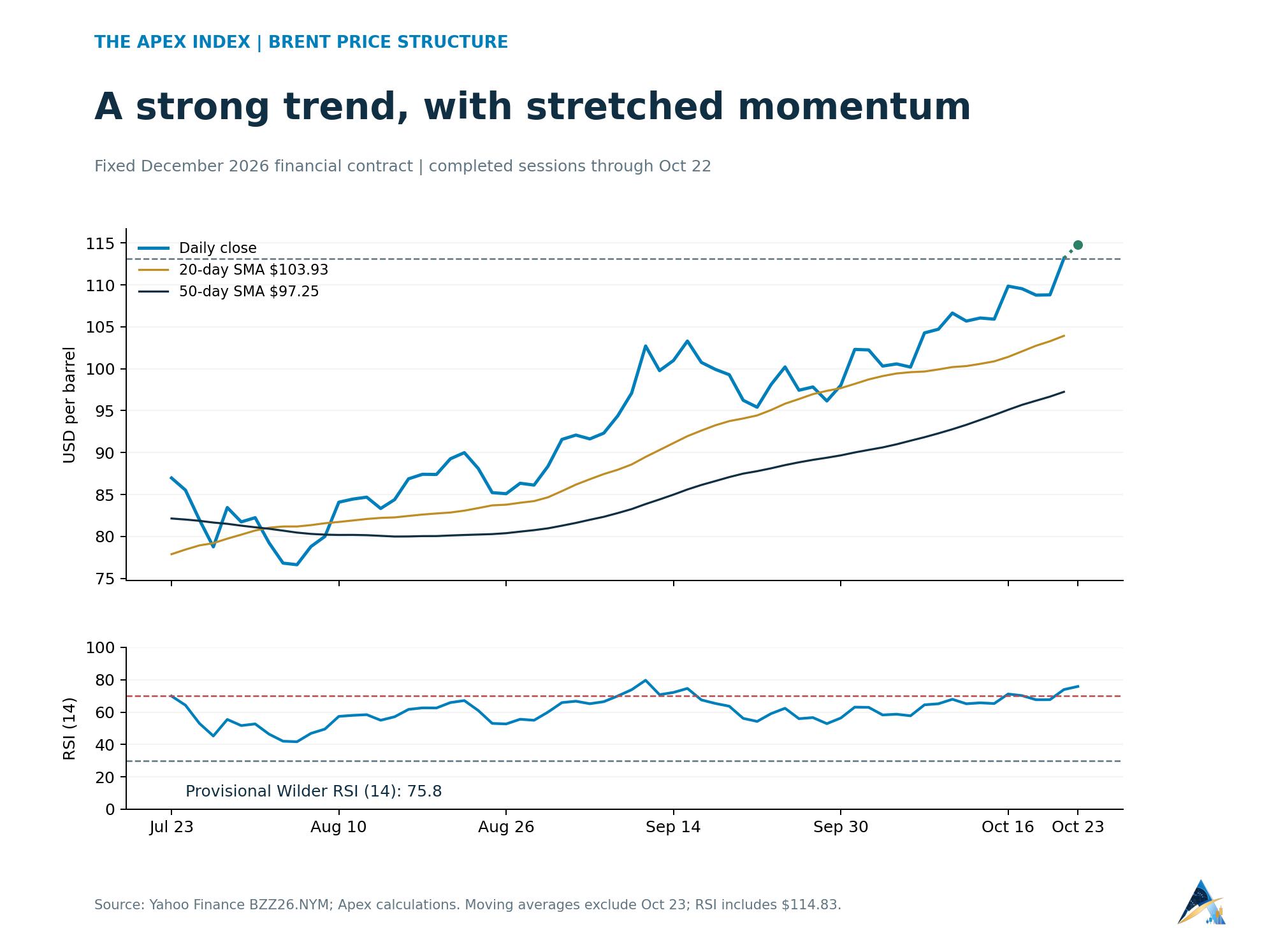
The price trend remains upward. For the fixed December Brent financial contract traded on NYMEX, Apex calculations put the completed-session 20-day simple moving average at $103.93 and the 50-day average at $97.25. These use daily closes through October 22. The technical chart uses that specific contract throughout, avoiding a distortion from switching delivery months.
Its 14-day Wilder RSI rises to a provisional 75.8 when the $114.83 quote is included. A reading above 70 flags stretched momentum. A strong market can stay there, but chasing the rally leaves less room for an ordinary pullback.
The immediate resistance area is $115-$115.17, covering the round number and Friday's high in the financial contract. A sustained break would strengthen the upside case. The next round-number reference is $120, a conditional marker rather than a calculated price target.
On a retreat, $113.17 is the first reference, matching Thursday's closing price. Friday's $112.72 low in the financial contract follows. Losing both would suggest the breakout was struggling to hold, with Thursday's $109.73 low and Wednesday's $108.82 close becoming the next historical areas to watch.
A daily close back below $113.17 would weaken the immediate breakout case; a sustained move beneath $109.73 would damage the short-term structure further. Conversely, holding above the old close while repeatedly testing $115 would leave buyers in control. These levels can move quickly when a military or diplomatic headline hits.
For the inflation outlook, the duration of the rally matters more than a brief touch of $115. Several weeks of expensive crude would give refiners, transport companies and importers more costs to pass along. A retreat driven by safer shipping and restored supply would give them considerably less reason to raise their next invoice.