

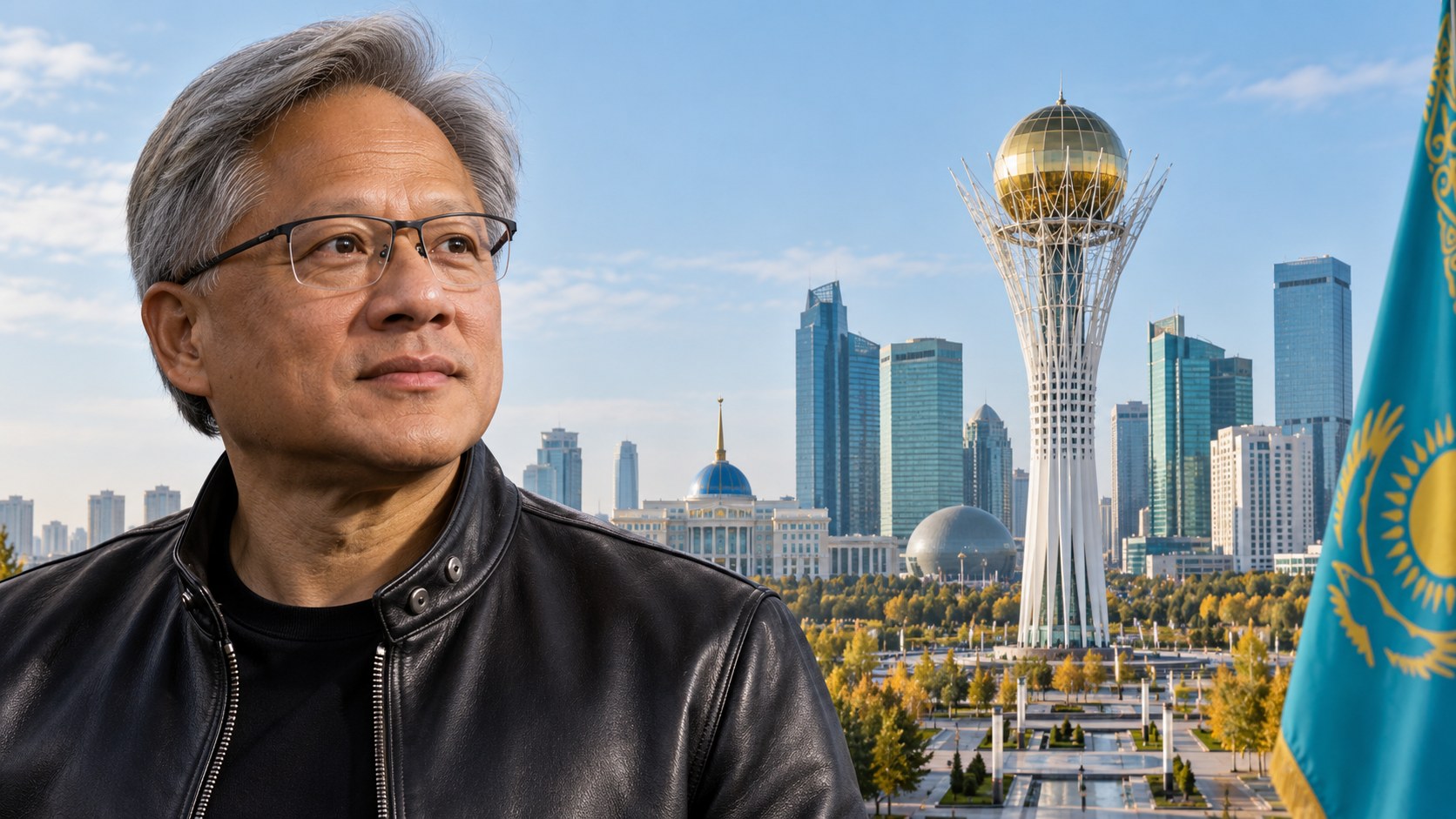
Jensen Huang has arrived in Kazakhstan as the country tries to turn its energy resources into a new export business: computing power. The Nvidia chief's first visit brings fresh details on a major data-center project and plans to put AI to work on the streets of Astana.
The $10 billion figure comes from a package of AI infrastructure agreements announced by the Kazakh government in June. Today's developments show how parts of that ambition are taking shape, with Firebird building a facility alongside Kazakhtelecom and securing U.S. permission for a large shipment of Nvidia processors.
In a fresh update, Nvidia said Huang met President Kassym-Jomart Tokayev at the Akorda Presidential Palace and joined AI minister Zhaslan Madiyev for a public fireside chat on October 23. A signing ceremony at the palace marked Firebird's investment agreement with the government.
The first facility has a launch target
Firebird has secured a U.S. export license for 45,000 Nvidia Grace Blackwell GPUs. Its first phase at Data Center Valley in Ekibastuz is under construction with Kazakhtelecom, with commercial operations targeted for the third quarter of 2027.
A planned second phase would take Firebird's potential AI infrastructure capacity in Kazakhstan to approximately 500 megawatts. The company also plans Firebird Labs Kazakhstan, offering local startups and researchers funding, computing access and research partnerships.
Those are the latest project details. The original government announcement, dated June 15, described a broader $10 billion program involving a planned cluster of 100,000 advanced GPUs, including GB300 and Vera Rubin chips.
The documents signed then included a strategic cooperation agreement with Firebird and a binding term sheet between Firebird and Kazakhtelecom. Madiyev estimated the project could generate at least $3 billion in annual export revenue. That forecast explains the commercial ambition: sell computing services internationally while creating skilled jobs at home.
The government's pitch to investors emphasizes available land, investment incentives and competitive electricity costs. At the fireside chat, Huang described the opportunity this way:
Instead of just exporting energy, in the future, you could transform energy into intelligence and export intelligence.
Kazakhstan wants to build the products, too
The country also wants local companies to use that infrastructure. Madiyev discussed AI that understands Kazakh and reflects the country's cultural context, while pointing to mining, factories, agriculture, transport and logistics as industries where AI and robotics could be applied.
Some computing capacity is already operating. Kazakhtelecom has deployed 400 Nvidia H200 and 480 B300 GPUs in Astana and Almaty, according to Nvidia's update. Next year, the telecom operator plans further deployments at Data Center Valley and in the Ekibastuz region, including Vera Rubin processors.
Huang also praised the founders of Higgsfield, the Kazakhstan-founded AI video startup, and Nvidia announced an investment in the company during the event. That adds a software business to a visit otherwise dominated by power supplies, processors and data centers.
A robotaxi test for the capital
There is a fresh example of how the technology could reach customers. Ride-hailing company inDrive, autonomous-driving developer Pony.ai and Nvidia have signed a memorandum of understanding to explore robotaxi services in Kazakhstan.
InDrive's chief technology officer, Yuri Misnik, told TechCrunch that testing is planned in Astana in the first half of 2027, initially with a safety operator. Fully driverless rides are the eventual goal.
Under the proposed arrangement, Pony.ai would supply its Gen-7 robotaxis, inDrive would operate them through its platform, and Nvidia would provide technology including its Hyperion platform and Halos safety system.
Astana's snow and ice give that project a practical challenge beyond signing an agreement. InDrive founder and CEO Arsen Tomsky said:
Launching here will provide an important opportunity to evaluate autonomous driving technology in challenging winter conditions. Success in Astana could offer valuable insights for expanding autonomous mobility to other locations facing similar challenges.
The trials would test whether the technology can handle a demanding local environment while competing in a market where conventional ride-hailing is already relatively affordable.