

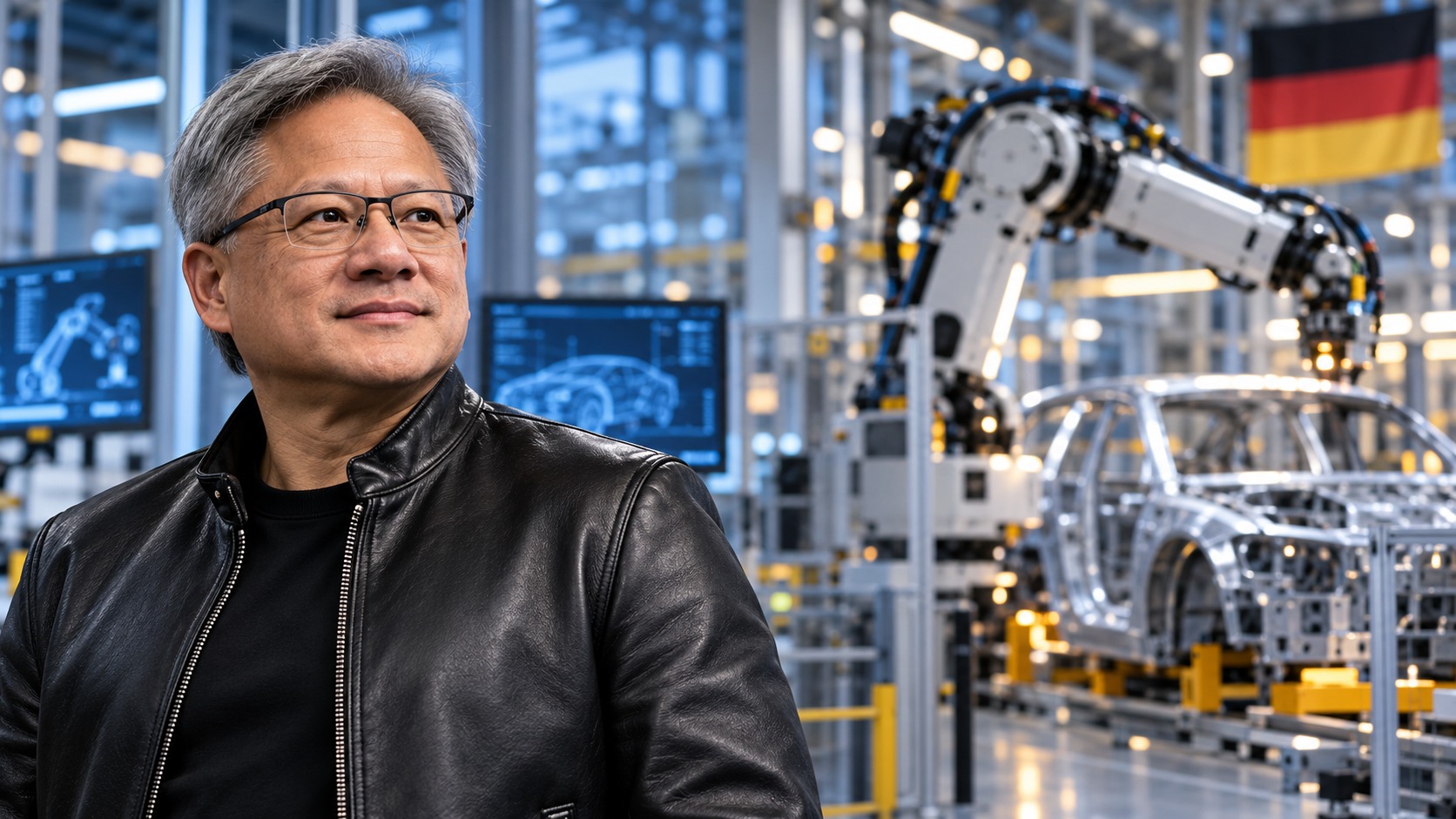
Jensen Huang is putting more of Nvidia's money into German technology companies, and he wants the country's industrial strength to make those bets pay off. Chancellor Friedrich Merz is offering his backing, urging businesses to bring AI into the factories and engineering operations that Germany already knows how to run.
At the Invest in Germany Summit in Berlin on October 19, Merz and two federal ministries signed a joint declaration of intent with Nvidia. The initiative aims to advance physical AI: systems that interact with the world through machines, robots and cars.
Huang spelled out what he wanted from the relationship during their discussion:
“Nothing would give me more joy than to see all of my investments in Germany turn into gold,” he said. “I'm very happy to hear that there are regulations involved to make it possible for the pension funds and the risk capital to come into Germany.”
The partnership brings Nvidia together with the Federal Ministry for Economic Affairs and Energy and the Federal Ministry for Research, Technology and Space. Nvidia's announcement says it will also expand cooperation with Germany's Industry 4.0 Platform, which includes government, industry, researchers and trade associations.
Four new bets, from hospitals to satellites
Nvidia named four German companies it plans to invest in: Agile Robots, Avelios Medical, Mirelo and Reflex Aerospace. They cover a broader spread of businesses than the chatbots that have dominated much of the AI conversation.
Munich-based Agile Robots builds machines for manufacturing, logistics and healthcare, including its Agile ONE humanoid. Avelios Medical develops hospital software that integrates clinical and administrative work, with AI built into its systems.
Mirelo develops models that generate sound effects, speech and music to match video. Berlin-based Reflex Aerospace designs satellites that it says can be ready for launch in about 12 months.
Nvidia places these investments within its nearly $10 billion commitment to Europe's technology ecosystem, including companies, universities and research institutions. It did not disclose individual funding amounts for the four startups in the announcement. Nvidia has not given a Germany-only allocation for that commitment.
Merz wants smaller manufacturers involved
For Merz, adoption across the Mittelstand, Germany's small and midsize businesses, is central to the plan. These companies hold industrial knowledge and operating data that Huang argues could give Germany an advantage in AI.
“The biggest advantage we have in Germany is our so-called Mittelstand,” Merz said. “Please open your doors for AI to make use of your data. This is a real secret and a real advantage for Germany to make use of all the data which is already available in our companies.”
Huang described a future in which companies operate both physical factories and digital twins, using virtual versions of their businesses to design and test products and production processes. His argument was that AI could amplify Germany's specialized engineering expertise.
There is already a factory project behind that pitch. In a separate October 19 release, Siemens said it and Nvidia have been developing and testing AI applications in live production at its Erlangen electronics plant.
Siemens says fully virtual production ramp-up can reduce engineering effort by up to 85%. Its work also includes agent-based production planning intended to make manufacturing more adaptable.
The safety question came up, too
Merz asked Huang how governments should regulate AI without stifling it. Huang's answer began with safety, then moved to engineering safeguards, company practices and regulation of applications. Merz said he favored at least a European approach and would prefer global coordination.
That discussion matters for manufacturers putting AI into equipment that moves, builds things or carries passengers. The investment announcement sits alongside questions about how those systems will be tested and supervised.
Huang is scheduled to deliver Nvidia's GTC Berlin keynote on October 21.