

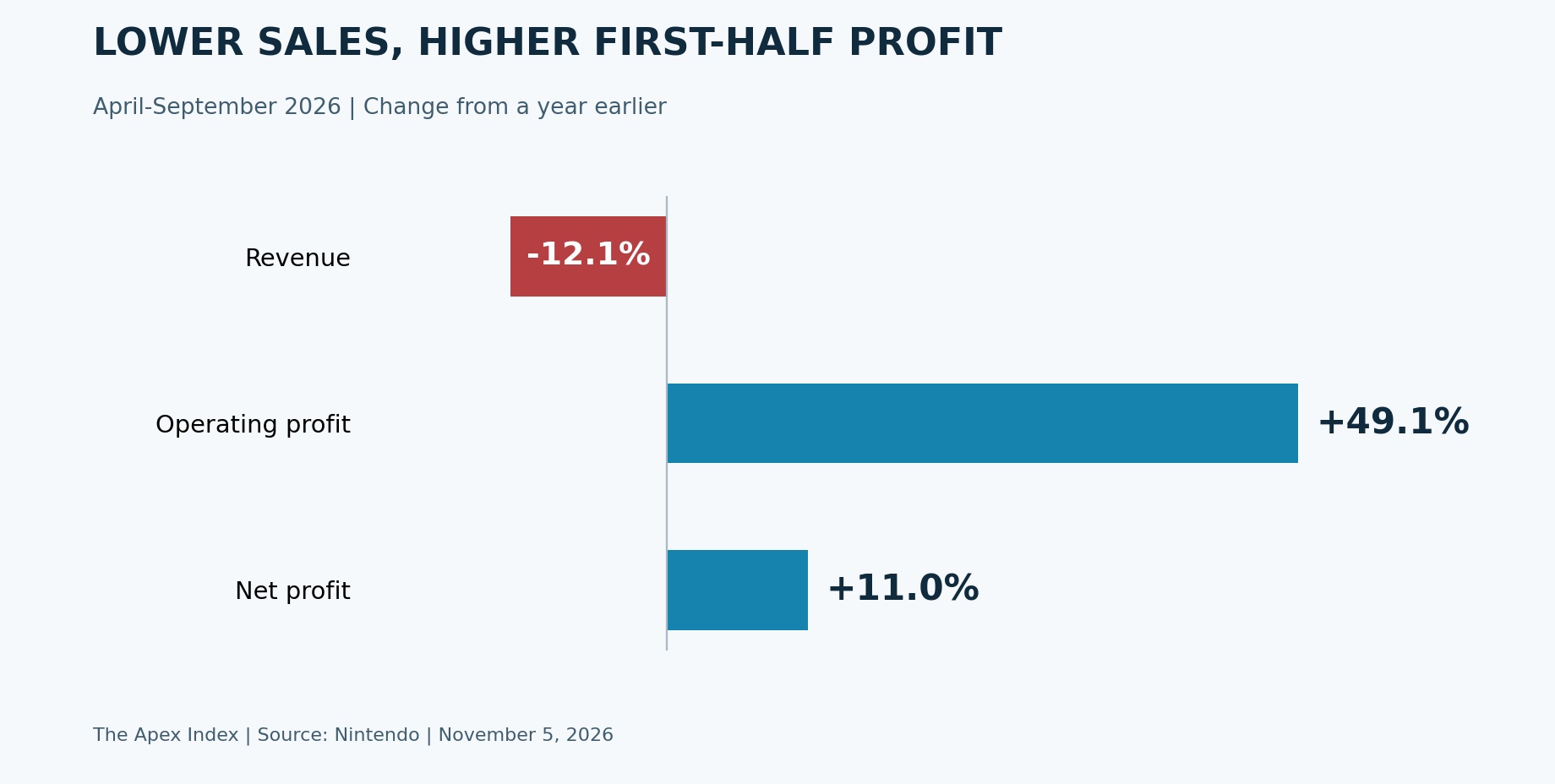
Nintendo's revenue fell 12.1% to 966 billion yen, about $6.1 billion, in the six months through September as Switch 2 console shipments slowed. Its July-September profit also missed analyst forecasts, leaving the company heading into the holiday season with fewer hardware sales to build on.
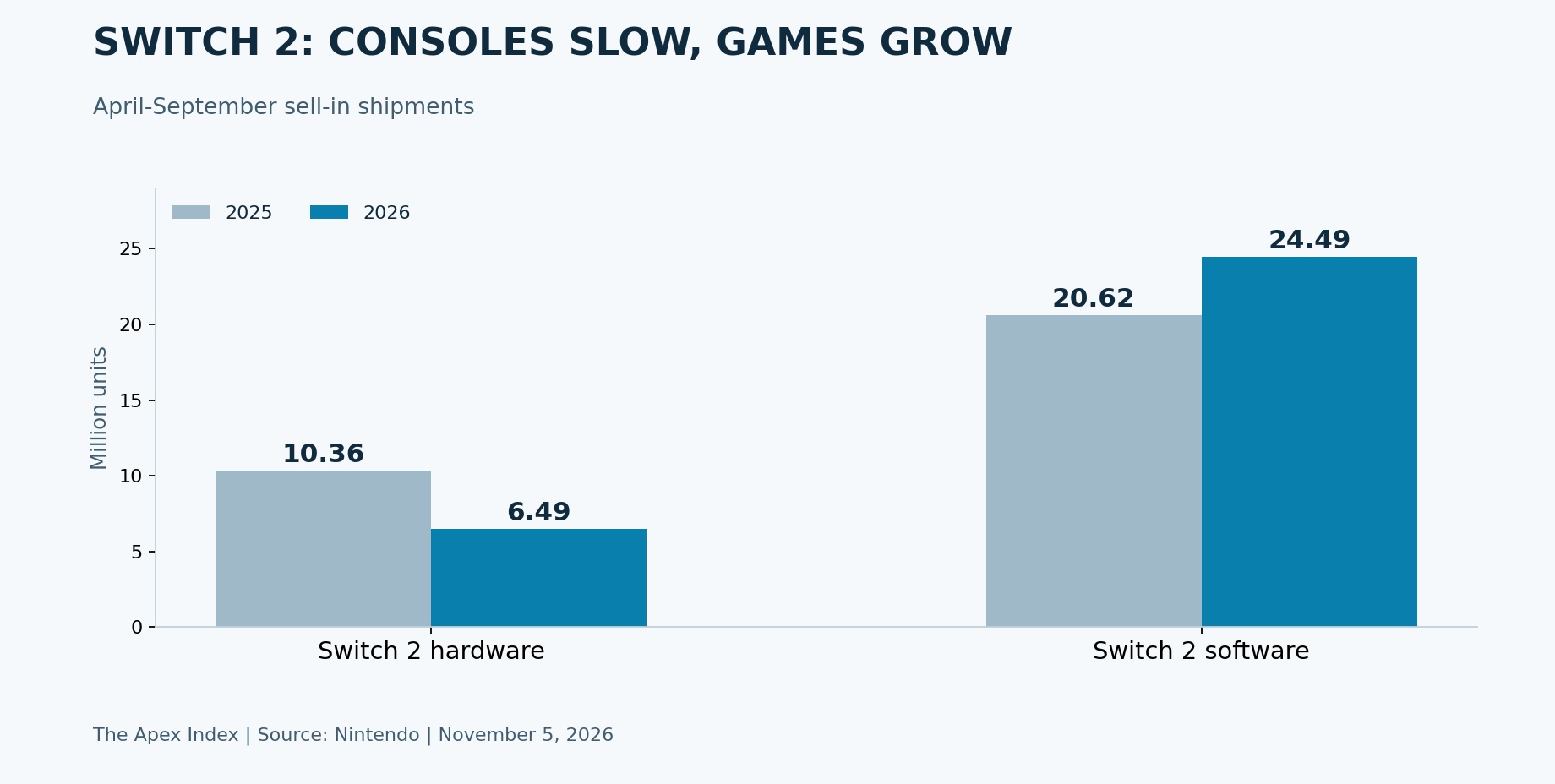
Nintendo shipped 6.49 million Switch 2 consoles during April-September, down 37.4% from 10.36 million a year earlier. That comparison includes the machine's launch period in 2025, when buyers rushed to pick up the new system.
The profit miss was in the second quarter
July-September net profit fell 29% to 73.5 billion yen, according to AFP. That was below the 82.2 billion yen expected in a Bloomberg survey cited in its report.
The six-month picture was stronger. Net profit rose 11% to 220.9 billion yen, while operating profit climbed 49.1% to 216.5 billion yen. Those figures cover April through September, including a first quarter that benefited from a U.S. tariff refund.
In its results, the company tied the improvement in operating profit to steady game sales, a greater contribution from software and the tariff refund. Operating margin widened to 22.4%, from 13.2% a year earlier.
The refund was substantial: approximately $300 million, recorded as a reduction in the cost of sales during April-June. It concerned tariffs imposed under the International Emergency Economic Powers Act that had previously been booked as costs.
The company explained in its presentation:
"The tariffs related to the refunds were primarily borne by the company rather than passed on to consumers through product prices."
That helps explain how Nintendo could report a double-digit revenue decline alongside a large increase in operating profit. Software also made up more of the business as hardware's share of dedicated gaming-platform revenue fell to 54.5%, from 73.2%.
Games sold better than consoles
Switch 2 software shipments rose 18.8% to 24.49 million units. Splatoon Raiders, released in July, sold 2.42 million copies. June's Star Fox reached 1.17 million, while Fire Emblem: Fortune's Weave, released in September, sold 1.34 million. Earlier releases, including Mario Kart World and Pokémon Pokopia, continued selling too.
The original Switch still contributed a large software business. Its game shipments increased 6.8% to 65.73 million units, even as console shipments fell 32.7% to 1.27 million. Tomodachi Life: Living the Dream reached 8.81 million copies, and Rhythm Heaven Groove sold 2.89 million.
Digital revenue increased 60.5% to 249.6 billion yen. Digital sales accounted for 60.7% of software revenue, up 6.2 percentage points. Separately, income from intellectual property and related activities rose 87.9% to 62.7 billion yen, helped by The Super Mario Galaxy Movie.
Nintendo keeps its holiday targets
Despite the hardware slowdown, Nintendo left its full-year outlook unchanged. For the year ending March 2027, it still expects revenue of 2.05 trillion yen, operating profit of 370 billion yen and net profit of 310 billion yen.
Its Switch 2 hardware target remains 16.5 million units. The latest six-month shipment total leaves much of that target to be met during the second half, which includes the Christmas and New Year shopping seasons.
The hardware forecast is below the 19.86 million Switch 2 consoles shipped last fiscal year. Its software target is 60 million units, against 48.71 million previously. This year's software forecast excludes games bundled with hardware, while last year's reported shipments included them. On the older platform, Nintendo's annual plan calls for two million console shipments and 105 million game sales.
The next test arrives immediately. The Legend of Zelda: Ocarina of Time remake launches November 5, adding a major franchise release ahead of the holidays. Nintendo Switch Sports Resort arrived in October, and Metroid Ravenous is scheduled for January.
Nintendo described its approach this way:
"We aim to grow the Nintendo Switch 2 installed base by working to expand sales of existing titles and continuously introducing these new titles."
The company also plans to keep selling games to the original Switch's established audience, alongside its push to bring more players onto Switch 2.