

Benjamin Netanyahu's hold on power faced another test on October 27 as initial Israeli election exit polls left both his bloc and the main opposition short of a parliamentary majority. After about 19 years as prime minister across separate terms, he faces a fight over who can turn seats into a government.
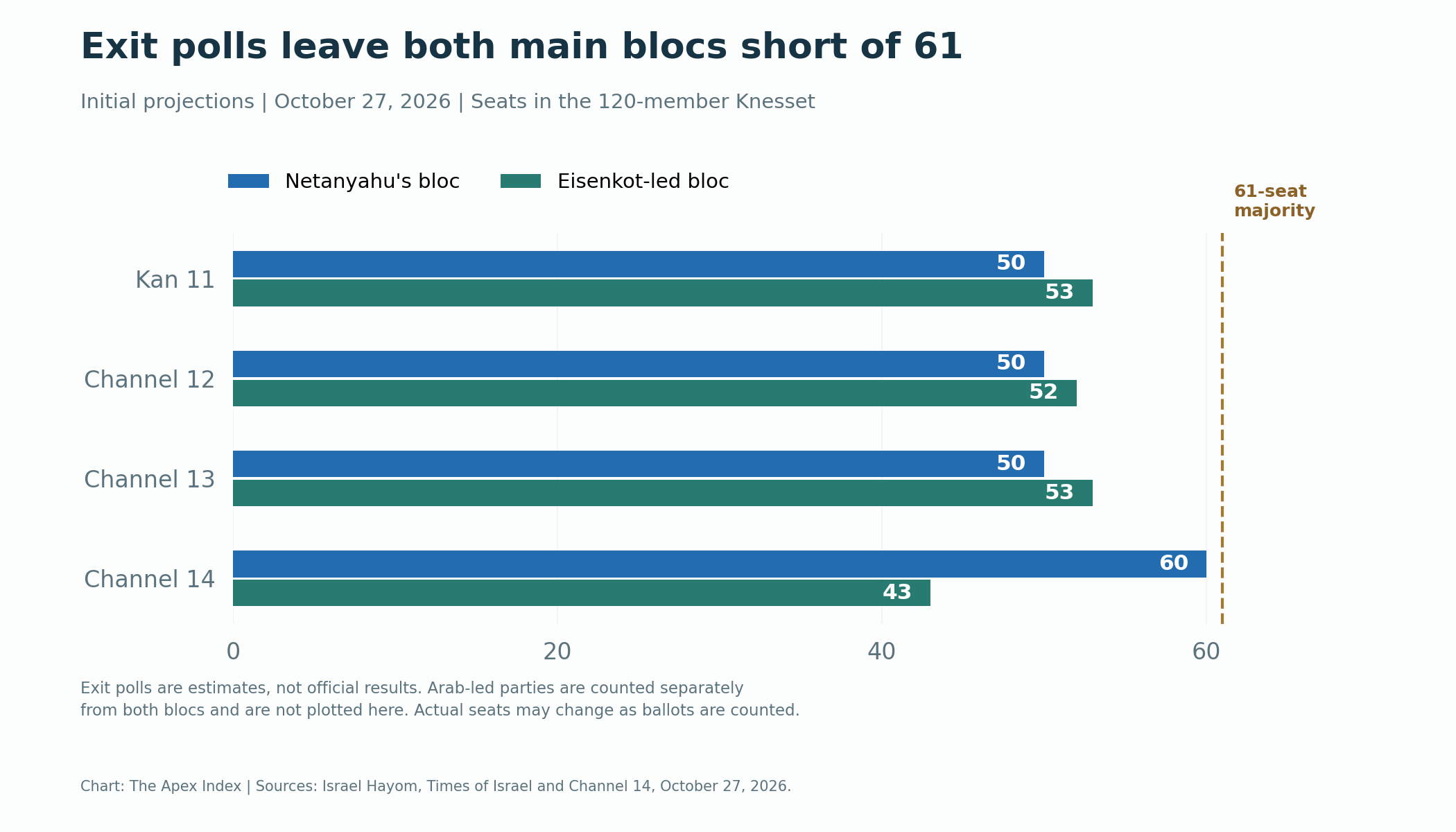
The projections are not final results. Kan and Channels 12 and 13 put Netanyahu's bloc at 50 seats in the 120-member Knesset, against 52-53 for the Jewish-led opposition parties aligned against him. Neither side reached the 61 seats needed for an outright majority.
Likud leads, but the coalition numbers don't add up
The initial polls gave Netanyahu's Likud 24-25 seats, keeping it ahead of Gadi Eisenkot's Yashar party, which was projected to take 21-23. The larger opposition bloc includes parties led by former Prime Minister Naftali Bennett, Avigdor Liberman and Yair Golan.
Channel 14 offered a substantially different projection: 60 seats for Netanyahu's camp, 43 for the opposition and 17 for Arab-led parties. Even that poll left the incumbent's bloc one seat below an outright majority.
Being the largest party gives Netanyahu an argument for getting the first chance to form a government. It does not automatically give him that right. President Isaac Herzog will consult the elected parties and choose the lawmaker he believes has the best chance of assembling a government.
Eisenkot treated the projections as a rejection of Netanyahu, while acknowledging that the count could change them. In a statement reported by The Jerusalem Post, he said:
"If these are the final results, they represent a victory for Israel's national-minded, Zionist majority."
Arab parties hold seats the opposition may need
The main three networks projected 17-18 seats for the Joint List and Ra'am combined. Those parties oppose Netanyahu, but they are counted separately from Eisenkot's bloc because support for an alternative government is not agreed.
As the report explains, opposition leaders have largely ruled out forming a government with Arab parties, with Golan an exception. Eisenkot has also rejected serving under Netanyahu, including through a rotation arrangement. Both positions narrow the options for a deal.
Ra'am leader Mansour Abbas signaled his own ambitions while voting was still underway, telling the Associated Press:
"Our vote will change the government."
A minority government offers another possible route. It would not need 61 lawmakers inside the coalition, but it would need enough support or abstentions to win a confidence vote. Arab parties could therefore influence who takes office without formally joining a government.
A vote shaped by war and accountability
This was Israel's first national election since the Hamas-led October 7, 2023, attacks and the wars that followed. Netanyahu campaigned on his security record and support from U.S. President Donald Trump. His opponents have demanded accountability for the failures surrounding the attacks, including a national inquiry his government has resisted.
Netanyahu also warned of possible Iranian attacks before the vote, as previously reported by Apex. That security debate sits alongside domestic disputes over military service for ultra-Orthodox men and the independence of the judiciary.
Eisenkot is a former military chief who joined Netanyahu's wartime cabinet after the attacks, then quit eight months later. His appeal to voters has centered on replacing Netanyahu's leadership while maintaining a hard line on security.
The next government could take weeks
The first candidate tasked with forming a government normally has 28 days, with a possible 14-day extension. Failure can open the process to another candidate and further parliamentary efforts before a new election becomes necessary.
Netanyahu could remain caretaker prime minister through another prolonged deadlock. Israel held five elections between April 2019 and November 2022, showing how an inconclusive vote can turn into repeated rounds of bargaining and voting.
The official results are scheduled for publication on November 4. Special ballots, including soldiers' votes, can alter the seat distribution and the options for forming a coalition.