

If Jensen Huang doesn't make it back to Nvidia, Lisa Su has a serious opening to take his AI crown. His cousin already knows how to rebuild a chip company that people have written off. Now she has something much more useful than a famous relative: a growing AI business, customers deploying its systems and a leadership job she can get on with while Huang fights to regain his.
Would I hand her the crown today? No. I still regard Huang as the king of AI. Watching Nvidia struggle with the question of who should replace him has made his importance clearer to me. But Su is a formidable competitor, and this is a particularly inconvenient moment for Nvidia to give her an opening.
The cousin who built her own reputation
Su was born in Taiwan and grew up in New York. Her three electrical engineering degrees came from MIT. She worked at Texas Instruments, spent 13 years at IBM and became Freescale's chief technology officer before joining AMD in 2012.
That is the background I care about. She understands the engineering decisions behind the earnings presentation, and she has spent decades learning what it takes to turn those decisions into products customers will buy.
The family connection makes the rivalry entertaining. Su and Huang are distant cousins; genealogist Jean Wu mapped the relationship as first cousins once removed, with Huang's mother a sister of Su's grandfather. Su's own account to Emily Chang explains why they weren't childhood companions:
We were really distant, so we didn't grow up together.
She said they met at an industry event, well into their careers. The connection emerged publicly as their professional rivalry grew. I like that detail: two relatives reaching the top of competing chip companies through separate careers, then finding themselves in the same industry conversation.
Su earned the job, then changed the business
AMD's board appointed her CEO on October 8, 2014, succeeding Rory Read through a succession plan. She had been chief operating officer, responsible for pulling product strategy, sales and operations together. The board was promoting someone already doing much of the difficult work.
The financial record shows the scale of what followed. Annual revenue rose from $5.506 billion in 2014 to $34.639 billion in 2025, a gain of about 529%. The starting year includes months before she became CEO, but the long-term direction is unmistakable.
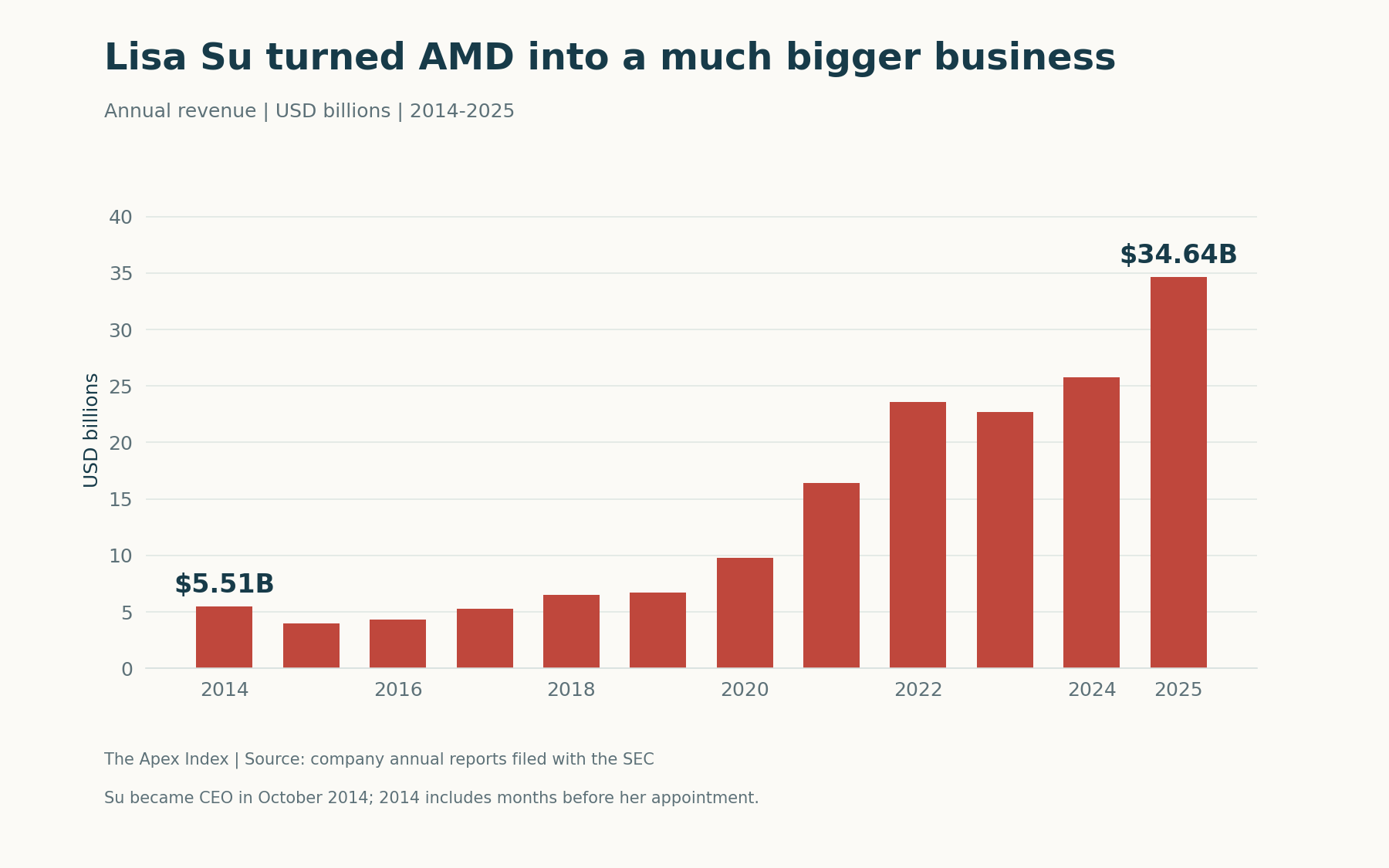
I think she has the strongest claim to being AMD's best CEO. The recovery has grown into a business capable of supplying major AI infrastructure customers, alongside its server and PC products.
The current results are stronger still: third-quarter revenue reached $13.4 billion, up 45%, while data center sales increased 97% to $8.5 billion. AMD reported $2.4 billion in net income and forecast roughly $17 billion in fourth-quarter revenue.
Su said:
We delivered a record quarter with revenue exceeding the high end of our guidance as Data Center segment sales nearly doubled year-over-year.
Huang built a kingdom worth challenging
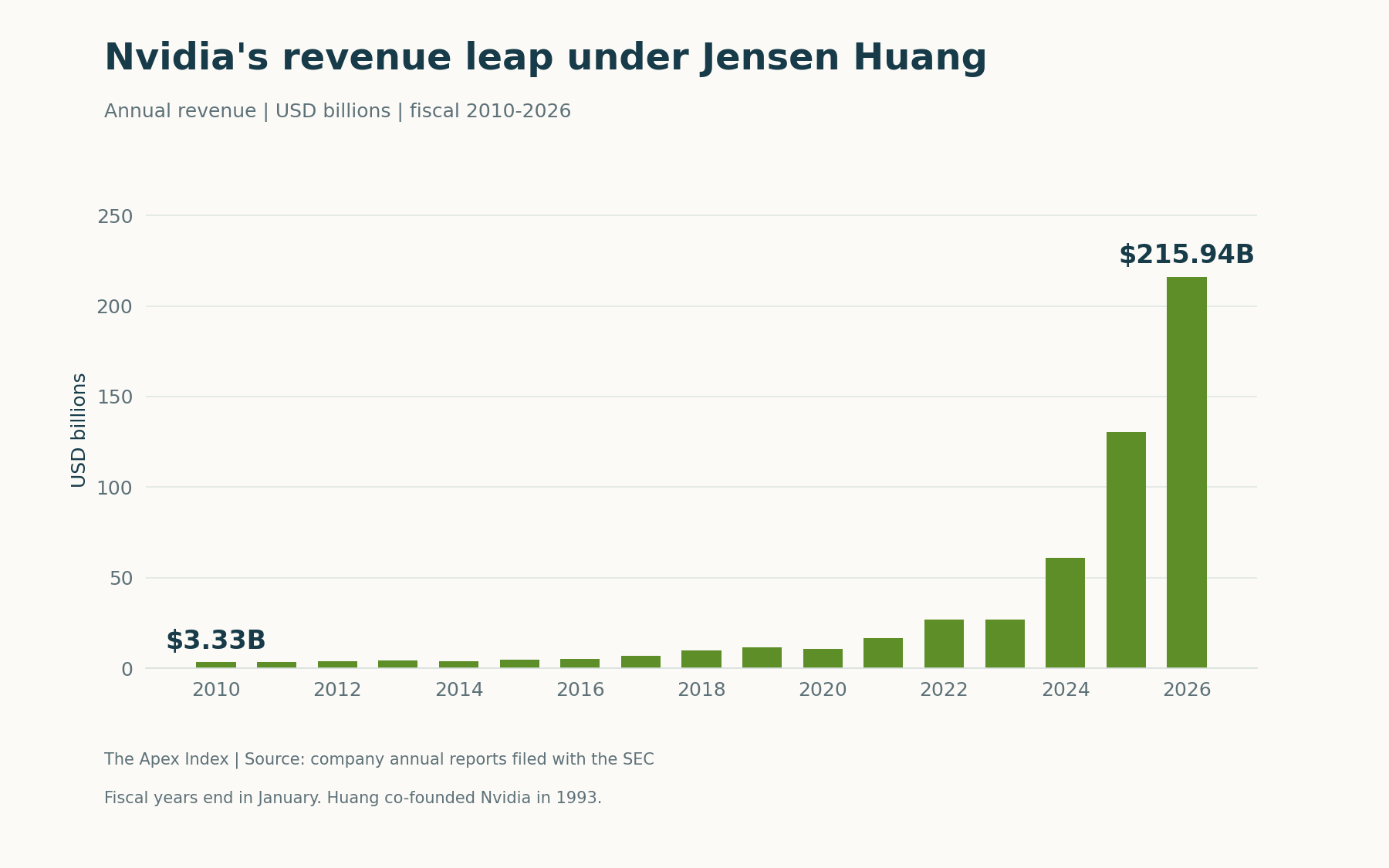
Now look at what she is chasing. Nvidia's annual revenue rose from $3.326 billion in fiscal 2010 to $215.938 billion in fiscal 2026. Its latest reported quarter produced $96.2 billion in revenue, including $89 billion from data centers.
Those figures explain why I won't confuse AMD's momentum with an accomplished takeover. Huang helped build an enormous business around accelerated computing. His influence reaches customers, developers, suppliers and governments. Replacing that combination takes more than appointing a competent executive.
As previously reported by Apex, Huang has said he would accept a comeback. He has also agreed to congressional questioning on December 1, as detailed in the report linked above. His next chapter involves directors and lawmakers. Su's involves executing a production ramp.
AMD says Anthropic, Meta, Microsoft, OpenAI and Oracle Cloud Infrastructure are running workloads on its first Helios systems. That is where I would focus as an investor: customers actually using the alternative, and how much of that use turns into repeat orders, revenue and profit.
The market has already rewarded Su
Over the past two years, the share-price contest has favored AMD decisively. From November 18, 2024, through November 16, 2026, its split-adjusted closing price rose about 263%. Nvidia gained roughly 11%. Those are price returns, excluding dividends, calculated from TradingView data.
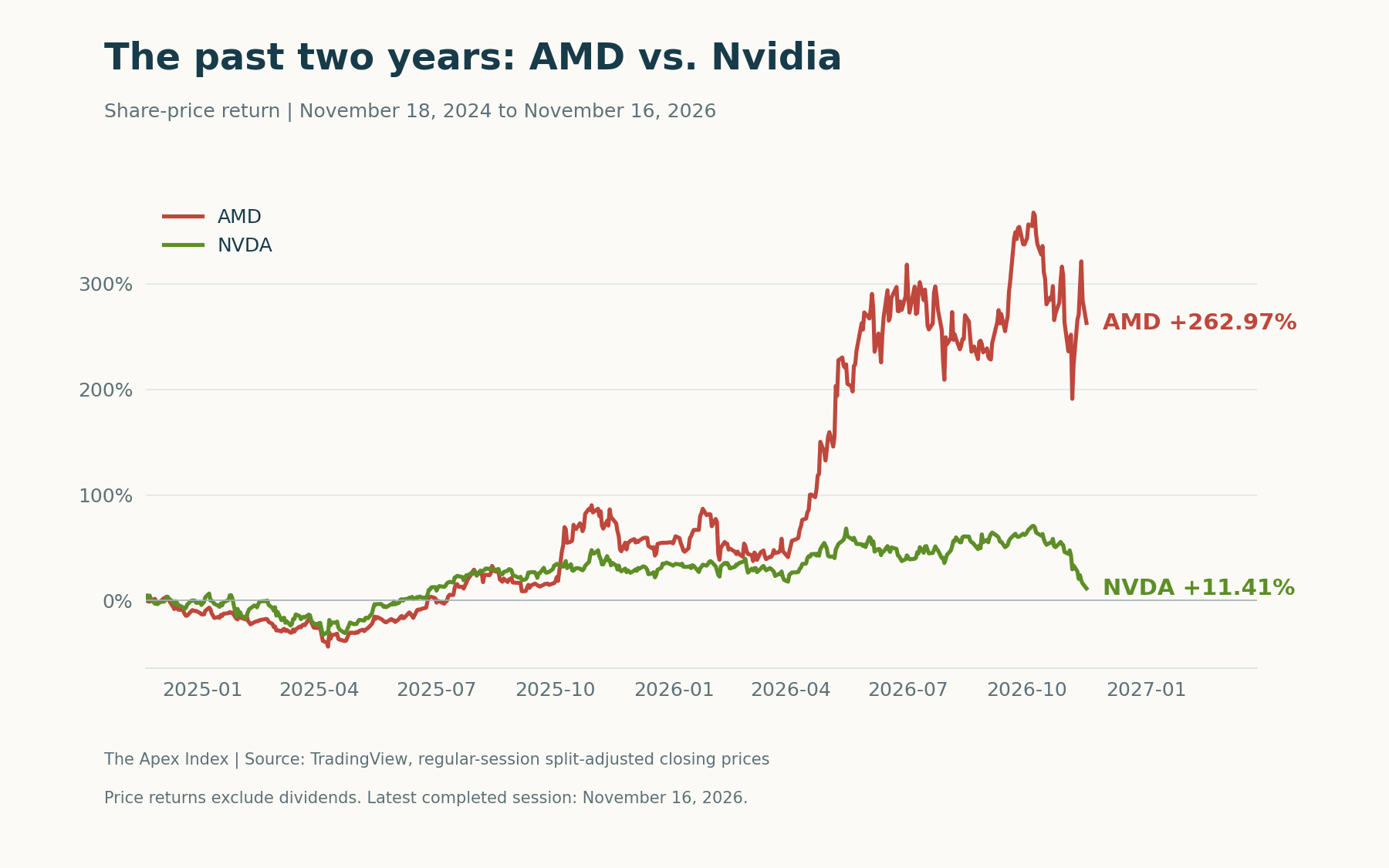
A rally that large also raises the bar. Su has to deliver enough growth to justify the enthusiasm. Investors buying AMD because Nvidia has a leadership problem still need AMD's own numbers to work.
My answer to the crown question is yes, she could take it. I would give her a better chance if Huang remains outside Nvidia and the company spends months sorting out its leadership. But the decisive contest will be fought in customer deployments, software, production and profits. Su has earned her place in that fight. Her cousin's throne is suddenly looking less comfortable.