
Borrowing to buy Kioxia's AI rally has left Japanese retail investors with losses and a repayment clock. An early-October estimate put their unrealized losses at roughly $280 million, while the shares have since fallen further.
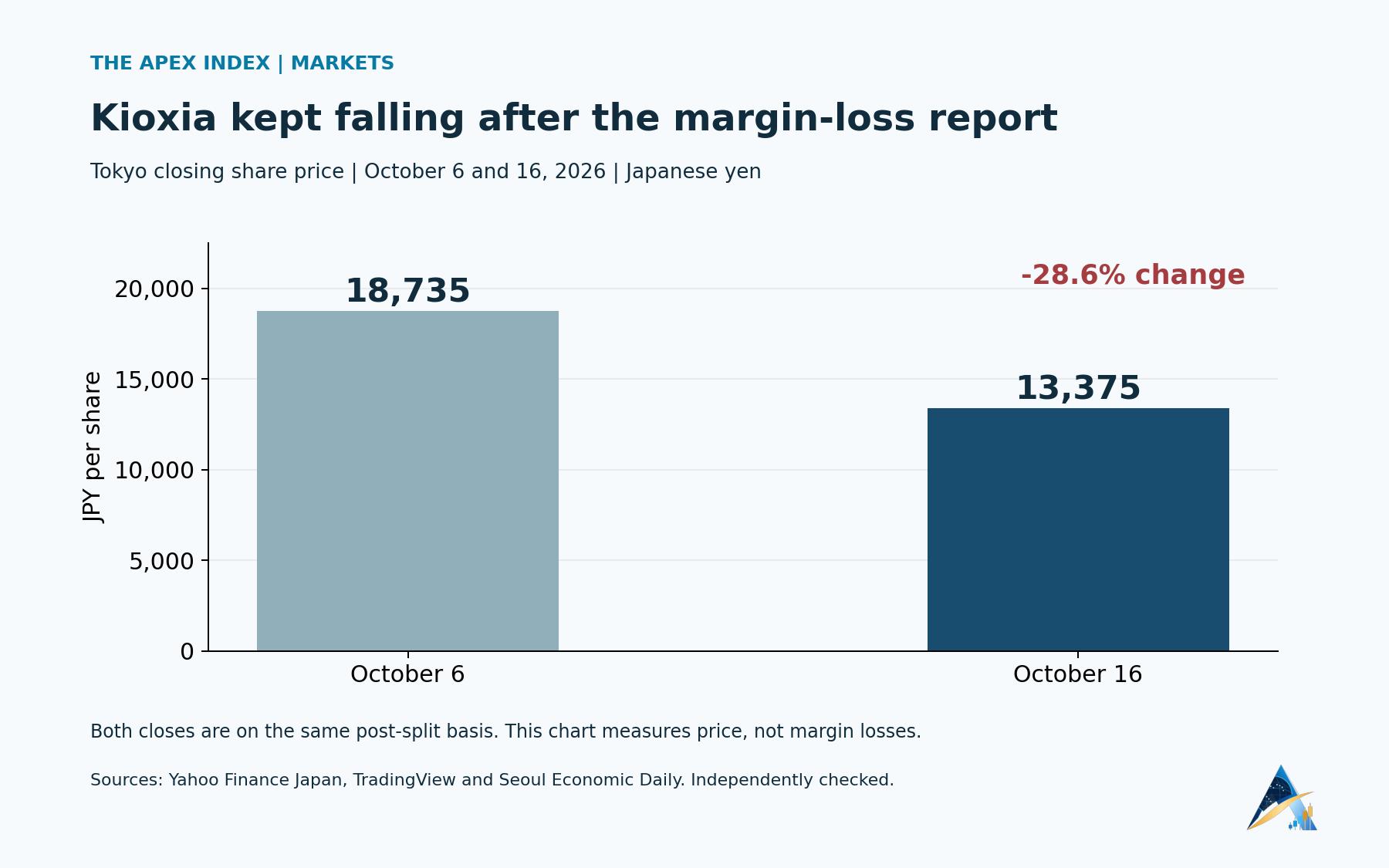
The figure is a snapshot, not a new tally of losses booked this weekend. It comes from an estimated 48.3 billion yen shortfall on margin positions as of October 2. Kioxia finished October 16 at 13,375 yen, down 28.6% from its October 6 close, even after a 3.8% rebound on Friday.
The borrowed-money trade has an overhang
Bloomberg reported on October 18 that accumulated positions from investors who borrowed to buy Kioxia could put further pressure on the shares as those holders face selling at a loss.
The earlier Nikkei figures, carried by Seoul Economic Daily, put the acquisition cost of outstanding margin-buying positions at 848.7 billion yen as of October 2. That is the purchase value of financed positions, including investors' own money, rather than a measurement of borrowed funds alone.
Kioxia's September 29 stock split gave investors three shares for every one they held. Both closing prices in the chart below are after that split, keeping the comparison on the same basis.
The shares had attracted buyers expecting AI investment to lift demand for memory. Those investors now have to decide how long they can afford to hold the trade, particularly when their financing comes with a settlement deadline.
Investors cannot simply wait forever
Japan Exchange Group explains the mechanics this way:
A margin transaction is a transaction which uses funds or securities that the customer has borrowed from a securities company after making a deposit of collateral (margin) to said securities company. Repayment is made mainly through reverse trades within a predetermined time frame.
Under standardized margin trading, the settlement deadline is up to six months. Negotiable margin trading has terms agreed between the investor and broker. The timing therefore depends on when a position was opened and which arrangement the investor used.
That creates a problem even for someone who still believes in AI-driven memory demand. A business outlook can improve over several years while a borrowed-money position has to be settled much sooner. A rebound can also become an opportunity for trapped holders to exit, limiting how far the recovery runs.
The positioning was unusually one-sided
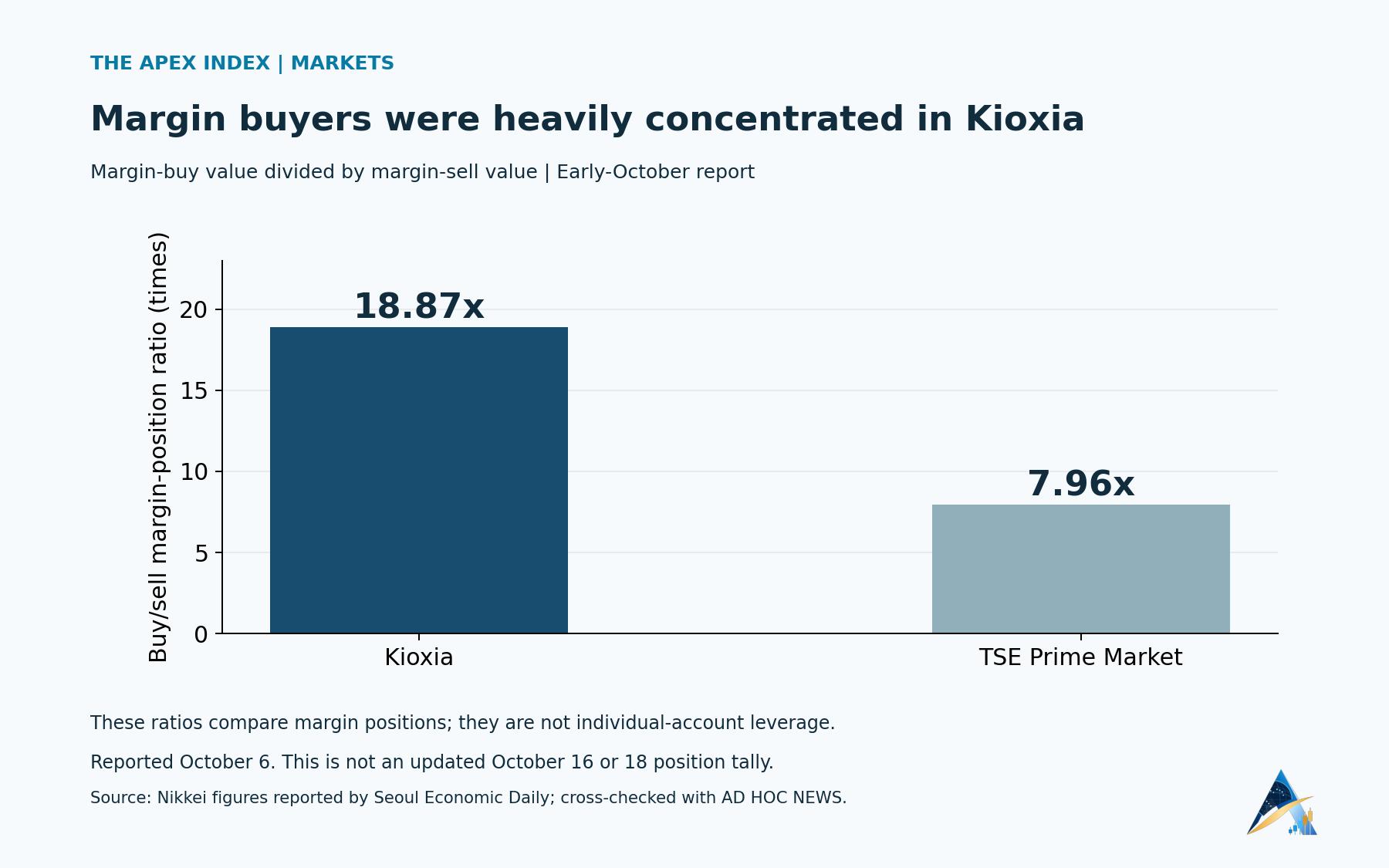
The early-October report put Kioxia's margin-buy to margin-sell value ratio at 18.87 times, compared with 7.96 times for the Tokyo Stock Exchange's Prime Market overall.
That comparison shows how heavily outstanding margin positions leaned toward buying the stock. It describes the balance between long and short margin positions, rather than the borrowing multiple in any individual account.
The company tells a stronger business story
The pressure on shareholders sits alongside an improving assessment of Kioxia's finances. In an October 13 announcement, the company said:
Kioxia Holdings Corporation, a world leader in memory solutions, today announced that its long-term issuer credit rating from S&P Global Ratings was upgraded to "BBB", and that its outlook has been deemed to be "Positive".
The company attributed the upgrade to profitability supported by AI-focused data centers and enterprise demand for flash memory and solid-state drives. It also said cash and deposits exceeded debt, giving it a net cash position.
Those are company-level financial claims. The margin loans in this story belong to investors buying its shares. A healthier corporate balance sheet does not repay those investors' brokerage borrowing.
The next scheduled company test is its second-quarter fiscal 2026 results on October 30, according to its investor-relations calendar. Until then, Kioxia holders are balancing an AI growth thesis against a much shorter financing timetable. Friday's rebound offered some relief, but the stock remained well below where it traded when the early-October losses were reported.