


AI-assisted illustration based on an NVIDIA press portrait.
CoreWeave has billions of dollars of contracted business, yet its shares keep falling. Jensen Huang says the demand for AI computing is there. The hard part is finding the money to build enough of it.
The Nvidia-backed company had roughly $52 billion in combined debt and operating lease liabilities at June 30. Its stock was down 3.86% at $59.44 at 13:57 UTC on October 22, according to Nasdaq, as investors continued to question how the AI infrastructure expansion will be financed.
Speaking in a CNBC interview on October 22, Huang defended the specialized cloud providers, known as neoclouds, that rent out computing power for AI:
"The demand for the neoclouds is off the charts."
His explanation for the strain was a shortage of financing:
"Because there's just so much demand across so many sectors of AI, there's a scarcity of capital."
Huang did not name CoreWeave in that interview, Business Insider reported. He was defending the sector's demand and arguing that its funding shortage can be solved. The company has become a prominent test of whether those two things can be brought into balance.
What the $52 billion figure includes
CoreWeave's June 30 filing records $35.551 billion of debt principal and $16.319 billion of operating lease liabilities. Together, they come to $51.87 billion. That is the basis for a roughly $52 billion financing burden, with loans and lease liabilities counted separately.
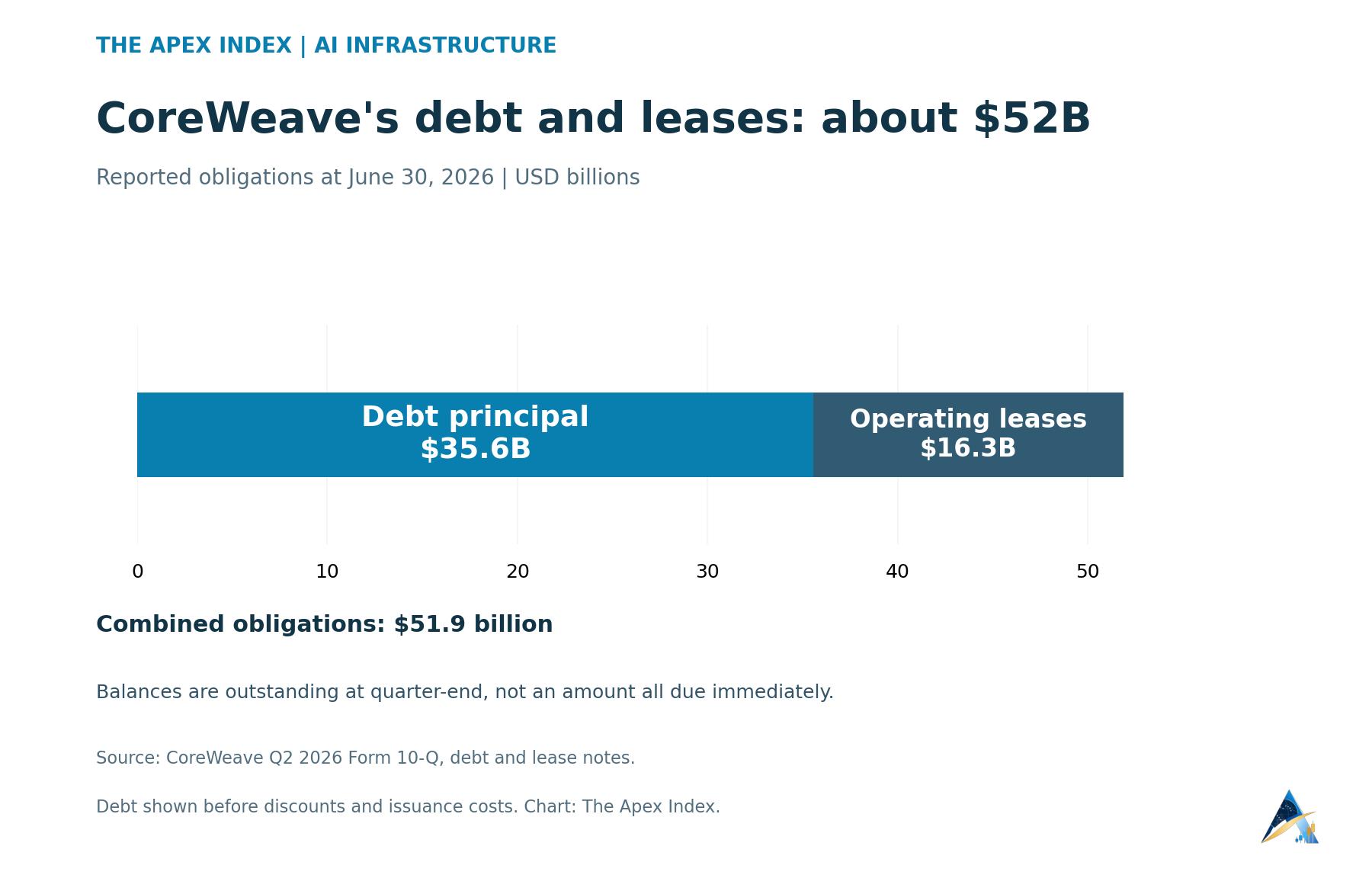
Those obligations run over several years. The quarter-end debt schedule put $4.4 billion of principal payments in the second half of 2026 and $6.2 billion in 2027. The total balance therefore describes the scale of the commitments, rather than a single bill falling due today.
CoreWeave also warned that its business depends on continued access to additional debt and equity capital. Expanding a cloud network means committing money to equipment and facilities while customer contracts are fulfilled over time. A company can have a busy order book and still need lenders willing to finance the next stage.
The interest bill is rising
The second-quarter results show how expensive that financing has become. Revenue more than doubled from a year earlier to $2.575 billion, but net interest expense reached $640 million, up from $267 million. The company recorded a $626 million net loss.
There is substantial business waiting to be delivered. CoreWeave reported about $104 billion of revenue backlog at June 30. Its regulatory filing separately listed $103.7 billion of unsatisfied remaining performance obligations, with 41% expected to be recognized over the following 24 months, through June 2028.
The company's backlog definition ties future revenue to delivery and service-availability requirements. Bringing computing capacity online, then providing the service customers have contracted for, is what turns those commitments into reported sales.
That helps explain why strong demand alone has not settled the financing debate. Revenue growth, interest costs and the timing of repayments all matter to a business building infrastructure at this pace.
Nvidia has money riding on the outcome
Nvidia is both an investor in CoreWeave and a supplier of the chips powering its cloud. In January, the companies announced another $2 billion Nvidia equity investment and an expanded collaboration aimed at building more than five gigawatts of AI factories by 2030.
Their agreement also called for using Nvidia's financial strength to accelerate CoreWeave's procurement of land, power and building shells. The relationship extends beyond selling processors: Nvidia has committed capital to a customer whose expansion creates demand for its equipment.
Huang is also trying to make that equipment easier to finance. He told CNBC that Nvidia's computing hardware is becoming a financeable asset class, with its useful life and productivity helping support lending to cloud providers.
CoreWeave's filing identifies the risk on the other side of that argument. Higher rates on its existing floating-rate debt, or more expensive new borrowing, could increase financing costs and hurt its financial performance. Getting more capital through the door is only part of the job; the terms attached to it matter too.