

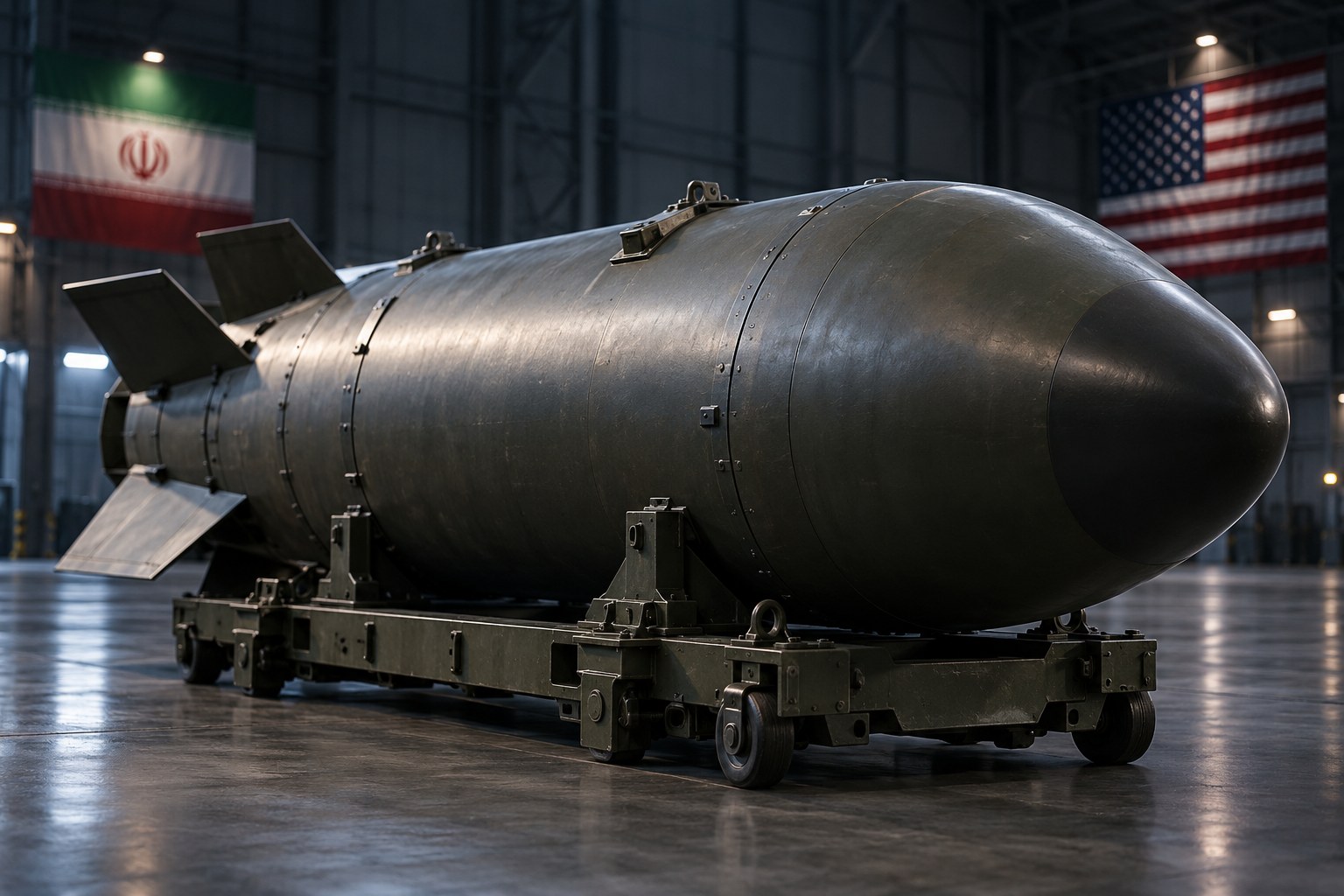
Iran is answering Donald Trump's talk of the "mother of all bombs" with a promise of its own: a "father of all bombs" that the Revolutionary Guard says it is preparing to unveil.
The announcement came on October 21, but without specifications or an unveiling date. There is no independently verified information establishing what the proposed Iranian weapon can do, how it would be delivered or whether it has been tested.
IRGC spokesman Hossein Mohebi made the remarks in statements carried by Iran's Young Journalists Club, according to Anadolu. In the news agency's English translation, he said:
"We are in the stage of preparing to unveil the ‘father of all bombs.’ This is something new for the enemy."
Mohebi also claimed that Iran's missile stockpile had increased by a factor of 1.5 since the 12-day war with Israel in June 2025. He said the missiles' range, destructive power and accuracy had improved, without supplying inventory figures. These were claims about Iran's broader arsenal, rather than specifications for the newly promised weapon.
The current confrontation follows the U.S.-Israeli war launched against Iran on February 28. Washington and Tehran signed a memorandum of understanding in June, but subsequent negotiations collapsed over navigation and security in the Strait of Hormuz.
Iran describes a change in its response
Mohebi framed the announcement as part of a shift toward what he called permanent and absolute deterrence:
"Previously, Iran’s defense doctrine was purely defensive. We used to say that if a country attacked us, we would respond. Now, we say that if a country attacks us, we will not only respond but also launch an offensive."
He also said the military would increasingly rely on asymmetric warfare.
Trump has left the option open
The American side of the exchange has a weapon with a documented design and combat history. MOAB is the nickname for the GBU-43/B Massive Ordnance Air Blast bomb, a conventional munition weighing roughly 21,600 pounds.
Trump discussed it in a Newsmax interview published on October 15, according to Al Jazeera's report. He stressed that he was not proposing a nuclear attack and declined to say whether he had authorized MOAB's use against Iran.
"Well, the mother of all bombs is not nuclear. It’s not nuclear at all. This is just an extremely large bomb."
He also said he did not foresee sending American ground troops into Iran. His comments followed reporting that U.S. planners were considering MOAB among options for further attacks on Iranian energy infrastructure and nuclear sites.
As previously reported by Apex, those options included Pickaxe Mountain, where Washington and Israel believe Iran has stored nuclear-program components.
A big blast has limits underground
The Defense Department's own description explains the problem. MOAB has a relatively thin aluminum casing built to burst on a surface, producing a large blast with less fragmentation. Deep penetration is a different task.
The weapon is GPS-guided and about 30 feet long. The military's account describes it being carried aboard a C-130 transport aircraft on an airdrop platform. A parachute pulls the platform from the aircraft; the bomb then separates, with fins stabilizing and guiding it toward the target.
MOAB was developed in nine weeks in 2003 for possible use in the Iraq war, though it was never used during that conflict. The United States first used it in combat on April 13, 2017, against an Islamic State tunnel complex in Afghanistan.
Pickaxe Mountain is why the distinction matters in the current strike planning. Officials familiar with the options told CNN that MOAB was designed for large-area clearance and could fall short against the mountain's suspected underground facilities. They also warned that using such a powerful blast against infrastructure near populated areas could endanger civilians and nearby non-military sites.