

Intel shares plunged after Thursday's earnings report as a weak sales forecast and damage from an explosion at an Israeli factory overshadowed a sharp jump in quarterly revenue. The company warned that the PC slowdown would continue into 2027, even as demand for its server chips remained strong.
The chipmaker reported third-quarter revenue of $16.5 billion, up 21% from a year earlier. Adjusted earnings reached 52 cents a share, beating the 40-cent estimate compiled by LSEG. Sales were broadly in line with expectations.
At 20:21 UTC on October 29, Nasdaq data showed the stock at $76.59, down 16.81% from its $92.07 regular-session close. That after-hours decline came on top of a 3.62% drop during the trading day. Prices were still moving, with earlier extended trading also showing losses exceeding 20%.
The fourth-quarter forecast was the problem
For the current quarter, Intel expects revenue of $15 billion to $16 billion. The midpoint, $15.5 billion, is about 6.1% below the quarter it just reported. Analysts had expected $17.07 billion, according to LSEG figures reported by Reuters.
The earnings outlook also fell short. Management forecasts adjusted profit of 25 cents a share, compared with Wall Street's 43-cent estimate. Its projected adjusted gross margin is 38%, down from 44.1% in the third quarter. That would leave less profit from each dollar of sales before operating expenses.
Chief Financial Officer David Zinsner put the PC warning plainly in the company's release:
Looking ahead, we see the PC slowdown continuing at least through the first half of next year, but we remain optimistic about the opportunities across our broader portfolio, and we will continue making disciplined investments in capacity and working capital to increase supply and support future growth.
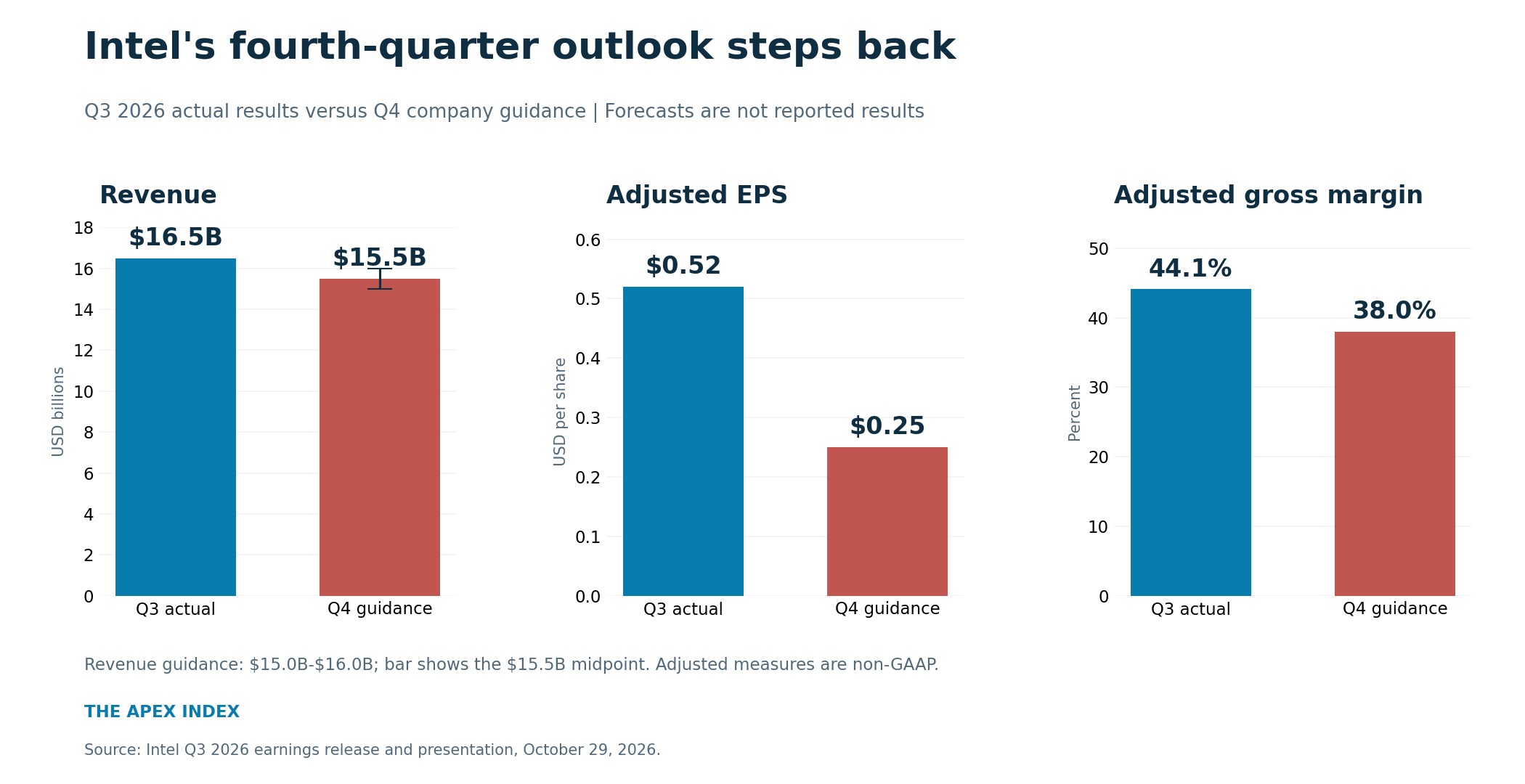
The latest results did exceed Intel's own July forecast. Its earnings presentation showed revenue $200 million above the midpoint of that outlook and adjusted earnings 14 cents above guidance. The new forecast points to a step back from that performance.
A factory shutdown adds to the pressure
Zinsner told Reuters that an October explosion at Intel's Kiryat Gat factory in Israel cut roughly $300 million from the fourth-quarter revenue outlook and about two percentage points from gross margin. The facility did not operate for two weeks, and the company was still checking which partly manufactured chips could be used or sold.
He said Intel expected a similar revenue impact in the first quarter of 2027. Production was expected to start ramping up again by the end of this week, but the full damage was still being assessed:
We're still assessing all of the wafers to see which ones are usable and which ones aren't, so we'll have to see whether there is an impact that stretches beyond that.
Yahoo Finance separately reported that the explosion was unrelated to the war. The plant largely makes data-center chips using Intel's Intel 10 manufacturing process, adding a supply problem to a business where demand is already strong.
AI growth is real, but so are the costs
Data Center and AI revenue rose 78% to $7.3 billion in the third quarter. Meanwhile, the Client Computing and Physical AI Group, which includes PC chips, brought in $8.1 billion, down 5%. The two businesses are moving in very different directions.
Chief Executive Lip-Bu Tan said:
Our immediate priority is to unlock additional supply to meet extraordinary demand for our Xeon family, while strengthening our product portfolio and roadmap.
As previously reported by Apex in the related coverage, Intel had benefited earlier this month from an analyst upgrade tied partly to demand for AI computing. Thursday's forecast put PC weakness and manufacturing constraints back in focus.
The expansion also needs funding. Intel raised its 2026 capital spending forecast to $20 billion from $18 billion in July and said spending would increase significantly in 2027. Its foundry business still posted a roughly $1.9 billion operating loss for the third quarter, according to the earnings presentation.
The company completed a $23 billion share offering during the quarter to support future investment. Operating cash flow was $5.1 billion, and adjusted free cash flow was $1.6 billion.