

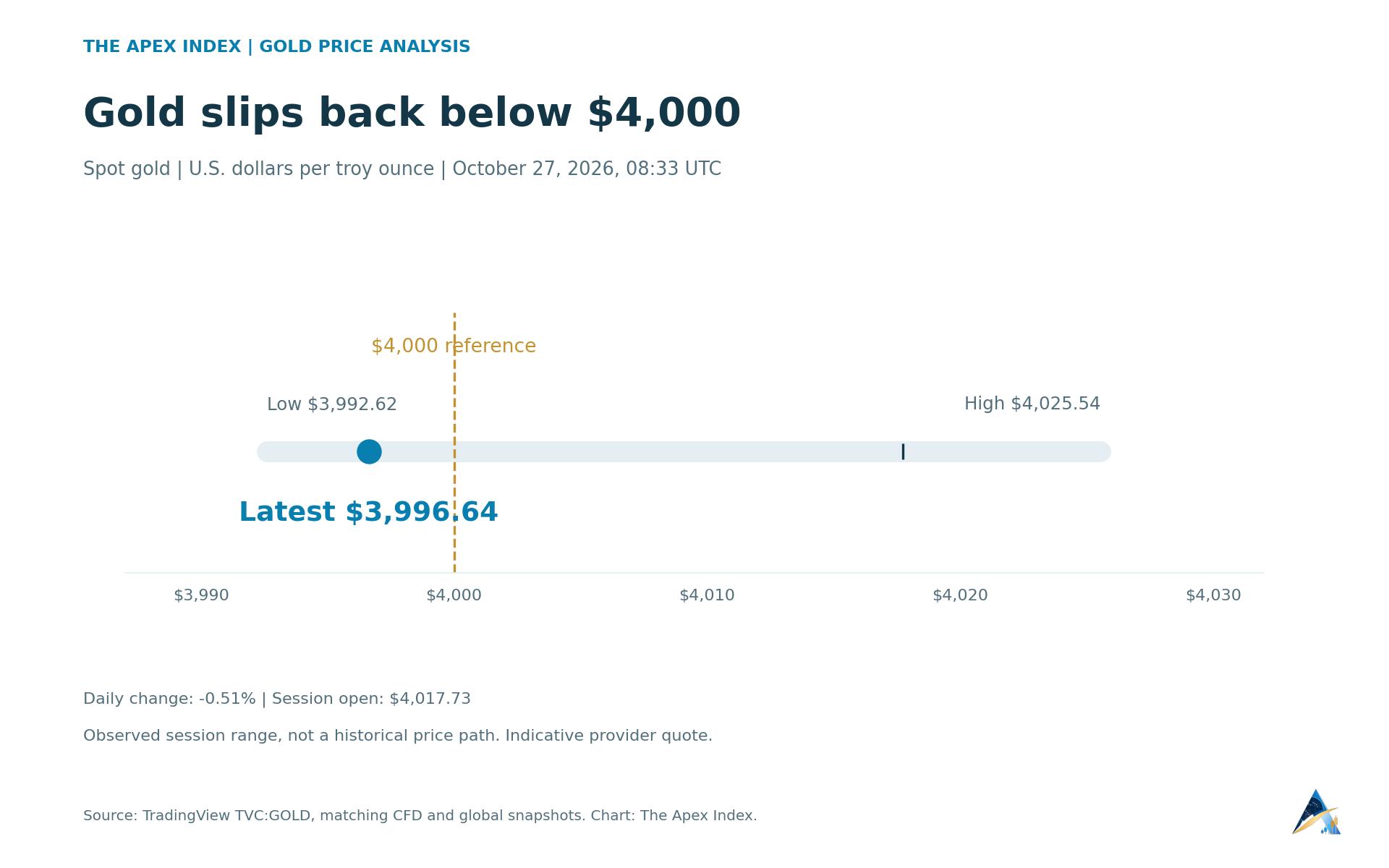
Gold is having trouble holding $4,000, even as buyers in China treat the pullback as a chance to get in. Spot gold traded at $3,996.64 a troy ounce at 08:33 UTC on October 27, down 0.51% on TradingView's indicative feed after reaching $4,025.54 earlier in the session.
Chinese households' appetite for the metal has grown over the past two months as prices have fallen and local stocks have lost their appeal, Bloomberg reported on October 27. That gives gold a source of buying while traders wait for Wednesday's Federal Reserve decision. The question for anyone buying now is whether that demand can hold prices up against pressure from interest rates and the dollar.
Chinese buyers see an opening
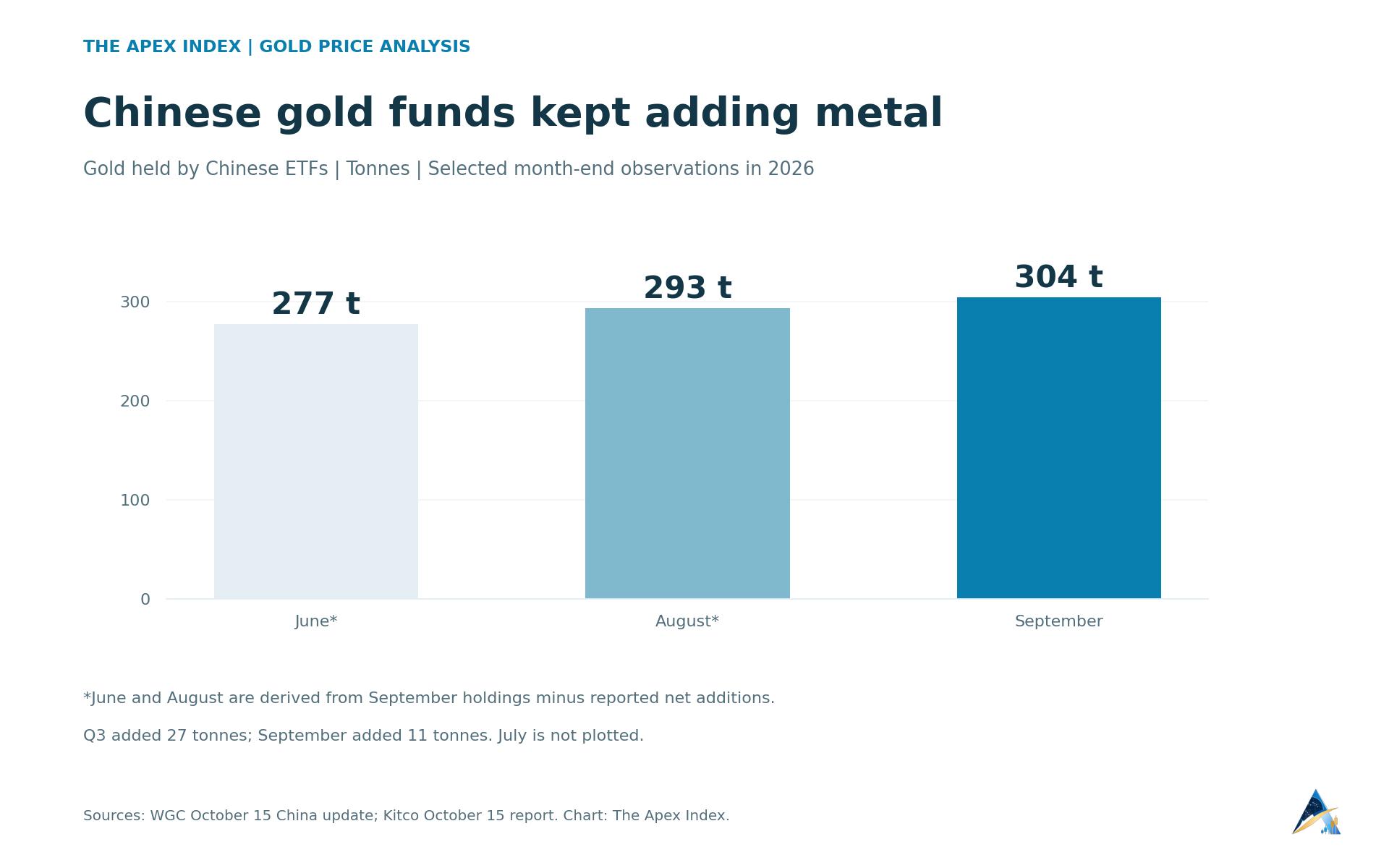
There is already evidence of investment money moving into gold. The World Gold Council's October 15 review put Chinese gold ETF holdings at a month-end record of 304 tonnes in September. Funds added 11 tonnes that month and 27 tonnes across the third quarter.
These funds let investors buy exposure to gold through exchange-traded shares rather than taking bars home. Falling Chinese government bond yields also made holding gold less costly in terms of the interest investors give up, the report said.
Its author, Ray Jia, wrote:
"Demand in Q3 has been influenced by rising portfolio diversification needs in the face of plunging local equities."
That creates two different reasons to buy the same asset: some people want to pay less for gold, while others want somewhere else to put their money when stocks disappoint. Neither requires an immediate recovery in jewelry spending.
Buying the dip doesn't mean all demand is strong
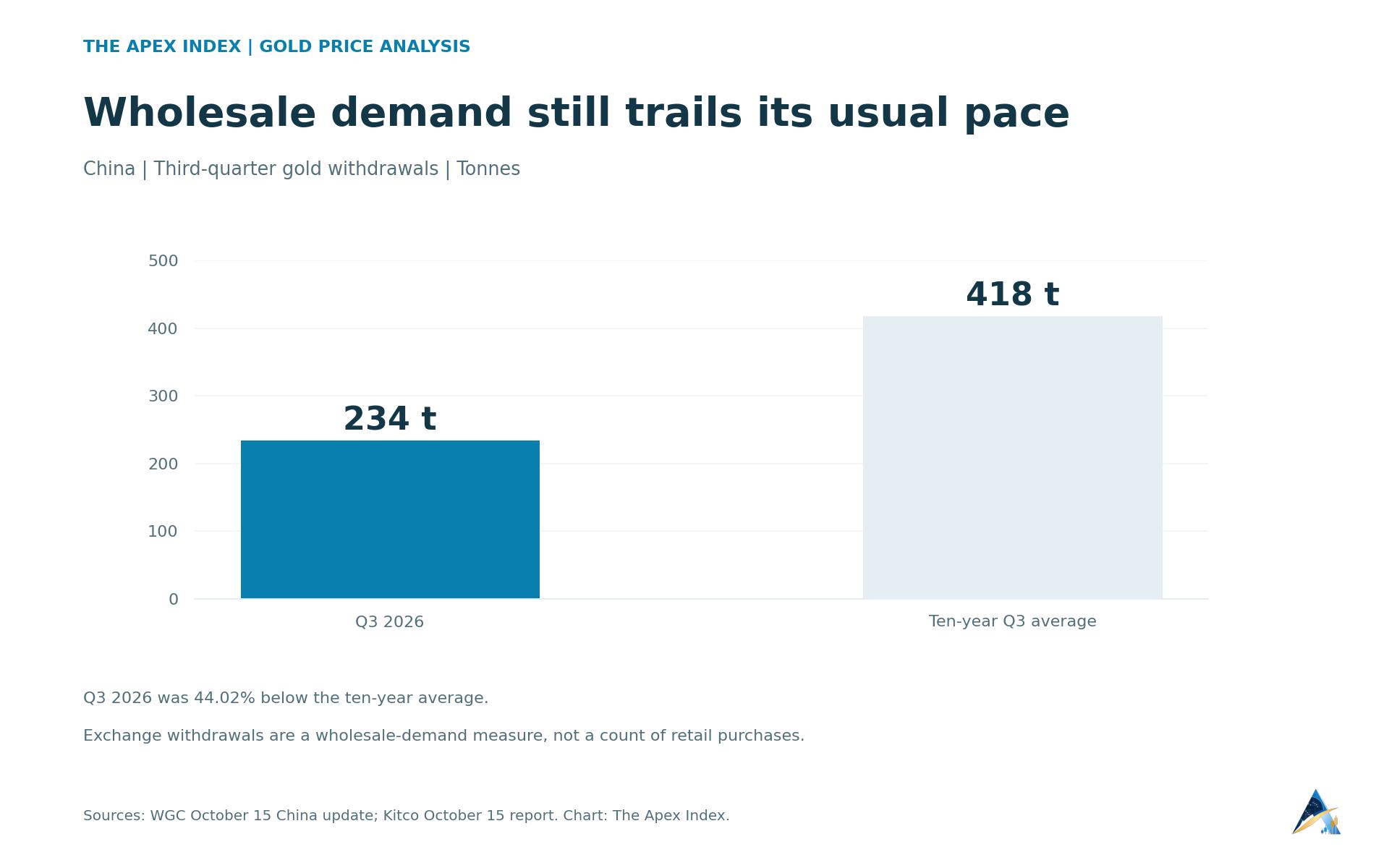
The physical market tells a less cheerful story. China's third-quarter wholesale gold demand totaled 234 tonnes, down 21% from a year earlier and 44% below its ten-year average of 418 tonnes. Weak jewelry consumption was the main drag, according to the same October 15 review.
Those figures concern exchange withdrawals, a measure of wholesale demand. They sit alongside stronger ETF buying rather than contradicting it: investment funds can attract money while jewelers need less metal. September's figures also describe a completed month, not the number of people buying gold today.
For the price, the distinction matters. Investment demand could help absorb selling, but a recovery spread across funds, bars and jewelry would have more sources of buying behind it. Today's household interest is encouraging for gold owners; it doesn't establish that the market has found its low.
Why the Iran war hasn't guaranteed higher gold prices
Gold pays no interest. When inflation worries keep borrowing costs high, interest-paying assets give investors a reason to hold something else. A stronger dollar can also make dollar-priced gold more expensive for buyers using other currencies.
Rob Haworth, senior investment strategist at U.S. Bank Wealth Management, described those pressures in an October 26 Kitco interview. He argued that the Iran conflict was keeping central banks focused on energy security and making a sustained gold recovery harder.
"I think the pressure probably stays here in the gold market as long as the conflict is in place," he said.
He also saw limited room for a strong physical-demand recovery in China and India given their economic difficulties. That is his assessment, rather than proof that Chinese buying will fade. It does explain why a report of bargain hunters needn't lead every investor to the same conclusion.
The gold price levels that matter now
The immediate test is whether gold can recover $4,000 and keep trading above it. Tuesday's observed range ran from $3,992.62 to $4,025.54 when the snapshot was taken. A move through the session high would offer a stronger sign of buying than another brief crossing of the round number.
There is a larger hurdle above that. TradingView's daily indicators put the 20-day simple moving average at $4,122.01, the 50-day at $4,285.68 and the 200-day at $4,507.29. These are running provider readings, which can change before the session closes.
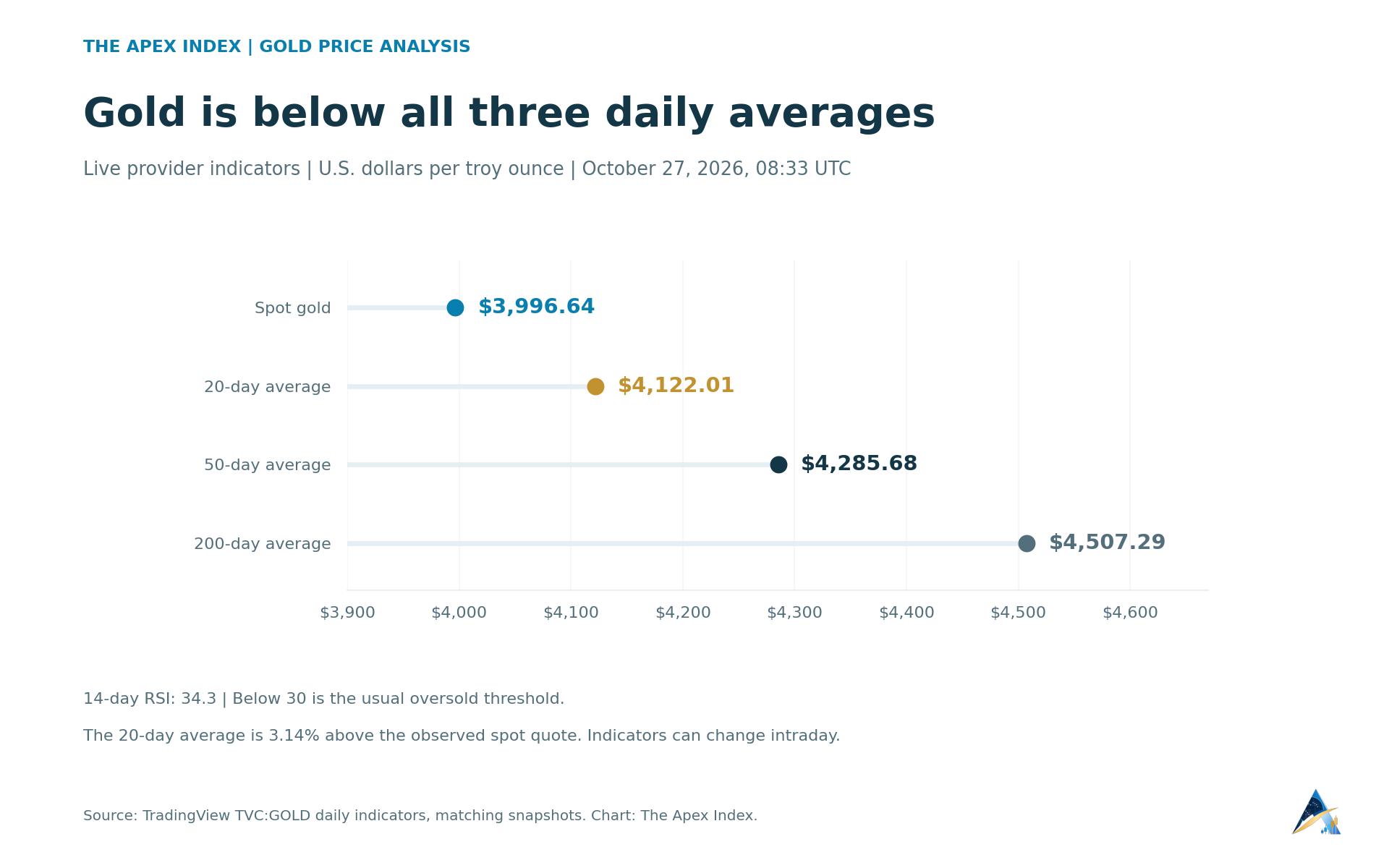
Price is below all three averages, and the shorter averages are below the longer ones. That is a bearish setup: recent prices have been weaker than the longer-term trend. Reaching the nearest average would require a gain of about 3.14% from the observed quote, so regaining $4,000 alone would leave a fair amount of ground to recover.
The 14-day relative strength index was 34.3. RSI measures the balance of recent gains and losses; below 30 is the usual oversold threshold. This reading shows weak momentum without having crossed that threshold. Even an oversold reading would not guarantee a bounce.
On the downside, another break below the measured session low would weaken the immediate rebound case. Below that, $3,950 and $3,900 are round-number checkpoints to watch, not historically verified support levels or price targets. The analysis would improve if gold held above the session high and then recovered its 20-day average.
The Fed's October 27-28 meeting gives traders their next scheduled policy decision. For gold, the useful thing to watch is how the dollar and bond yields respond to the bank's message. If those pressures ease, Chinese dip buyers would have less to fight against.