
Elon Musk has given Micron a public endorsement on the issue its customers care about most: the bill. He praised the memory maker's future chip prices on October 13, accusing unnamed competitors of charging too much and arguing that Micron was building lasting customer loyalty.
The compliment arrived after a rough trading day. MU closed at $953.19, down 3.62%, before Musk's pricing post appeared. His earlier warning about China's manufacturing power explains why praise from a major technology customer does not settle the bigger argument over memory stocks.
Musk's praise comes with a warning
In his latest post, Musk wrote:
Micron has been reasonable regarding future memory prices, while others have been extortionate, which is something today’s customers won’t forget …
His China warning, posted October 12, approached the industry from the other side:
When China figures out how to manufacture a product, their ability to scale is often greater than the rest of the world combined. We saw this with lithium batteries and solar, for example.
Musk also argued that standard memory designs were being solved quickly, while newer high-bandwidth memory architectures, stacking and cooling would be harder. That qualification matters: progress in ordinary memory does not automatically establish equal capability in the more demanding products used by AI processors.
Chinese producer CXMT plans a server-memory product using its new cell architecture by the end of 2026, the South China Morning Post reported on October 12, citing a company statement. The design aims to fit more memory cells onto a chip. The launch is a plan; competitive yields, customer adoption and production scale remain the tests that matter commercially.
Micron has plenty of profit to protect. Its September 30 results reported fiscal fourth-quarter revenue of $54.23 billion and a GAAP gross margin of 86.8%. The argument about future Chinese supply is also an argument about how much of that profitability can last.
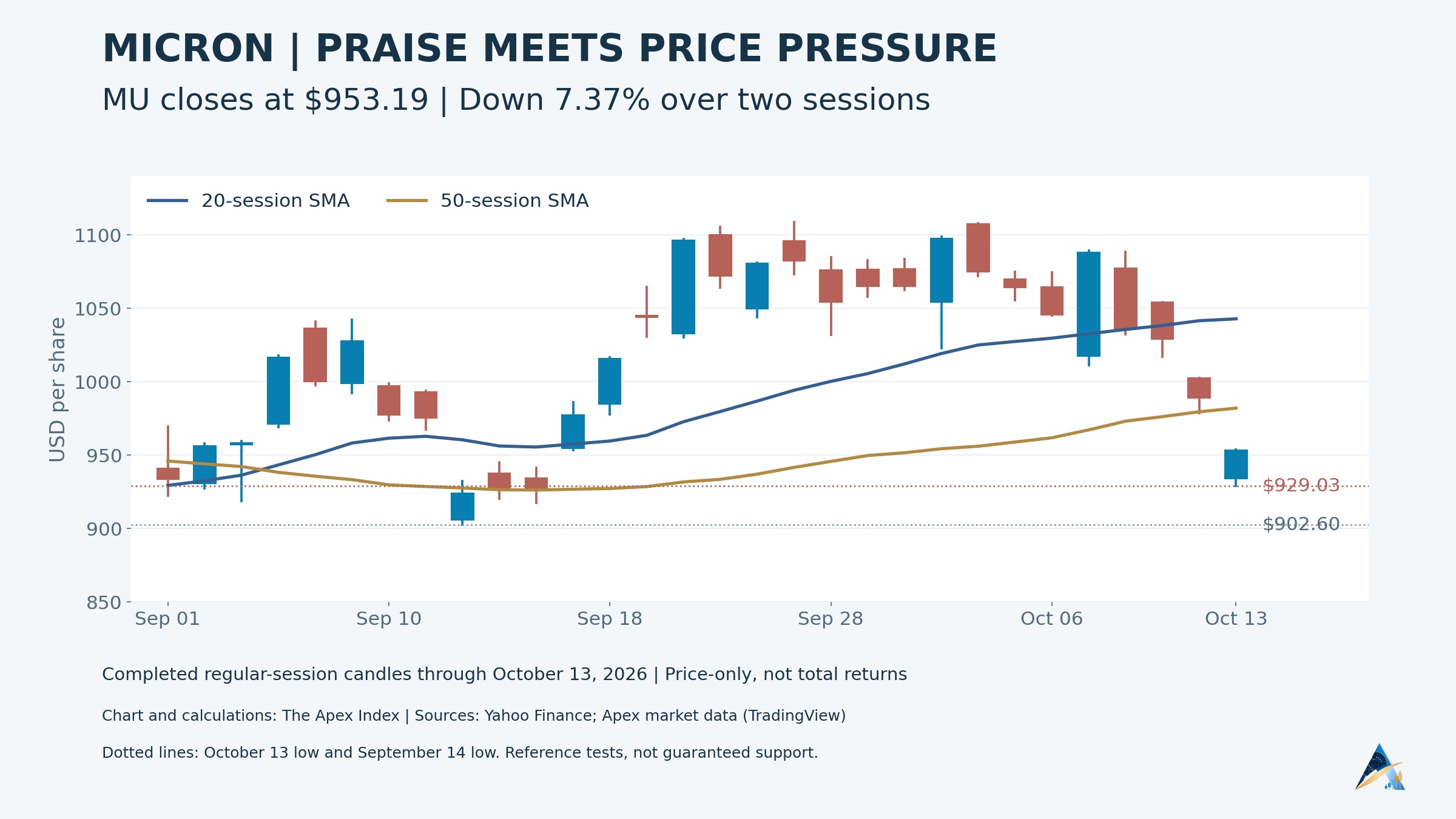
MU needs to win back $981.98
The stock's chart shows the damage. Across October 12-13, MU lost 7.37% from its October 9 close. Tuesday opened below the previous session's $989.04 close, reached $929.03 and recovered to finish just below its $953.60 high. That recovery helped limit the day's loss, but left the earlier price gap unrepaired.
Apex's calculations put the 50-session simple moving average at $981.98 and the 20-session average at $1,042.79. MU is below both. Reclaiming the first requires a 3.02% gain from Tuesday's close; reaching the second requires 9.40%. A sustained close above the 50-session line would strengthen the recovery case. Failure there would leave the broken trend intact.
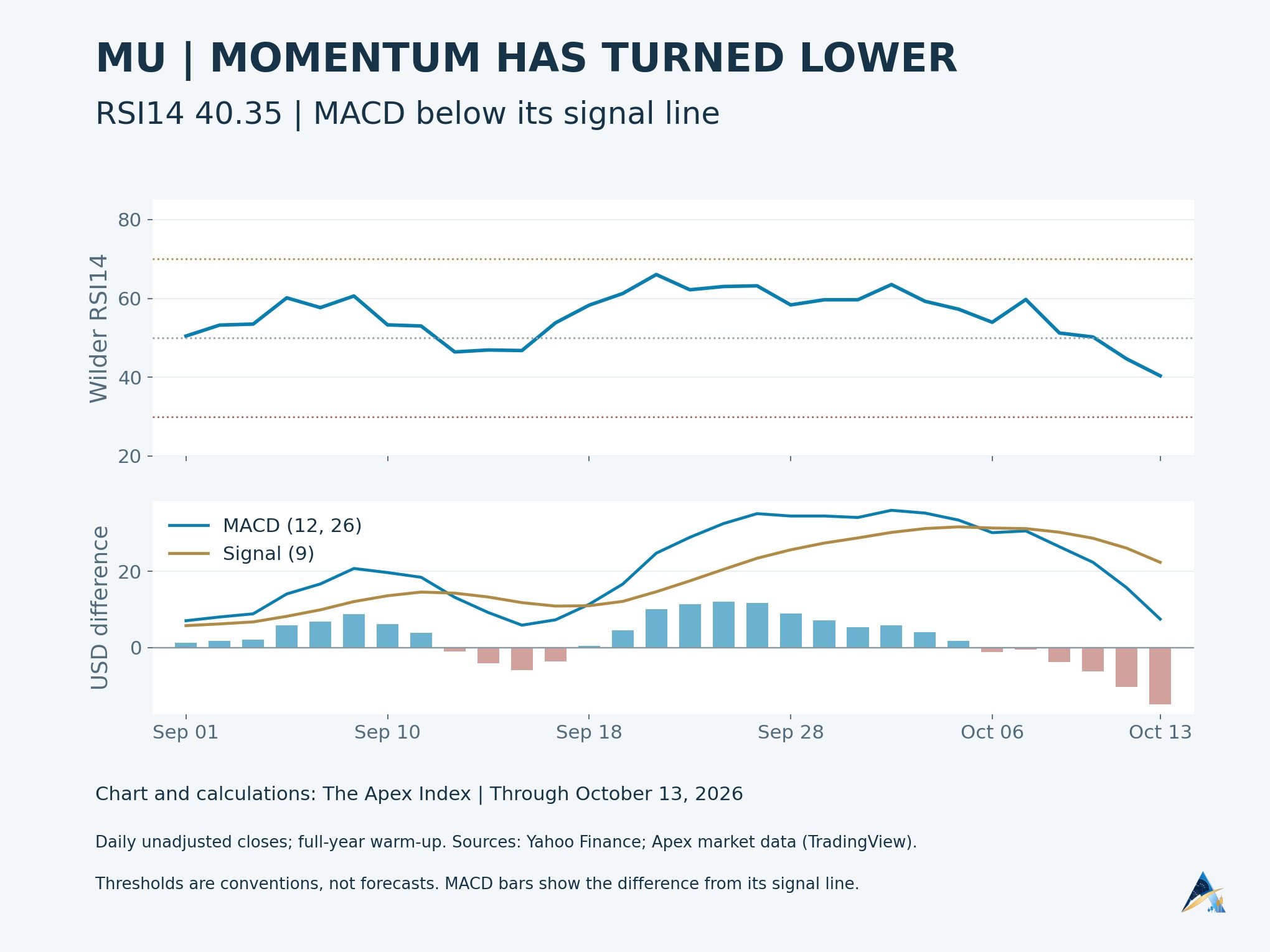
Momentum supports caution. The 14-session Wilder RSI is 40.35, below the neutral 50 reference but above the conventional oversold threshold of 30. The MACD line is 7.45 against a 22.36 signal, giving a negative $14.91 histogram. Shorter-term momentum has weakened even though MACD itself remains above zero. Neither reading proves a bottom or guarantees another fall.
MU still trades above its $708.58 200-session average, preserving a stronger long-term trend reference. The immediate problem is the gap between that longer view and the shorter averages it has lost. Repeated closes back above $981.98 would be more convincing evidence of repair than a single intraday touch.
On the downside, $929.03 is the first observed reference. A closing break below it would put the September 14 low of $902.60 back in focus, 5.31% below Tuesday's close. Holding those levels while reclaiming $981.98 would give buyers a stronger case than a bounce alone.
These calculations use completed regular-session candles through October 13, excluding after-hours prices. The charts are price-only, with indicators calculated from a full year of daily history.
Musk's pricing praise speaks to Micron's relationships with customers. Investors still need to judge how Chinese competition could affect margins, and whether the stock can recover the levels it has just lost.