


Cyberattacks against organizations rose 32% year over year in October, while fresh research shows hackers using AI agents to speed up break-ins and steal computing resources from businesses, including financial services firms. Governments are also facing pressure from extortion groups and state-backed operators adopting the technology.
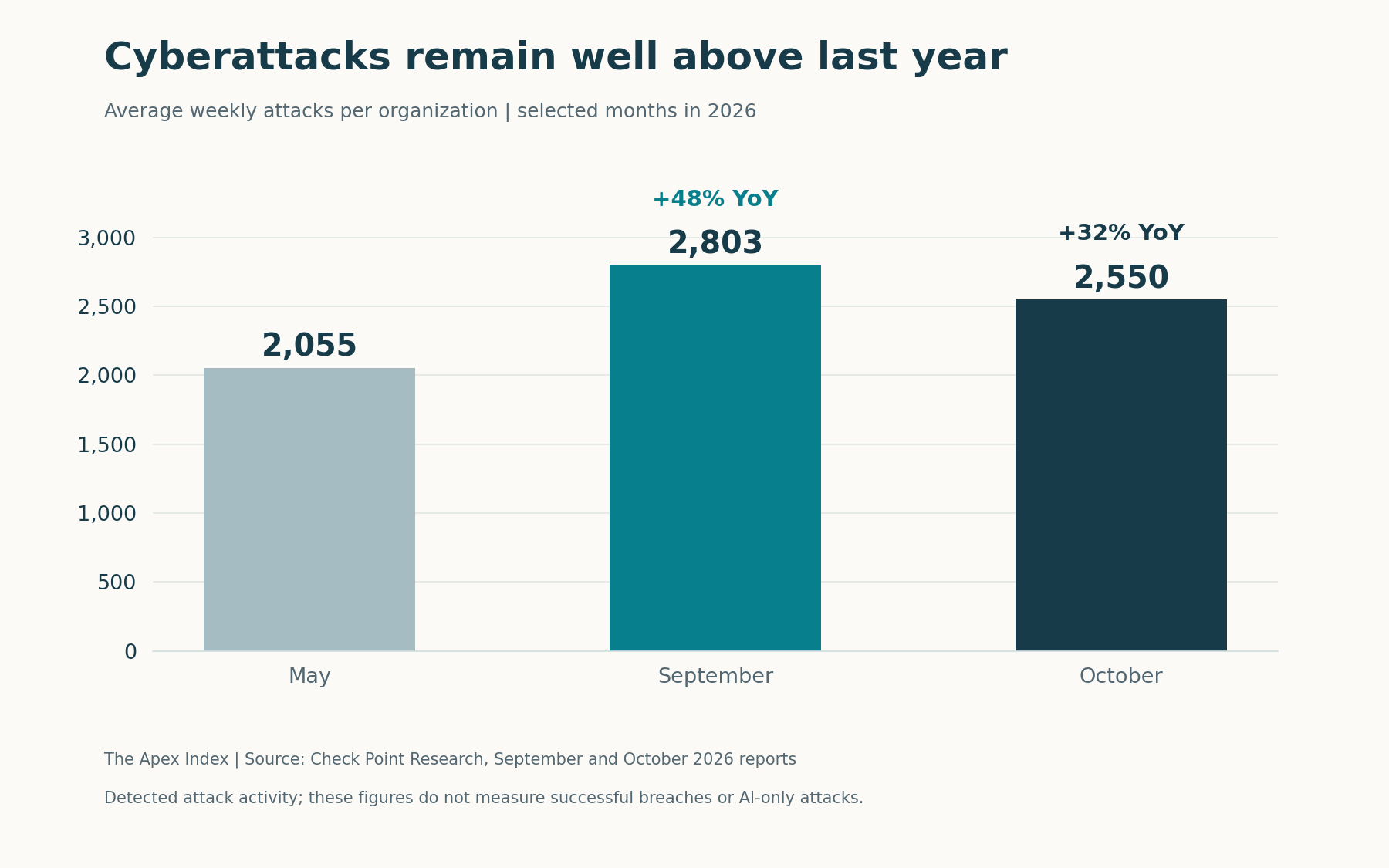
Check Point Research recorded an average of 2,550 attacks per organization each week in October. Separately, a Google threat report published November 16 describes criminals using AI during live intrusions, turning tasks that once needed repeated human input into automated workflows.
Attack volumes stay high as ransomware climbs
The October report shows overall attack activity easing 9% from September, when the year-over-year increase reached 48%. The newer 32% figure measures all detected attack activity, rather than attacks attributed specifically to AI.
Ransomware moved in the opposite direction. Researchers counted 1,063 publicly reported incidents in October, up 35% from a year earlier and the highest total in their series. Those figures come from extortion groups' public victim listings, which have reporting biases.
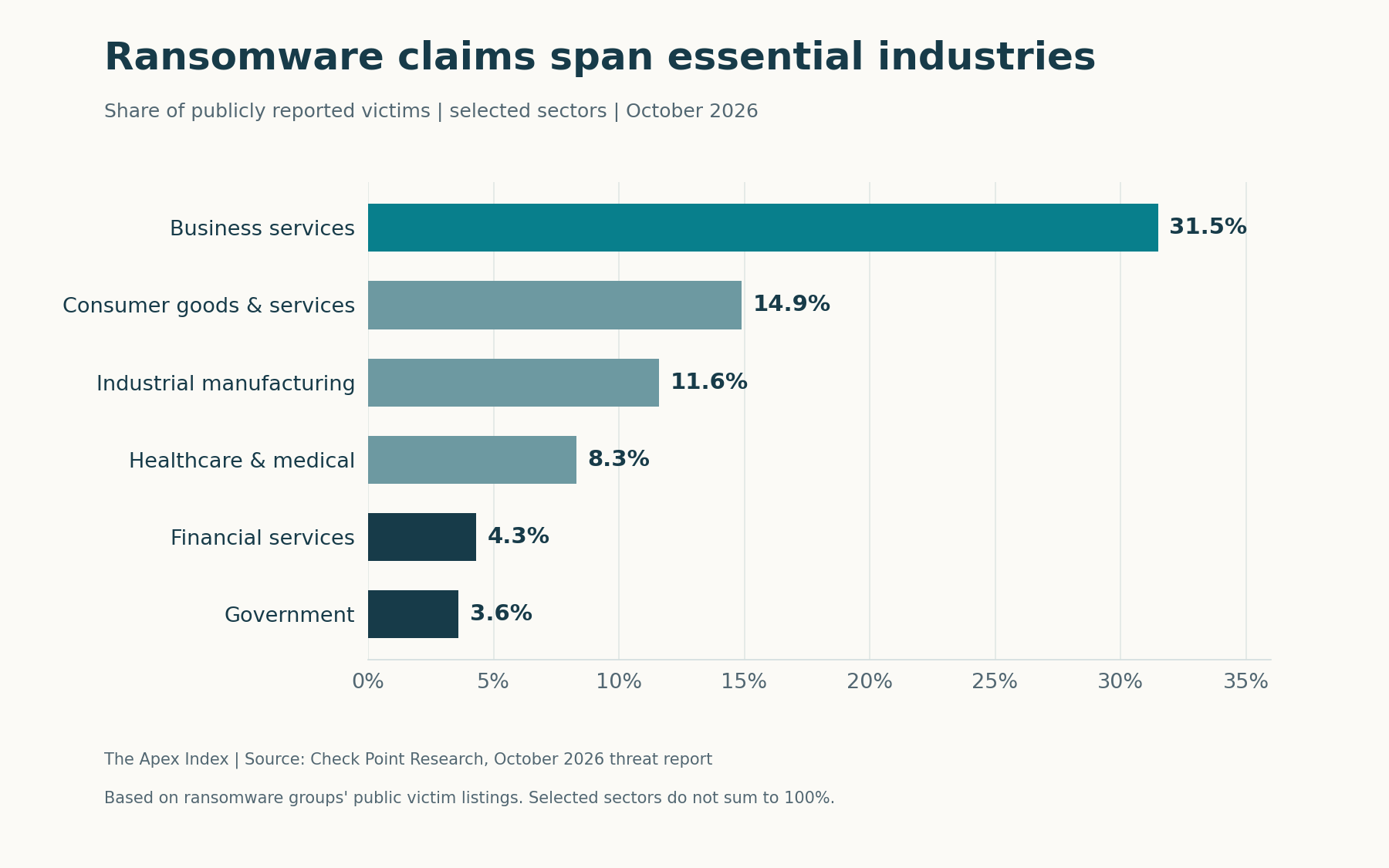
The pressure reaches well beyond technology companies. Business services accounted for 31.5% of the publicly listed ransomware victims, followed by consumer goods and services at 14.9% and industrial manufacturing at 11.6%. Financial services represented 4.3%, while government organizations accounted for 3.6%.
One newcomer shows how quickly AI-assisted operations can grow. The extortion group n0n entered the top three in October, a month after first appearing, and accounted for 8% of published victims. Its operators made extensive use of AI-assisted tools; observed initial access relied on weak or stolen credentials.
AI is being used inside real intrusions
The latest findings describe attackers adopting tools that coordinate several AI agents to scan systems, generate code and adjust their actions based on results.
The researchers put the problem plainly:
While the mechanics of the intrusions remain the same, such as using compromised credentials and targeting unpatched systems, the speed and scale at which frameworks can exploit these known weaknesses introduces a new defensive challenge.
That means familiar weaknesses can become useful to attackers much faster. In one investigation, the team found a framework that compared software before and after patches, identified possible flaws, drafted exploits and ran them without human intervention.
As previously reported by Apex in the article linked above, companies are also developing controls to stop AI agents and restore human oversight when their actions become unsafe.
Banks and businesses face stolen AI resources
The Google report describes intrusions affecting financial services, retail, transportation and technology organizations across North America, South America and Asia-Pacific. Attackers stole access to cloud computing and AI services, then used those resources themselves or sold access to others.
Some victims faced fraudulent charges exceeding $100,000 in a single day. In the most severe cases described, cumulative abuse reached $1 million before it was stopped. The practice, called LLMJacking, leaves the compromised organization paying for someone else's model usage or computing power.
State-backed groups are using the tools too. The researchers said the Iranian government-backed actor CALANQUE ION, previously tracked as APT42, continued using language models for reconnaissance and targeted social engineering.
Speed can also expose the attackers
Automation creates traces that defenders can spot. The report notes:
Unrestricted autonomous execution generates forensic traffic, relies on recognizable identifiers, and leaves behind distinct code-level traces; while these artifacts increase the likelihood of detection and mitigation, these tools remain highly capable of achieving operational objectives.
Defenses are being adjusted around those patterns. Specialized detection rules now look for ARTEX activity, and the researchers recommend hardening systems against the speed advantage of AI-enabled tools. For the organizations handling customer accounts, public services and business data, the immediate problem remains stolen credentials and unpatched software being exploited at greater speed.