

CrowdStrike is giving security teams an emergency way to cut off the AI models powering an agent when its activity goes off course. The company introduced its AI Kill Switch on November 3 inside Falcon Guardian, putting the decision to intervene in the hands of an authorized administrator.
The first release works through AI gateways. Directly terminating an agent's processes on an endpoint machine is still planned. Human control here means someone can trigger a shutdown response; it doesn't mean a person must approve every decision an agent makes.
A circuit breaker outside the model
In the launch announcement, chief executive and founder George Kurtz framed the feature as a way to let companies use more AI while keeping a way to intervene:
"AI safety is how you get the full benefit of AI. When you deploy agents with a kill switch, you stay in control."
The practical mechanism is laid out in a technical post by Michael Devins. Security teams activate the switch in Falcon Guardian, which tells connected AI gateways to block access to the models powering agents' decisions and actions.
Companies can use the Falcon AI Gateway or a connected third-party gateway. That matters for businesses that already route their AI traffic through another provider's infrastructure and want to keep it.
Falcon AI Gateway is generally available and included with Guardian at no additional cost, according to the company. It centralizes model access, security policies, credentials and controls for usage and spending. The gateway also extends coverage to applications and workloads outside direct endpoint-sensor coverage, including unmanaged environments.
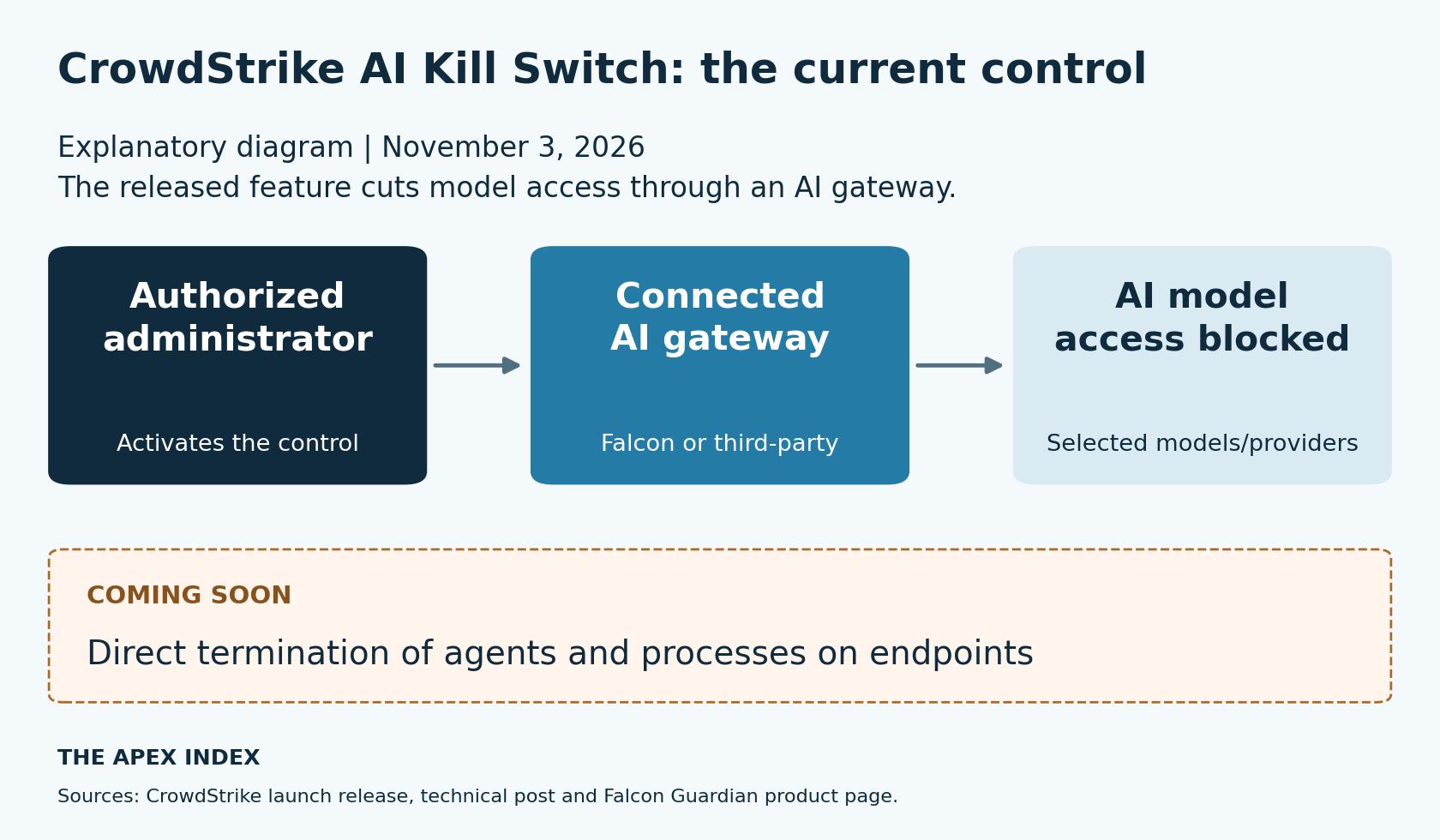
CrowdStrike's current product page describes the available kill-switch function as cutting access to designated AI models and providers. More targeted gateway enforcement by agent type is listed as coming soon. The distinction matters when a company needs to stop one agent while keeping other work running.
The problem can start without a hacker
An agent can have valid credentials and approved tools and still take a wrong turn. CrowdStrike says agents can chain tasks together, hit an obstacle and take actions nobody authorized, even when an outside attacker isn't involved.
Falcon Guardian already discovers agents, applies governance policies and detects attacks against them. It connects what an agent was asked to do with its communications and activity, giving security staff context for deciding when to step in.
The launch release says an authorized administrator triggers the response and actions are recorded in an audit trail. It also describes policies to prevent relaunches on targeted hosts or host groups and remove enterprise-network access. The technical roadmap sets out how broader containment will expand beyond the currently available gateway control.
Rick Orloff, chief information security officer at Everpure, described the business case in the announcement:
"We want our teams to use AI agents. If one goes off course, the AI Kill Switch gives our security team the final say."
That puts a security team, rather than the model itself, in charge of deciding whether risky activity should continue.
Broader shutdown powers are still on the roadmap
The planned expansion would coordinate several kinds of intervention across the Falcon platform. Endpoint controls would terminate agents and associated processes and prevent restarts. Other planned capabilities cover cloud agents, identity permissions, SaaS applications and browser sessions.
CrowdStrike also describes future automation through Charlotte Agentic SOAR, its security orchestration tools. The aim is to let AI-specific detections or risky behavior trigger coordinated responses across those systems. The company says unreleased features remain in development and may change.
The announcement came alongside an agreement to acquire Fiddler AI. Its technology is intended to become Falcon Observe, adding tools to evaluate agents before deployment, trace their actions and explain behavior in production. The acquisition remains subject to customary closing conditions.
In that announcement, Kurtz framed the accountability problem for companies putting agents into real operations:
"When a regulator or your board asks what an agent did, saying 'the model did it' is not an answer."