

China's economy is giving stock investors an awkward answer: growth is holding up, but many of the businesses they own still face customers who aren't spending much. That leaves Beijing with less pressure to deliver the big rescue investors have been hoping for.
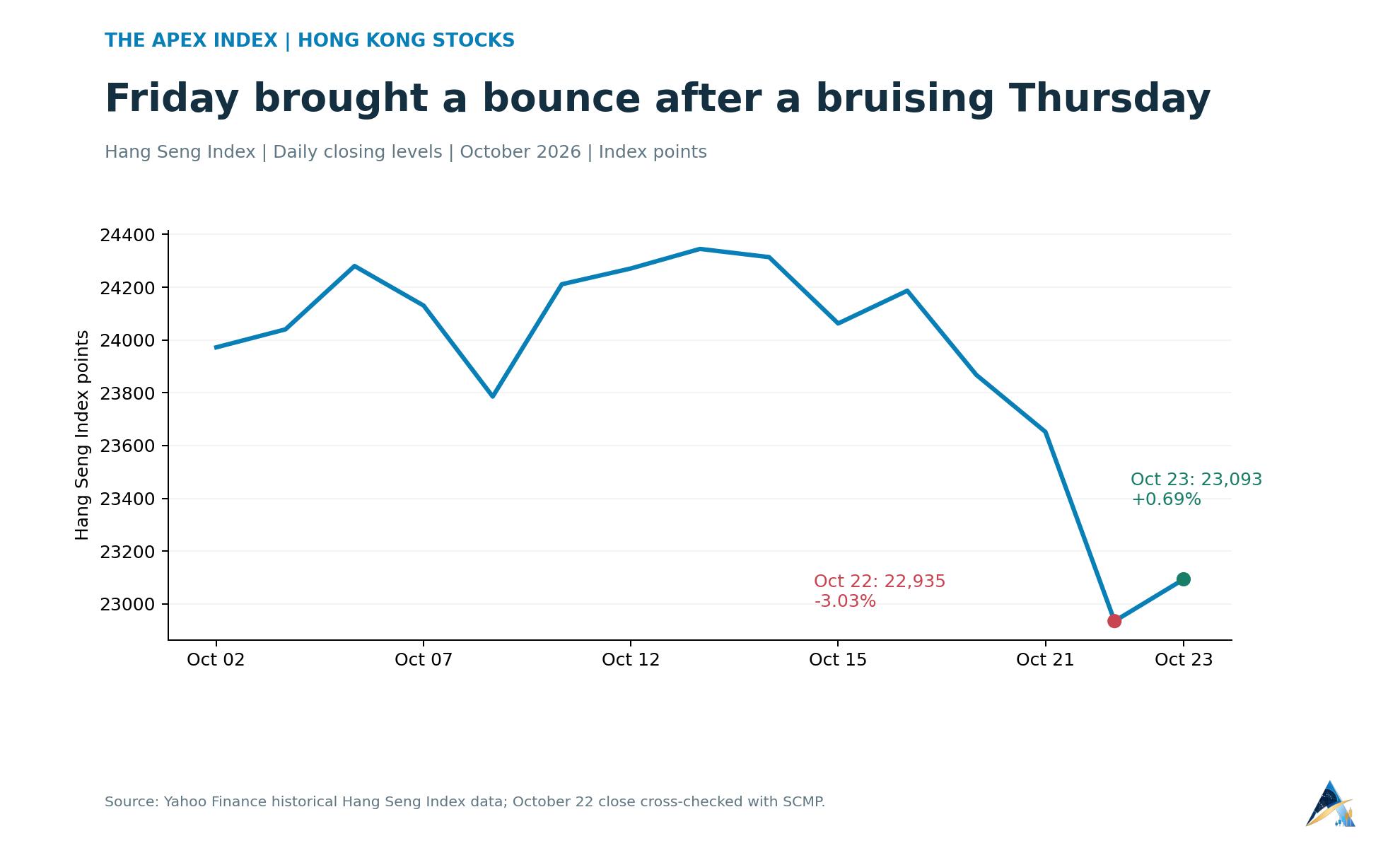
An October 24 report on Hong Kong's selloff described traders giving up on stronger near-term stimulus after the latest growth figures. There was some relief before the weekend: the Hang Seng Index recovered 0.69% on Friday to 23,093.37, after Thursday's 3.03% fall. It still finished well below Wednesday's close.
Good enough for the target, weak enough to hurt
As Apex previously reported, China's economy grew 4.5% from a year earlier in the third quarter, up from 4.3% in the second. Growth across the first nine months was 4.6%, keeping the government's full-year target of 4.5%-5% within reach.
Those figures help explain the policy hesitation. If the economy can hit the target with the support already in place, officials have less reason to spend heavily or cut rates aggressively just because shares are falling. That's the assessment economists are making, rather than a promise from Beijing that further help is off the table.
The problem for shareholders sits underneath that GDP number. September industrial output rose 5.5% from a year earlier, while retail sales of consumer goods increased just 1.1%. Across January-September, fixed-asset investment fell 7.2% and property investment dropped 20.6%, according to the statistics bureau's release.
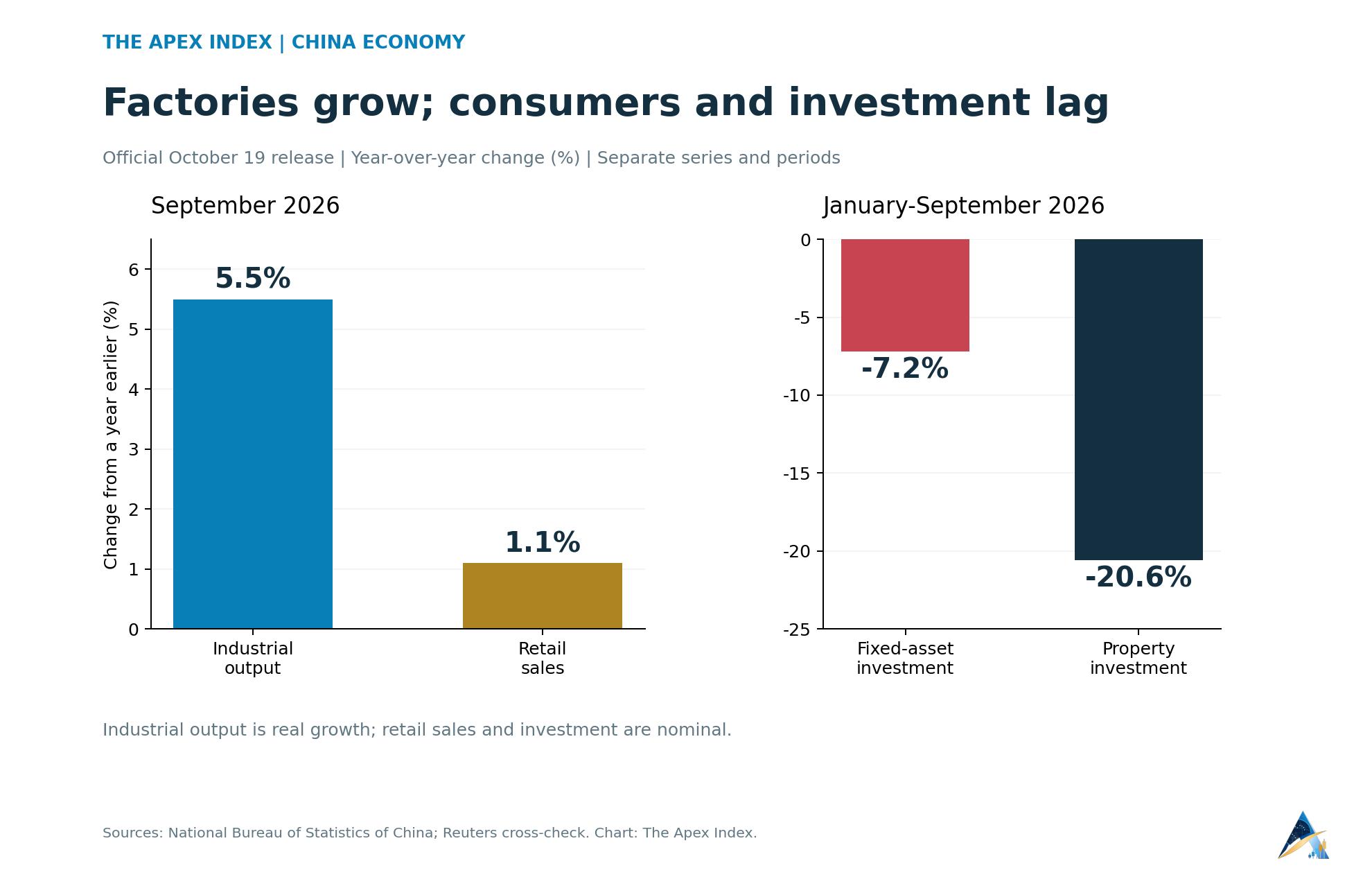
A factory can keep producing for foreign buyers while Chinese households hold back. Companies selling to those households don't automatically enjoy the same improvement. Retail sales are measured in current prices, while the industrial output figure measures real growth, so the two rates shouldn't be read as equivalent contributions to GDP.
Ho Woei Chen, an economist at UOB in Singapore, put the government's calculation plainly in comments carried by Reuters on October 19:
External demand is still keeping the economy afloat, and I think that is also why the government is not really very aggressive in the stimulus.
Stock investors wanted more than targeted help
The South China Morning Post's report, republished October 24 by The Star, said recent mortgage interest subsidies had disappointed investors because they focused on buyers of lower-priced homes in smaller cities. Comments from the securities regulator about longer-term market stability also fell short of the immediate support traders wanted.
The damage spread across different kinds of companies. On Thursday, Alibaba fell 6.1%, Tencent lost 2.9%, battery maker CATL dropped 7.2% and AI developer MiniMax declined 6.5%, the report said. Weak household spending, company earnings concerns and doubts about returns from heavy AI spending were all part of the backdrop.
Kelly Chung, chief investment officer for multi-assets at Value Partners, told the Post:
In China and Hong Kong, weak domestic demand, limited policy support and continued capital outflows weigh on sentiment.
Her assessment helps explain why meeting a national growth target hasn't been enough to reassure shareholders. They also need reasons to expect better sales and profits from the companies whose shares they hold.
What could break the stalemate?
The biggest risk to this arrangement is the export business that has kept growth going. If overseas orders weaken while households and property developers keep spending carefully, the case for wider government support becomes stronger. If consumers start buying more, company earnings could improve without a large rescue.
Neither outcome follows automatically from the GDP release. The latest monthly figures show that September retail growth improved from August's 0.4%, but investment remained weak. Getting a better retail number and getting a broad recovery are different stages of the same problem.
For investors, that makes the next spending, housing and export releases more useful than simply counting on another stimulus announcement.