


China supplied banks with 541 billion yuan, roughly $81 billion, in overnight funding on Monday as a new policy-rate framework took effect. The change gives banks a lower benchmark for short-term borrowing and reduces the base rate used to price several other central-bank tools.
The new anchor is an overnight reverse repo rate of 1.25%, compared with the previous seven-day benchmark of 1.40%. That puts the reference rate 15 basis points lower, although the two operations have different maturities.
The People's Bank of China's November 2 announcement said it met the full amount requested by primary dealers. Those are the institutions that participate directly in its open-market operations.
The 541 billion yuan is the gross amount provided through this operation. It is short-term funding against securities, rather than a permanent payout or a measure of the net cash added after earlier loans mature.
A lower rate becomes the daily reference
Under the new arrangement, the central bank offers overnight reverse repos every working day at a fixed interest rate. Eligible banks bid for the amount they need, with Monday's requests fully allocated.
The seven-day operation is changing jobs. It will use a fixed quantity, with institutions bidding on interest rates and successful bids accepted at multiple rates. Those operations will mainly take place around tax-payment periods and month-end, when funding demand can shift.
The details were set out in a Friday notice, which made the changes effective November 2.
Other tools previously priced at a spread above or below the seven-day reverse repo rate will instead use the overnight rate. Their spreads stay unchanged. That lowers the resulting rates by 15 basis points for affected tools, including temporary repo operations and the repo facility for overseas central-bank institutions.
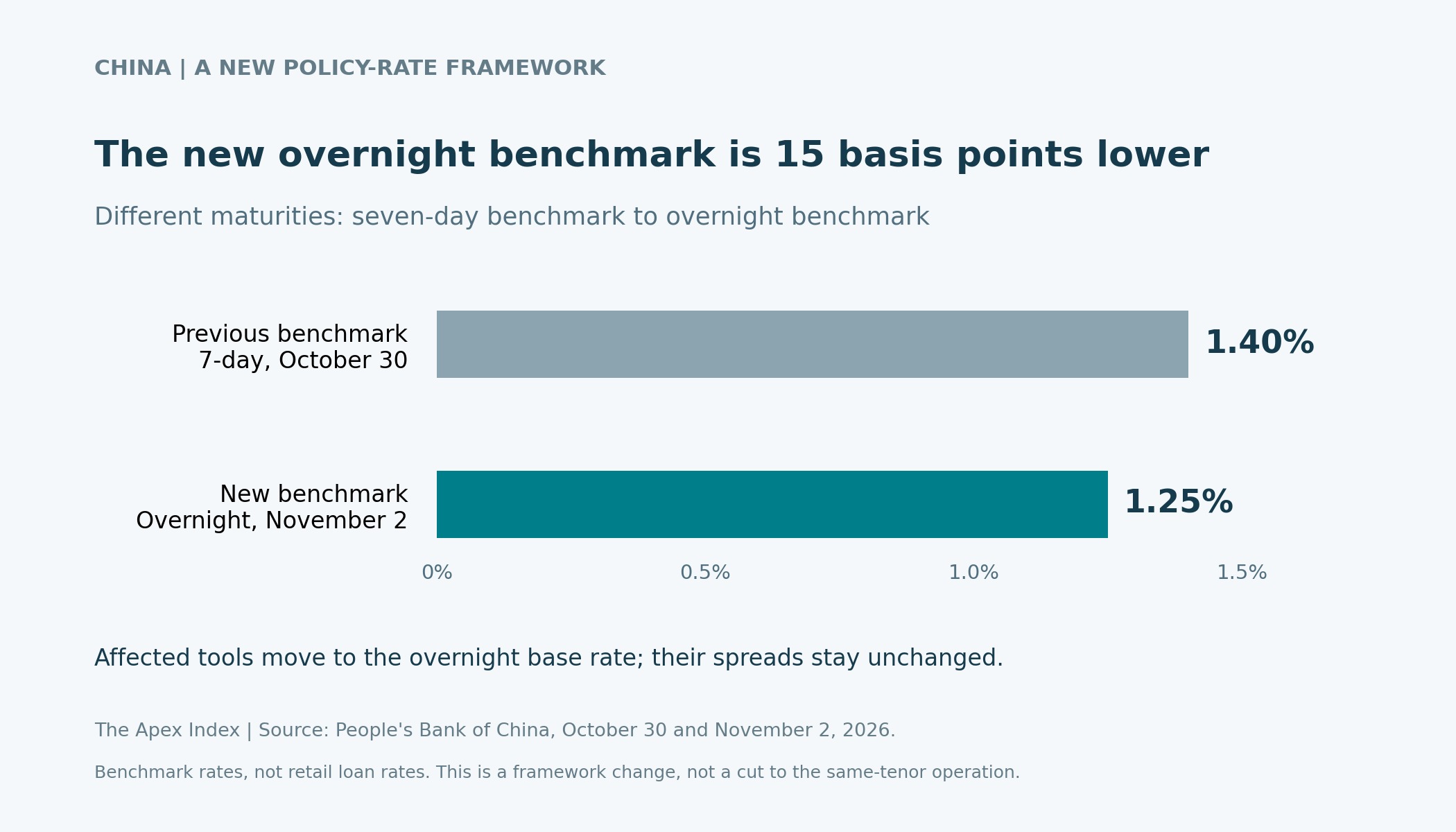
The easing therefore comes through the new pricing base. The announcement does not simply take the existing seven-day operation and reduce its rate to 1.25%.
The aim is to make rate changes reach borrowers faster
Governor Pan Gongsheng had laid out the reasoning in an October 19 speech. Banks already trade heavily in overnight money, making that market an important guide to day-to-day funding conditions.
He said:
At present, the interbank overnight repo rate has become the de facto target rate in our monetary policy adjustment.
The problem was a mismatch: the market rate officials were trying to guide was overnight, while the main central-bank operation and policy rate were seven days. Moving the main operation to overnight brings the two maturities into line.
Pan also described changes to how banks price loans. Some institutions have already agreed with clients to use market rates, including the interbank overnight repo rate, as a benchmark for floating-rate borrowing.
That market rate, known as DR001, is formed through trading between banks. It is distinct from the 1.25% rate set for the central bank's overnight operation. He also said the overnight market rate could become an alternative benchmark for bonds and financial derivatives, extending its role beyond bank loans.
Financially strong companies could choose between the overnight market rate and the loan prime rate, or LPR, through negotiations with lenders, he said. For other borrowers, the existing benchmark could continue:
Meanwhile, the LPR could remain in place as the pricing benchmark for loans to small businesses and individuals.
That leaves household and business borrowing costs dependent on the benchmark and terms in each loan contract. Monday's operation changes banks' access to short-term central-bank funding; it does not automatically reset every mortgage or business loan.
The governor said the central bank would issue guidance on the wider choice of loan-pricing benchmarks in due course. It also intends to reform how LPR quotations are produced, with the aim of improving their quality.