


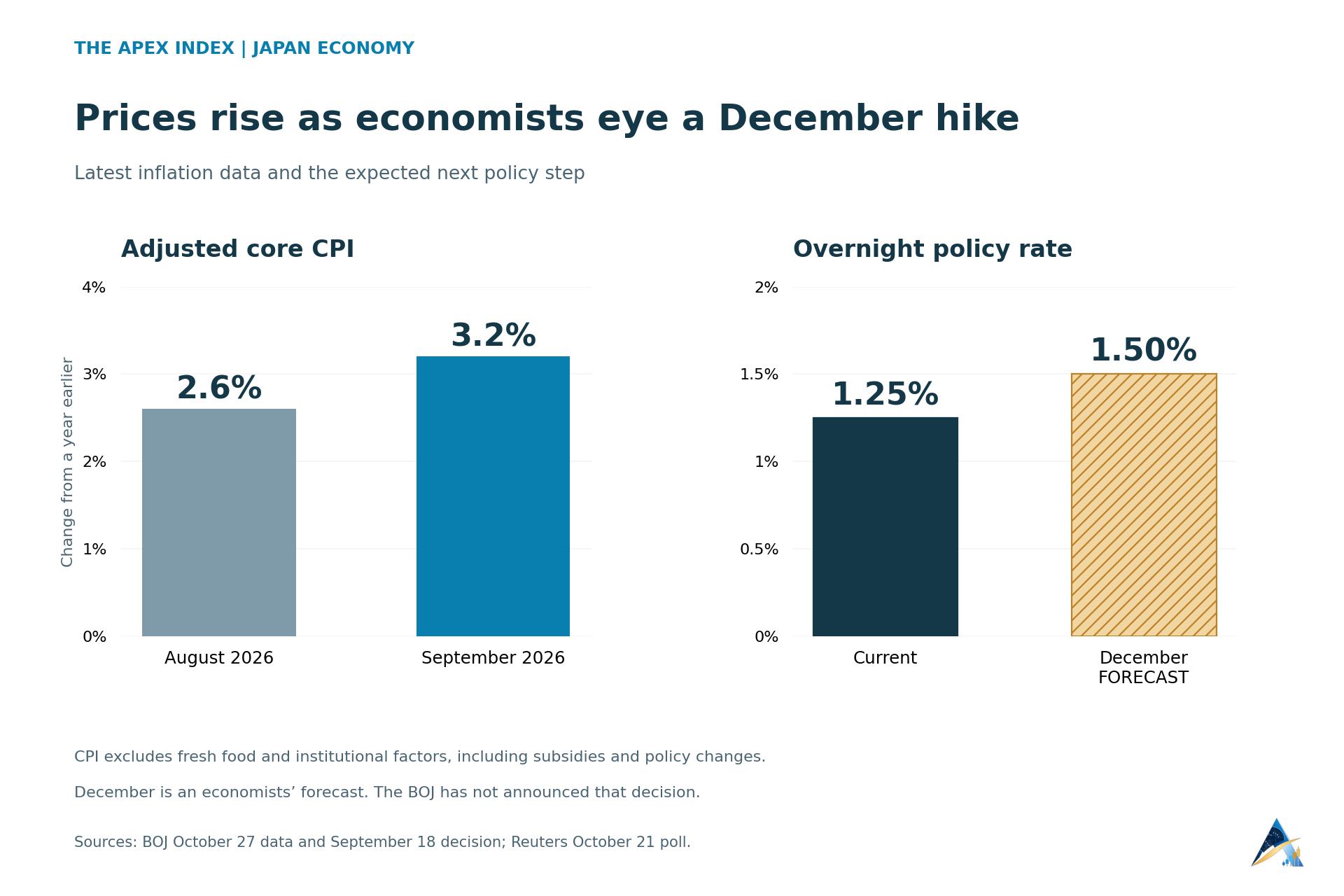
Economists expect the Bank of Japan to raise its policy rate to 1.5% in December, as new data show one of its key measures of price pressure accelerating to 3.2%. The October 27 figures give policymakers more evidence that inflation is running above their 2% goal.
The December increase remains a forecast. The BOJ's current policy rate is 1.25%, and its next meeting ends on October 30, when analysts expect it to hold steady. The year's final policy meeting is scheduled for December 17-18.
What the 3.2% inflation reading measures
The central bank's latest data show consumer prices excluding fresh food and government-related distortions rising 3.2% in September from a year earlier. That was up from 2.6% in August, the fastest annual increase since October 2023, according to Reuters.
The distinction matters because this is an adjusted measure of core inflation. It removes the effects of policies such as education subsidies and measures that reduce electricity, gas and gasoline costs. The government's usual core CPI excludes fresh food but retains the effects of those policies.
Removing those effects helps the bank assess price pressure beyond changes caused directly by government programs. Its research department estimates the series alongside other inflation indicators, wage growth, labor-market conditions and inflation expectations.
December is the leading forecast
The December outlook comes from an October 13-19 Reuters survey. Nearly 70% of the 78 economists polled expected the policy rate to reach 1.5% this quarter. Among respondents who identified a month, about 80% selected December.
That would mean a quarter-percentage-point increase from the current rate, following hikes in June and September. The September increase took effect on September 24, according to the central bank's policy statement.
There are reasons to wait another meeting before moving. Officials want to assess how earlier increases are affecting financial conditions, Reuters reported. In the October 21 poll report, Norinchukin Research Institute chief economist Takeshi Minami explained:
"The economy is not overheating to the extent that would warrant consecutive rate hikes, and price developments are also within the BOJ's expected range."
Service prices add to the pressure
Another BOJ release on October 27 showed services producer prices rising 3.7% in September from a year earlier, after a revised 3.5% increase in August. These are prices businesses charge one another for services, rather than prices paid directly by households.
Kenichiro Ahara, an economist at Dai-ichi Life Research Institute, told Reuters in its October 27 report:
"The data shows companies are passing on prices at the business-to-business level reflecting the strong outcome of this year's wage negotiations."
Transport costs were also important. Ocean freight prices jumped 97.7% from a year earlier, and the central bank's release identifies shipping as a major contributor to the acceleration. Excluding international transportation, services producer prices rose 2.9%, unchanged from August. That leaves a less dramatic picture outside the transport surge.
The board still has competing concerns
The BOJ's September 18 decision to set the overnight rate at around 1.25% passed by seven votes to two. One dissenter pointed to recent core CPI readings below 2%. The other argued that economic and price conditions had not changed enough to justify an increase.
The bank nevertheless said it would continue increasing the policy rate as economic activity, prices and financial conditions develop. Its statement highlighted the Middle East conflict, foreign-exchange movements and AI-related demand among the risks it would consider when choosing the timing and pace of further moves.
September's statement also described financial conditions as supportive even after the increase, with real interest rates still low. The next scheduled opportunity to update those judgments comes with Friday's quarterly economic and price outlook.