

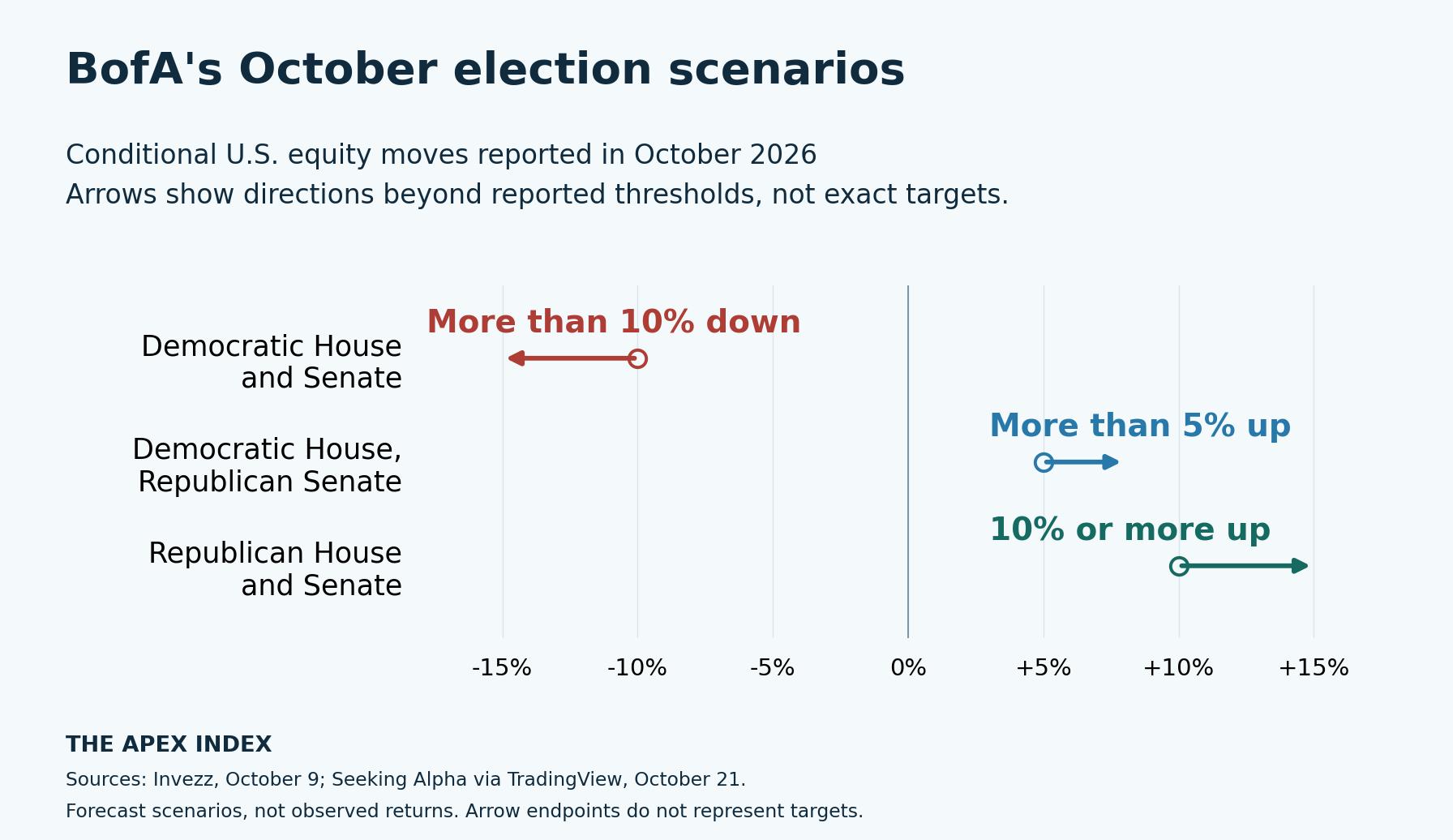
Bank of America has warned that U.S. stocks could fall more than 10% if Democrats win both chambers of Congress, putting a sharp downside scenario on the table as Americans vote in the November 3 midterm elections.
The warning comes from Michael Hartnett's October election framework. His concern is that a Democratic sweep would weaken President Donald Trump's political influence and change investors' expectations for taxes, regulation and the artificial intelligence spending boom that has helped support U.S. equities.
Hartnett sees a much tougher backdrop after a Democratic sweep
MarketWatch reported the call on October 9, describing Hartnett's view that a Democratic takeover posed a meaningful threat to investors' willingness to take risk. The forecast was for a possible decline of more than 10%, rather than an exact S&P 500 closing level or a guaranteed reaction on election night.
His framework also pointed to a weaker dollar and lower Treasury yields under that outcome. International stocks could fare better as expectations for geopolitical tensions and U.S. policy shifted. These are linked market scenarios, dependent on how investors interpret the result and the policies that follow.
The other congressional outcomes produced very different calls. Hartnett saw gains of more than 5% if Democrats took the House while Republicans held the Senate. Continued Republican control of both chambers could produce gains of 10% or more, with stronger support for the AI trade.
The split-government case rests on legislative gridlock: neither party could easily push through a broad agenda, while the existing investment cycle could continue. Under a Democratic sweep, the risk would be greater scrutiny of companies and the infrastructure supporting AI, alongside expectations of higher taxes and tighter regulation.
That doesn't mean a change in Congress would immediately put those policies into law. Trump would retain his veto, and a Democratic majority would still need to navigate the legislative process. Committee investigations, budget negotiations and changes in investor expectations could matter before any major law passed.
Election Day puts the scenarios to the test
The prospect of a sweep has become a central issue for investors. Yahoo Finance's November 3 report put Polymarket's probability of Democrats winning both chambers at 76% that morning. Those are trading odds, not election results.
The AI buildout is one reason the congressional balance matters to Wall Street. In a November 3 report, Fox Business cited JPMorgan strategists explaining why continued Republican control could support that investment cycle:
"If Republicans maintain control of Congress, that would likely provide the most supportive incremental federal policy backdrop for the AI/infrastructure buildout through policy continuity, potential fiscal expansion, deregulation and faster federal permitting."
A Democratic Congress could instead use its oversight powers to question corporate spending and the costs of the AI expansion. Investors would also have to assess how a new majority handled government funding and the debt ceiling, where negotiations with the White House could create another source of uncertainty.
History offers a less bearish comparison
The downside case isn't the only reading of the election. Historical returns depend heavily on the period being measured and the economic conditions surrounding each vote.
Yahoo Finance calculated that, since 1946, the S&P 500 was higher a year after all 20 midterm elections, measured from the Election Day close, with an average gain of about 14%. That record covers different congressional outcomes and doesn't rule out a substantial decline along the way.
The same report cited Kurt Reiman, head of fixed income at UBS's Chief Investment Office, on the limits to sweeping policy changes:
"We expect the 2026 midterm elections to yield a divided government, with sweeping policy changes constrained by Senate rules, party divisions, presidential veto power, and already wide federal deficits."
A short-term selloff and a positive return over the following year could both occur. In 2018, when Trump lost the House, the index fell nearly 15% by Christmas Eve amid Federal Reserve rate increases and escalating trade tensions with China. It was roughly 12% higher a year after the election, according to the historical analysis.
For Hartnett's warning, the next test is whether an actual Democratic sweep changes expectations for corporate profits and AI investment enough to outweigh those constraints on policymaking. The size and timing of any market move remain forecasts, with the election outcome and investors' response still ahead.