
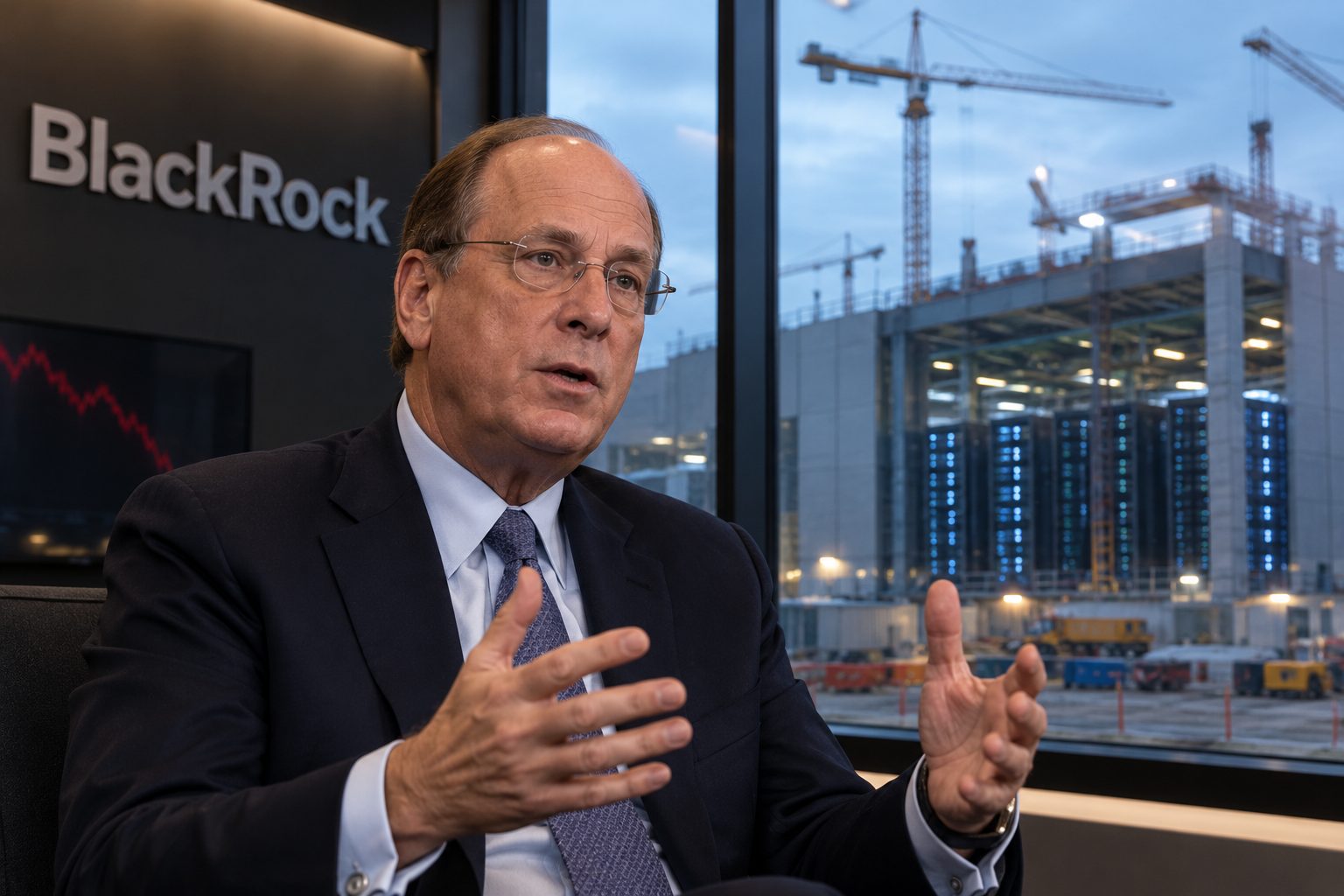
BlackRock CEO Larry Fink thinks America could talk itself straight into a recession by stopping the construction of AI data centers. His warning came Wednesday as anger over these massive facilities spilled into local politics.
Companies are spending fortunes on computer servers, power plants and the buildings needed to run them. Larry's argument is that pulling the plug on all that spending wouldn't just hurt Big Tech. It could hit construction, energy, equipment suppliers and jobs across the country.
The warning landed on the same day BlackRock (NYSE: BLK) reported stronger-than-expected third-quarter earnings. The world's largest asset manager is also helping finance the boom, giving it a direct business interest.
Larry Fink says freezing data center projects could put America in trouble
“If we have a moratorium of some sort in this country, we will be in a recession,” Larry told reporters on Wednesday. “So much of our economy is based on the buildout of this capex.”
The word capex means capital expenditure, or money spent building things expected to last for years. Right now, that includes everything from chips and cooling systems to transmission lines and new sources of electricity. Those purchases generate work for businesses that have little to do with writing AI software.
Still, communities have real questions about what they're getting in return. Data center opposition has become an issue ahead of the November 3 midterm elections.
Residents worry about higher electricity bills, heavy water consumption, environmental damage and deals whose financial details aren't always clear. An economic argument won't necessarily lower anybody's utility bill.
Larry recognized those fears, although he argued that much of the debate is driven by inaccurate information.
“Data centers are not the problem. They’re creating more new jobs than ever before,” Larry said.
There's serious money behind his warning. Wall Street estimates suggest annual AI capital spending could exceed $1 trillion in 2027, with the total topping $5 trillion by 2030. Those forecasts show the scale of projects needing workers, equipment and huge amounts of power.
And BlackRock has a seat at that table. Through partnerships with Microsoft (NASDAQ: MSFT) and Meta (NASDAQ: META), the firm is involved in financing the infrastructure behind AI expansion. Its position makes Larry's comments both an economic warning and a reflection of an industry where his company expects to do business.
BlackRock beats Wall Street estimates while chasing a new AI asset class
BlackRock's earnings report shows that investors put $205 billion into its products, including $134.5 billion in new money for iShares ETFs.
Assets under management reached $15.49 trillion, up from $13.46 trillion a year earlier and $15.34 trillion at the end of the previous quarter. Rising stock prices also increased the value of the investments it already held.
Revenue rose to $7.8 billion, compared with the $7.5 billion analysts expected. Adjusted earnings reached $15.93 per share, beating the $14.13 forecast, while earnings per share grew 38%. The S&P 500, which finished the quarter near record levels, helped lift performance. BlackRock shares jumped as much as 5% Wednesday, although another market snapshot showed a gain of around 1%.
“Market fundamentals are strong and well supported, with higher margins and earnings momentum catalyzed by new technology,” Larry said in the company's earnings statement.
The mood in other parts of the market is less comfortable. Bond yields have climbed, bond prices have fallen and investors are weighing whether the Federal Reserve's recent rate increase could lead to more hikes. Even so, BlackRock pulled in $78.2 billion for debt products during the quarter.
“I don't believe we can evaluate the investment environment as risk-on or risk-off any longer,” said BlackRock CFO Martin Small, describing a market plagued by scarce capital, higher long-term yields and new approaches to diversification.
Larry also sees a way to turn AI computing capacity into a tradable investment. He compared the opportunity with the early mortgage securities market of the 1980s, which eventually grew into a multitrillion-dollar business. BlackRock wants to use its large datasets and new AI performance measures to support securities backed by computing resources.