

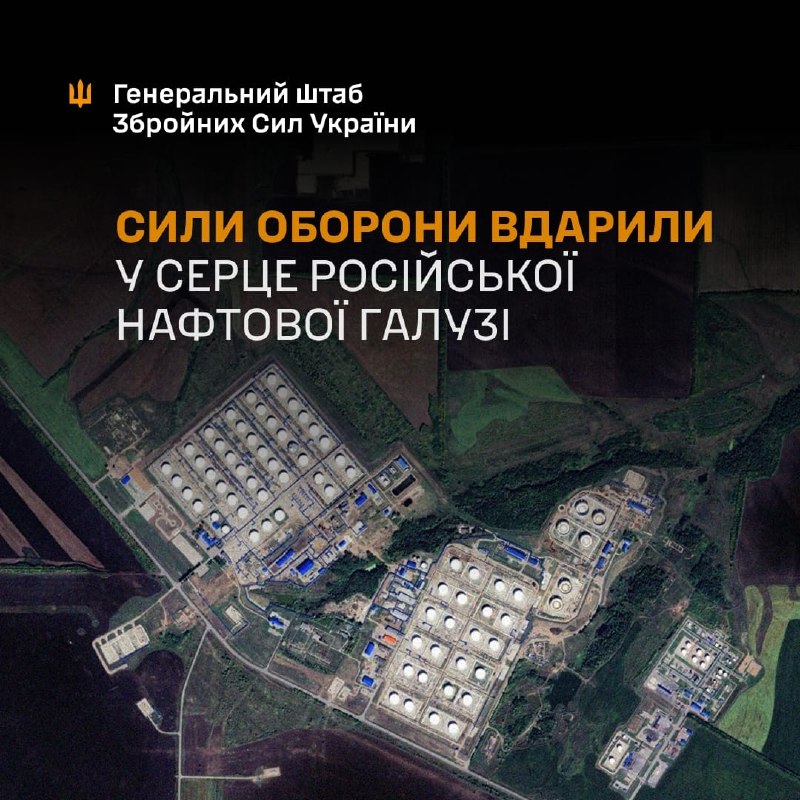
Ukrainian forces struck a major Russian oil hub near Samara on November 13, setting several storage tanks on fire, Ukraine's military said. The facility handles crude used to make Urals, Russia's flagship export blend, putting a key part of the country's oil network under renewed pressure.
The Samara station is near Prosvet, outside the city of Samara, roughly 530 miles southeast of Moscow. Ukraine's General Staff announced the strike on November 14 and said it had also hit fuel and support infrastructure at the Lipetsk-2 military airfield.
In its official statement, the military said, translated from Ukrainian:
A fire broke out at the facility, several oil tanks are burning.
The reported damage hasn't been independently verified. The statement didn't give a casualty figure, identify how many tanks had been destroyed or provide a timetable for repairs. It also didn't specify the weapons used against the Samara site.
An oil-blending hub deep inside Russia
The target was the Samara linear production and dispatch station, a facility connected to trunk pipelines carrying crude from Tatarstan, western Siberia and other Russian oil-producing regions.
Oil arriving from those regions is mixed there to form the Urals export grade, according to the Ukrainian military. The station's role extends beyond storing barrels: it is part of the system that combines crude from different sources before it reaches export markets.
The General Staff described the site as a source of revenue supporting Russia's war effort. In a second passage, translated from Ukrainian, it said:
Every tank hit in Samara directly strikes the main source of money with which the aggressor pays for missiles, drones and the war against Ukraine.
The military said Urals accounts for up to half of Russia's oil exports. The November 14 announcement didn't quantify how much crude had been lost, identify the tanks affected or say whether pipeline flows through the station had stopped.
Russia's export rebound faces fresh pressure
The strike comes as Russian oil shipments have been recovering. As previously reported by Apex in the article linked above, refined-product exports rose by 260,000 barrels a day in October to 1.49 million, their highest level since June.
That increase followed President Donald Trump's diesel agreement with Moscow. Gasoil deliveries doubled to about 270,000 barrels a day, while crude production separately rose by 210,000 barrels a day to 8.73 million.
Those figures describe October's performance, before the newly announced Samara attack. They show the scale of the recovery underway as Ukraine continues targeting the infrastructure used to process, store and move Russian petroleum.
The International Energy Agency's November assessment, covered in that earlier Apex report, said persistent attacks on Russian energy infrastructure were constraining diesel supplies to international markets. It also pointed to a wider recovery in global oil supply as Gulf exports increased.
The agency said global production rose by 2.3 million barrels a day in October to 105.4 million. Its balances pointed to a supply surplus in the fourth quarter, although diesel availability remained under pressure from damage to Russian facilities and losses in the Middle East.
Lipetsk-2 airfield also targeted
The same military update reported a separate November 13 strike at Lipetsk-2 in Russia's Lipetsk region, where Russian military aircraft are based.
The General Staff said the targets hit included a hangar holding specialized aircraft-servicing equipment, an aviation fuel tank and the airfield's central command and dispatch post. Its account focused on the base's ground infrastructure and didn't report aircraft destroyed in that operation.
Ukraine said the operations were part of its continuing effort to force Russia to end its invasion, invoking the right of self-defense under Article 51 of the United Nations Charter.
Image: General Staff of the Armed Forces of Ukraine, satellite image released November 14. Used under its Creative Commons Attribution 4.0 license.