

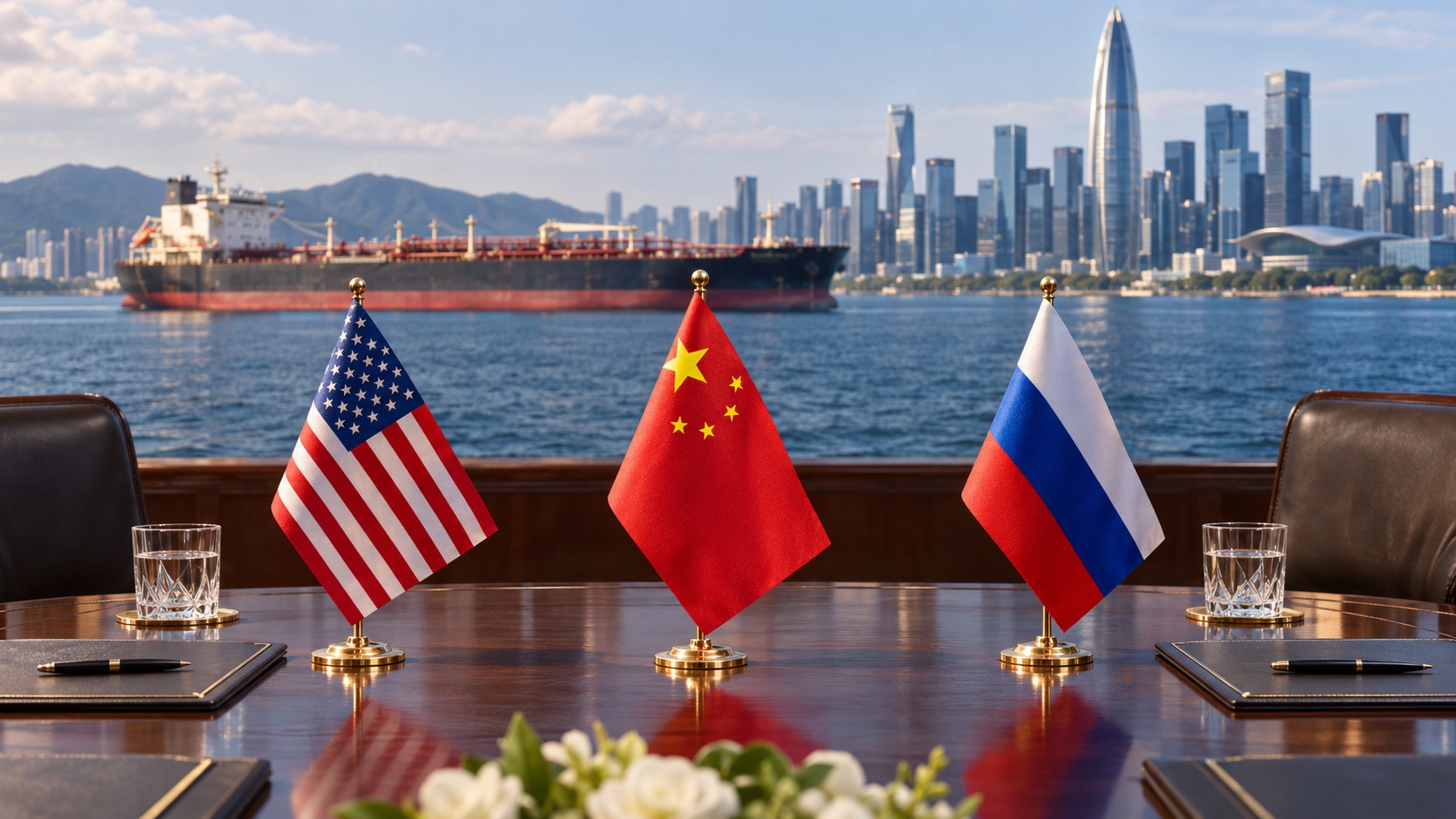
Donald Trump, Xi Jinping and Vladimir Putin wrapped up their first formal three-way summit in China on Thursday with a promise to increase fuel supplies. They left without a deal to reopen the Strait of Hormuz, keeping one of the biggest problems facing the oil market unresolved.
The three leaders issued a four-point peace declaration after meeting in Shenzhen alongside the Asia-Pacific Economic Cooperation summit. Its energy commitment was brief: more refined petroleum products and stable energy flows. There was no timetable, production target or agreement on how to restore reliable passage through the Gulf waterway.
That leaves a gap between what the leaders promised and what energy buyers can count on. Extra fuel would help ease supply pressure. A pledge without volumes or a delivery schedule gives importers little to build purchasing plans around, while the security of shipments remains a separate problem.
The fuel pledge stops short of a Hormuz agreement
The joint declaration, published by China's foreign ministry, set out the entire energy commitment in two sentences:
The three countries plan to increase the production and supply of refined petroleum products for the benefit of all nations. They reaffirmed the importance of stable energy flows.
The wording matters. It refers to refined products, such as gasoline and diesel, rather than specifying an increase in crude oil production. The declaration does not divide the work between the three countries, announce refinery commitments or explain how additional supplies would reach buyers.
It also contains no mention of Hormuz, Iran or a ceasefire. There is no shipping protection arrangement, reopening deadline or commitment from Tehran in the document. The summit brought together three powerful governments, but Iran was not a party to their declaration.
Trump had raised the waterway in his separate meeting with Jinping, saying the United States and China shared an interest in keeping oil moving through it. That conversation did not produce a published agreement to secure the route. Attacks during the Iran war have repeatedly disrupted traffic through the strait.
Oil prices were higher as of the time this article was written. The site's TradingView feed showed Brent crude futures at $92.82 a barrel, up about 0.95%, while West Texas Intermediate futures traded at $83.36, up roughly 1.28%.
Those gains leave little sign of an immediate price reprieve following the supply promise. The summit also did not announce the removal of sanctions or another specific measure that would turn its energy language into additional cargoes.
China pushes stable supplies and closer trade
Jinping used the meeting to argue for closer economic cooperation between the three countries. China's official readout described him calling for coordination to keep energy supply chains stable and protect the global energy market.
He also warned against breaking up industrial supply chains, arguing that the countries could use their different economic strengths to expand trade. Vladimir backed cooperation on energy and food security, according to the same account.
That gave the fuel pledge a place in a broader push for economic cooperation. It did not settle the practical questions surrounding it. Increasing refinery output, arranging exports and making a contested shipping route safe require different decisions, and the declaration offered no detailed plan for any of them.
For businesses buying fuel, that distinction has real consequences. A refinery can produce more diesel without resolving whether a tanker can safely take a particular route. For households, any benefit from extra supply would still depend on the amount delivered and the prices buyers pay.
The separate Trump-Jinping meeting produced another promise of follow-through: the two sides agreed to formulate an action plan for their relationship. Beijing's account said Trump wanted stronger cooperation in farm products, energy and advanced AI, while Jinping called for communication on trade concerns.
A peace declaration with limited commitments
The other three points in the joint statement covered United Nations reform, the jurisdiction of international courts and nuclear risks. The leaders reaffirmed:
A nuclear war cannot be won and must never be fought. The three countries will conduct a dialogue on reducing nuclear risks and preventing the proliferation of nuclear weapons.
That commits the governments to talks. It does not set nuclear weapons limits or establish a new arms-control agreement. Similarly, the document's promise to reform the UN comes without a detailed proposal.
China's fuller account said the leaders discussed Ukraine, the Middle East and the Korean Peninsula. Neither the Ukraine war nor the Iran war was named in the final declaration. No settlement to either conflict was announced.
Trump left China and described the trip as “Highly Consequential” on social media, announcing a White House press conference for Friday. For oil buyers waiting for the practical details, the outstanding questions are straightforward: how much extra fuel, when it will arrive and what happens to the ships passing through Hormuz.