

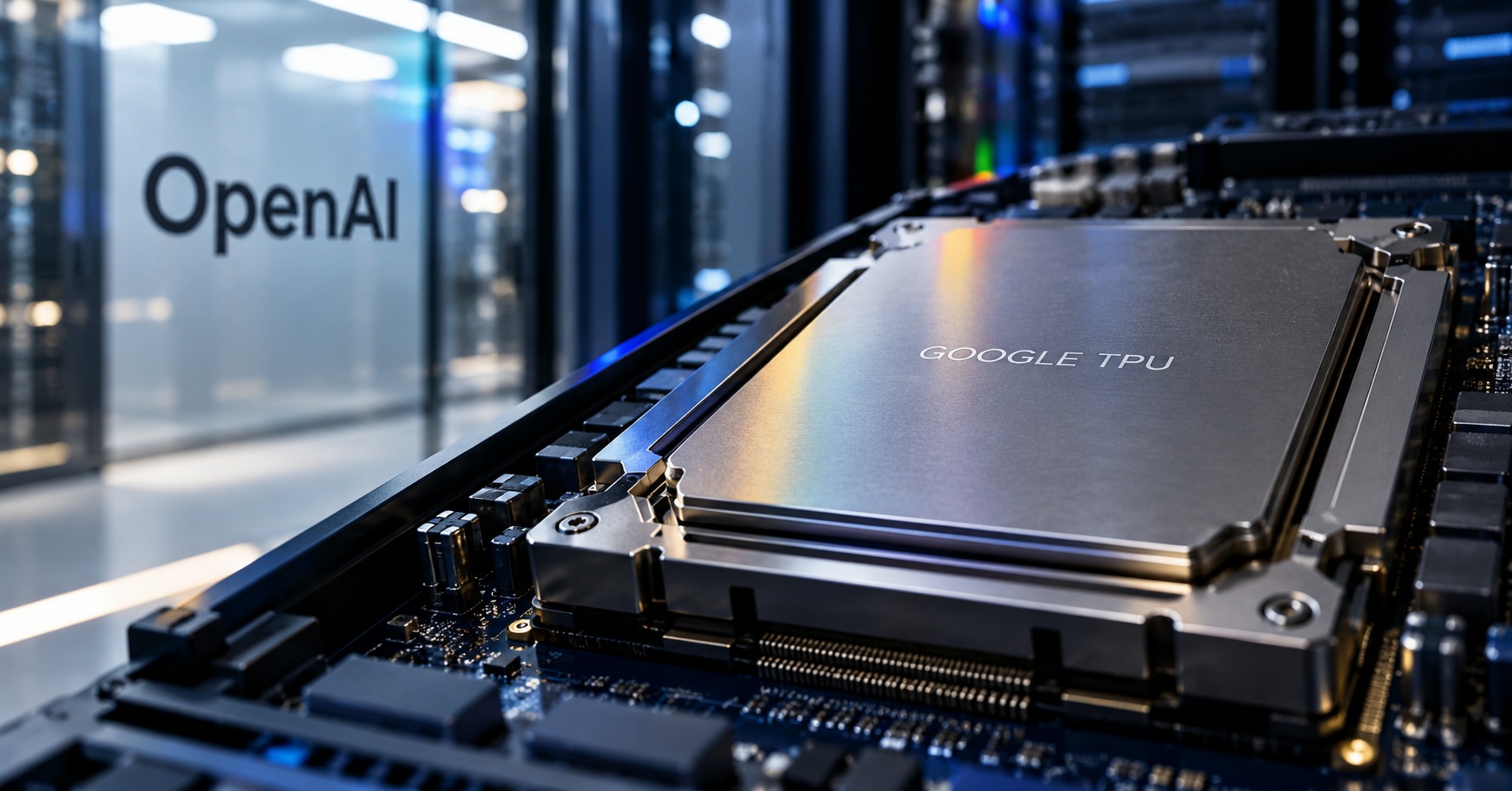
OpenAI plans to buy Google's AI chips, The Information reported on October 27, potentially giving the ChatGPT maker another supplier alongside Nvidia. The proposed purchase would deepen a relationship between companies that compete directly for AI users and search customers.
The hardware in question is Google's Tensor Processing Units, or TPUs, which are built for AI computing. OpenAI is already one of Nvidia's biggest GPU customers, using those processors to train models and run them when people ask questions or give them tasks.
Financial terms and other details of the planned purchase weren't disclosed in the report, which cited a person familiar with the matter. Reuters said OpenAI declined to comment and Google did not immediately respond to its request outside regular business hours. Neither company has publicly announced a completed chip-purchase agreement.
OpenAI's hiring points to deeper TPU use
There is a public sign that the company wants to do more work on this hardware. Its listing for a San Francisco-based software engineer in TPU compilers sits within its inference team, which focuses on running models efficiently through its products.
The description says:
"We’re looking for an engineer to lead the optimization of OpenAI’s state-of-the-art frontier models on TPUs."
The work includes finding slow points in model execution, improving response speed and increasing the amount of work the chips handle. The hire would also build benchmarks to measure those gains and validate that the optimized software still produces correct results. Candidates can bring experience from either training or inference work, according to the posting.
The advertised base salary is $380,000-$500,000, with equity offered. The role gives the hire responsibility from model code through the lower-level software that runs on the chip. That is practical engineering work needed to get useful performance from a different processor, rather than simply buying a box and plugging it in.
Google's chip business reaches beyond its own cloud
This would build on an earlier arrangement. Reuters reported in June 2025 that OpenAI had begun renting Google's chips. Purchasing hardware would be a different step from paying for access to someone else's computing capacity. The latest report doesn't give a chip count, delivery schedule or intended deployment site.
Google has another route to customers, too. As previously reported by Apex, its October 27 agreement with Oracle would bring TPUs to Oracle Cloud Infrastructure in calendar 2027, with capacity increasing over several years. The companies described that as the first offering of the chips on a hyperscale cloud outside Google.
That same announcement came alongside a separate expansion of Oracle's Nvidia relationship. Oracle announced general availability of Vera Rubin NVL72 systems and Vera CPUs, with larger deployments planned. The competing hardware options are being added to the cloud's menu together.
For OpenAI, moving some work onto TPUs would require attention to the software as well as the hardware. Google's documentation says TPU code must be compiled for the processors and describes workloads they suit, particularly those dominated by large matrix calculations. It also makes clear that the best choice depends on the task:
"In some situations, you might want to use GPUs or CPUs on Compute Engine instances to run your machine learning workloads."
There is no disclosed price or comparable performance test for this proposed purchase from which to calculate OpenAI's savings. The opportunity for Google is to win more AI computing business from a major customer of its chip rival, even while competing with that customer through Gemini.
The timing puts the chip business in focus ahead of Alphabet's quarterly results on October 28. Investors will be looking for evidence that its AI spending is producing growth in cloud computing, where selling access to infrastructure is a business separate from winning users for its own chatbot.