

Asset allocation is the decision about how much of a portfolio belongs in different kinds of investments. It connects the money to its job: growth over many years, income, an upcoming purchase, a reserve for emergencies, or some combination. Choosing a promising share or token matters, but choosing how much risk the whole portfolio carries matters first.
A portfolio is not diversified simply because it contains many names. Several stocks, funds and crypto assets can respond to the same economic forces. Allocation starts by examining those exposures together, then deciding which risks the investor can afford to take and which would prevent the money from serving its purpose.
Begin with a goal that has a date and a currency
A useful goal specifies an amount, a time horizon and a spending currency. Saving for a purchase in two years differs from building retirement capital over decades. Money needed in euros also has a different constraint from money needed in dollars. Those details turn a vague ambition to make a return into a decision that can be evaluated.
The SEC's investor guidance identifies time horizon and risk tolerance as central allocation considerations. A longer horizon may allow an investor to accept more volatility, but it does not make every risky investment appropriate. A business can fail permanently, a token can lose its economic purpose, and an illiquid investment can remain unavailable when needed.
Separate willingness to take risk from capacity to absorb a loss. Someone may feel comfortable with sharp price swings but lack cash to cover a job interruption. Another investor may have substantial financial capacity but know that large losses would lead them to abandon the plan. A sustainable allocation has to accommodate both realities.
A reserve for near-term spending should be considered before assigning the rest to volatile investments. Otherwise, an investor can end up selling a long-term position at a bad time to pay an ordinary bill. The reserve's size depends on liabilities, income reliability and available support. It is not a fixed percentage that every household should copy.
What the main asset classes actually contribute
Stocks offer ownership in businesses. Their long-term returns depend on profits, distributions and the valuations investors are willing to pay. Broad funds can spread company-specific risk, but remain exposed to recessions, interest rates and changes in sentiment. An equity allocation should also consider geography, industry and concentration in the largest constituents.
Bonds are contractual claims on an issuer. Their roles may include income, liquidity and a different response to economic shocks. Credit quality, maturity, inflation sensitivity and currency affect whether a bond is suitable for that job. A long-duration government bond is not interchangeable with a short-dated treasury bill or a high-yield corporate bond.
Cash and cash-like instruments preserve flexibility, but their real value depends on inflation and their legal structure. A bank deposit, a money-market fund and a short government security have different guarantees and redemption arrangements. Identify the product and the applicable protection instead of treating every account labelled cash as the same asset.
Commodities can expose a portfolio to physical scarcity and production cycles. Gold has different demand drivers from oil or copper. Futures-based funds introduce contract-roll economics, while producers' shares add business and financing risks. A commodity allocation needs to specify which of those exposures the investor is actually buying.
Crypto assets add substantial volatility, technology and custody considerations. Bitcoin differs from a token tied to an application, while a stablecoin has a different promise again. An investor should understand the mechanism connecting use of a network to value for its asset holders. A label such as digital assets is too broad to establish a sensible portfolio weight.
Property, private businesses and other alternatives can introduce distinct opportunities but also concentration and liquidity limits. A primary home may already represent a large exposure to one local property market. An employee's income and employer shares can create another hidden concentration. Allocation includes those economic relationships, not just investments visible in one brokerage account.
Allocation and diversification answer different questions
Allocation decides the weight assigned to asset classes or risk exposures. Diversification decides how exposure is spread within and across those choices. A portfolio can have a reasonable stock allocation but hold it in one company. It can also own hundreds of stocks yet remain heavily dependent on one country's large technology firms.
Overlapping funds deserve particular attention. A global equity fund, a technology fund and a large-company growth fund may all hold the same dominant businesses. Adding them together increases those positions, even though the account displays three separate products. Look through the funds to the underlying holdings and their weights.
Correlation describes how investments move together over a particular period. It is neither permanent nor a guarantee of protection. Stocks and government bonds can react differently to a growth shock but both lose value during an inflation shock. A portfolio should be examined under more than one economic scenario, rather than built around a single historical relationship.
Diversification can reduce the damage from a particular company or sector failing. It cannot eliminate the risk that broad markets fall together. Nor does it automatically produce higher returns than a concentrated winner. Its value is reducing dependence on one outcome, which is different from promising to own whatever performs best next year.
Build a target allocation before choosing products
Write down the purpose of each component. Equities might provide long-term growth, shorter high-quality bonds might support a medium-term expense, and cash might cover near-term commitments. A small commodity or crypto allocation might have a clearly defined role, but should not be included simply because it appears in someone else's model portfolio.
Then choose weights that add to 100% of the relevant portfolio. The relevant portfolio may exclude an emergency reserve, or explicitly include it. Either approach can be coherent if the definition stays consistent. Mixing a percentage of total wealth with a percentage of the brokerage account makes a plan impossible to track accurately.
For illustration, consider 60% stocks, 25% bonds, 10% gold and 5% crypto. This is a worked example, not a recommended allocation. An investor's actual mix could be entirely different because their horizon, liabilities, risk capacity and available investments differ. The example is useful because it makes weight changes and rebalancing calculations visible.
Product selection follows those decisions. Compare costs, tracking approach, liquidity, custody, issuer risk and tax treatment. A low-fee fund that does not match the intended exposure is not necessarily the right product. A cheap transaction also does not resolve a complicated legal claim or the difficulty of accessing an investment under stress.
Market moves change the portfolio without your permission
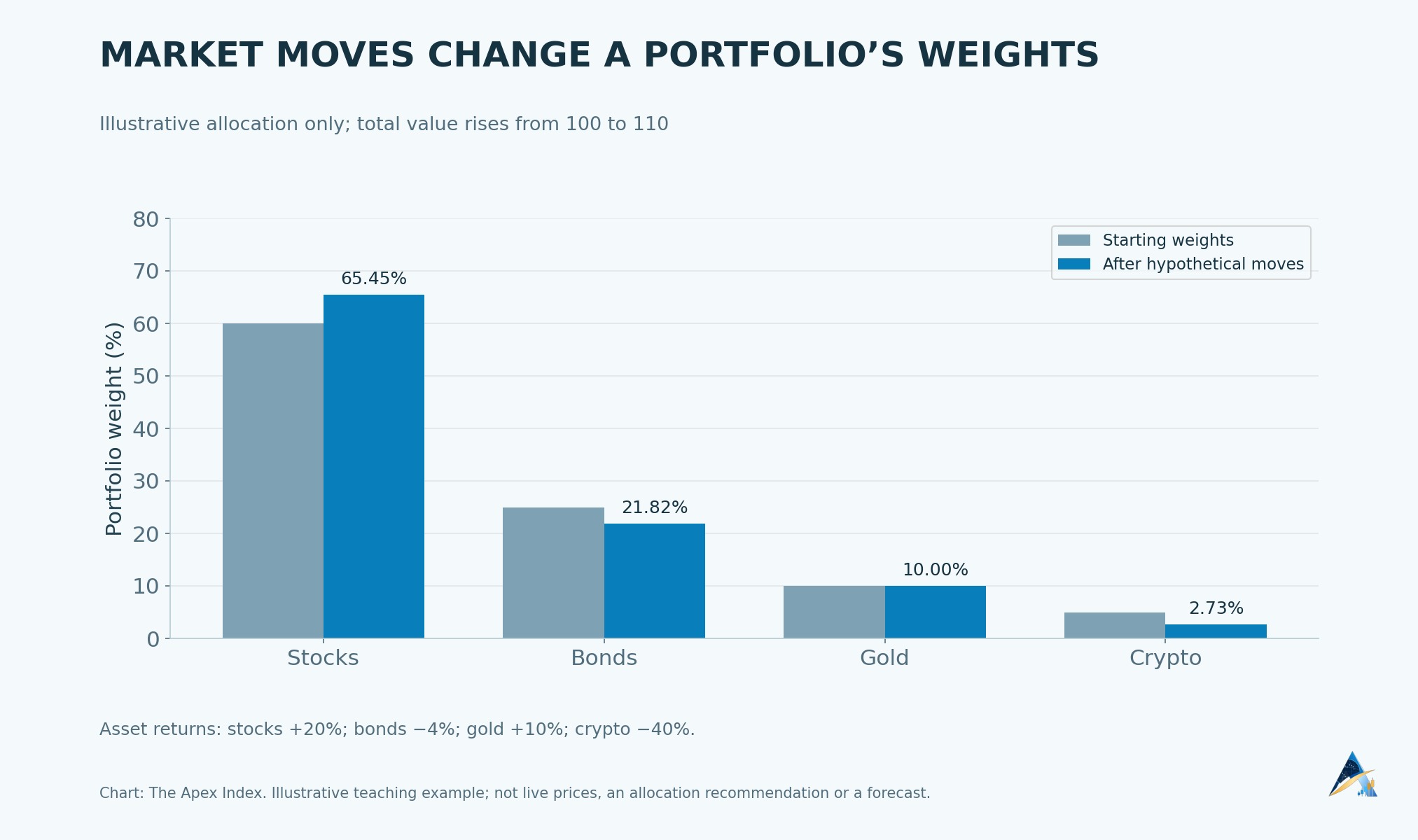
Suppose the example starts with 100 units of value. Stocks rise 20%, bonds fall 4%, gold gains 10% and crypto falls 40%. The holdings become 72, 24, 11 and 3 units respectively, totaling 110. The portfolio gains 10% even though two components lose value. Each outcome is hypothetical and excludes costs and distributions.
The new weights are approximately 65.45% stocks, 21.82% bonds, 10% gold and 2.73% crypto. The investor did not buy more shares, but the stock allocation expanded because it grew faster than the portfolio. A winning asset can therefore make a portfolio riskier without any deliberate decision to increase its weight.
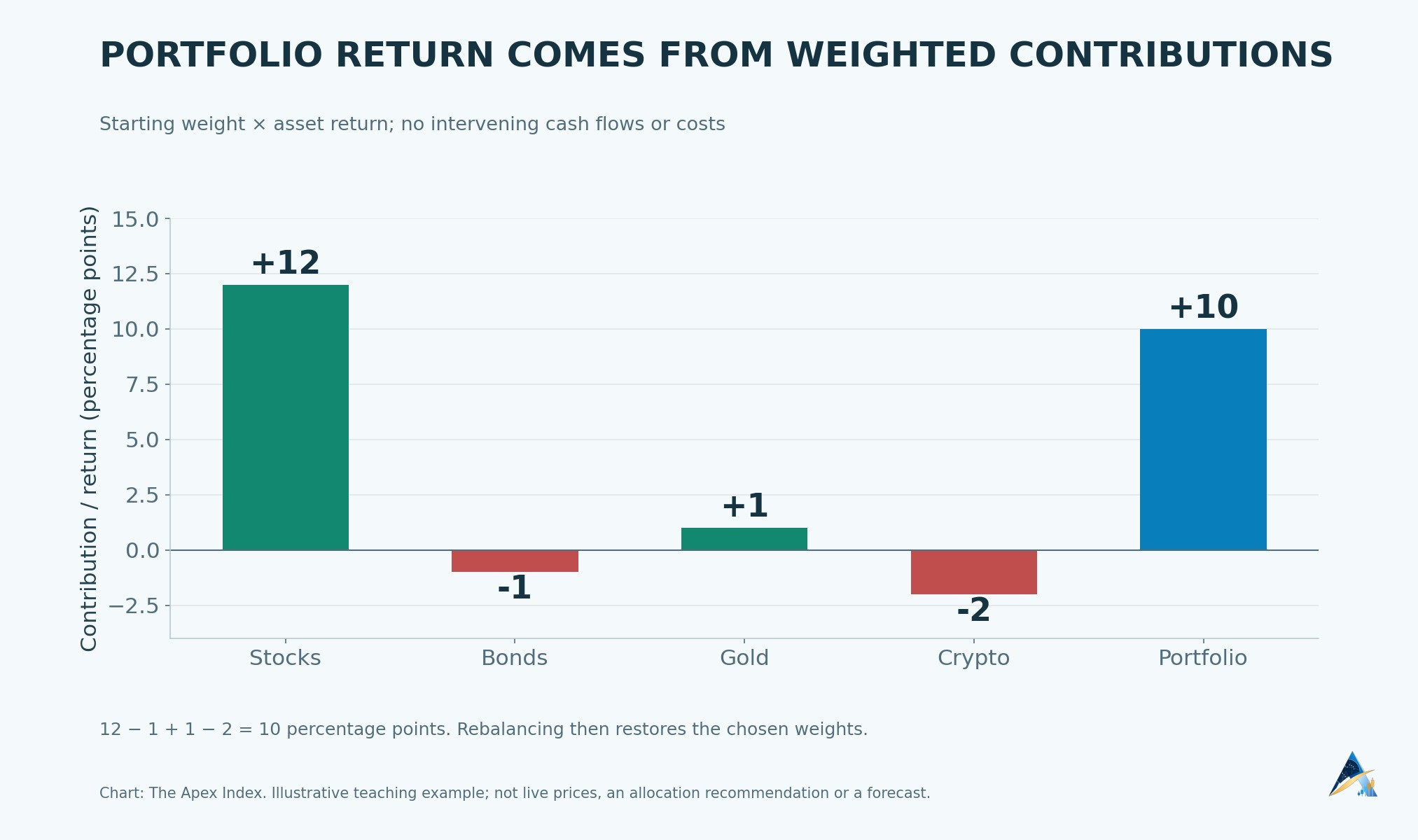
Portfolio return is the weighted combination of asset returns over the period, when there are no intervening cash flows and the starting weights are used. In the example, stocks contribute 12 percentage points, bonds subtract one, gold adds one and crypto subtracts two. The resulting ten-point gain explains the change from 100 to 110.
This calculation also shows why a small volatile position can matter. A 40% loss on a 5% starting allocation reduces the portfolio by two percentage points. The same loss on a 30% allocation would have a much larger effect. An asset's weight is part of its risk, not an administrative detail to decide after buying it.
Rebalancing restores a chosen risk level
To restore the original allocation at a total value of 110, the desired holdings are 66 stocks, 27.5 bonds, 11 gold and 5.5 crypto. That means selling six units of stocks and adding 3.5 to bonds and 2.5 to crypto. Gold requires no adjustment in this particular example. The purchases and sale balance before costs.
Rebalancing is not proof that the asset sold will fall or the assets bought will rise. It is a way to maintain a risk decision. That distinction can make an apparently uncomfortable trade understandable: the investor is reducing an unintended concentration, rather than claiming to predict the next market move.
Some investors review allocations on a calendar schedule. Others use tolerance bands that trigger a review when weights move far enough from target. A combined approach can also work. The process should be simple enough to follow, and should account for transaction costs, minimum trade sizes and any tax implications in the investor's jurisdiction.
New contributions or withdrawals can provide another route. Directing fresh savings toward underweight components may reduce the need to sell. Taking a planned withdrawal from an overweight holding can do similar work. The appropriate method depends on the account and the investor's cash flows, rather than a requirement to trade every component each time.
Risk budgets help when capital weights are misleading
A 5% position in a highly volatile asset can produce a disproportionate share of a portfolio's daily swings. Capital weights say how much money is invested; risk contributions describe how much each exposure affects the portfolio's uncertainty. They depend on volatility and relationships between holdings, which can change sharply during a crisis.
That does not mean every investor needs a sophisticated optimization model. A practical starting point is to test uncomfortable scenarios: a large equity decline, higher bond yields, a currency swing, or a severe crypto loss. Estimate what happens to the whole portfolio and whether the result would jeopardize its purpose. Use scenarios as stress tests, not forecasts.
Leverage makes that exercise more important. Borrowing, futures and options can produce an exposure much larger than the cash initially paid. The amount deposited in an account is not necessarily the maximum loss. A portfolio that appears diversified by cash allocation may be concentrated when its actual economic exposures are measured.
Consider liabilities alongside assets. A mortgage, business loan or future education payment changes the investor's needs. Holding assets that respond poorly when those obligations become harder to meet can create a double shock. Currency and liquidity mismatches can be especially damaging when the investor must make a payment on a fixed date.
Use a benchmark that matches the portfolio
Comparing a diversified portfolio with the strongest stock index of the year can encourage unnecessary risk. A portfolio containing cash, bonds and commodities should not be expected to track an all-equity benchmark. A more useful comparison considers the exposures the investor deliberately chose, alongside whether the portfolio remains on course for its financial objective.
Evaluate costs and results on the same basis. Returns before fees cannot be compared fairly with returns after fees, and cash added during the year complicates a simple beginning-to-end account balance comparison. Separate investment performance from contributions and withdrawals. That distinction helps identify whether a result reflects the market, the chosen allocation, implementation costs or additional savings.
Keep the plan specific enough to review
An investment policy can be a short document. Record the goal, time horizon, spending currency, target weights, acceptable drift and reasons for each component. State what circumstances justify changing the allocation. A change in a household's finances is different from a frightening headline or a fund that had a strong recent year.
Review the plan when the underlying circumstances change. Retirement, a major purchase, unstable income or a new liability can justify a different allocation. A market rally alone does not establish that the investor can afford more risk. Similarly, a decline should prompt a review of the holdings and the plan, rather than an automatic abandonment of both.
Be realistic about implementation. Costs, taxes, access restrictions and personal behavior can weaken a plan that looks excellent on a spreadsheet. A slightly less elaborate allocation that the investor can maintain may serve them better than a model requiring constant trades, perfect forecasts or accounts they cannot reliably use.
The purpose of asset allocation is to connect risk with a real financial objective. It does not require believing that stocks, crypto, bonds or commodities are always superior. It requires knowing why each exposure is present, how much damage it can do, and whether the portfolio can still perform its job when the market delivers an inconvenient outcome.