

A bull market is a sustained advance in an asset or a broad market. A bear market is a sustained decline. The labels describe the direction and character of prices; they do not tell you whether every company is healthy, whether an asset is cheap, or whether tomorrow will follow the same direction.
The distinction matters because rising and falling markets change how investors behave. Gains encourage borrowing, new listings and greater confidence. Losses expose weak balance sheets, tighten financing and make people demand more compensation for taking risk. The same investment can therefore trade at a very different price even before its underlying business changes much.
What counts as a bull or bear market?
A rise or fall of roughly 20% is the convention most often used to identify these regimes in a broad stock index. The U.S. Securities and Exchange Commission's glossary describes a bear market as a broad-index decline of at least 20% over at least two months. Its companion definition uses a comparable increase for a bull market.
That is a convention, not a universal law. Commentators differ about the starting point, minimum duration and whether a bull market must also surpass an earlier peak. A 20% rebound from a deep low can leave investors well below where they started. State the index, dates and measurement before treating a label as settled.
A correction usually means a decline of about 10% from a recent high, while a smaller retreat is often called a pullback. Those terms are descriptive. An investor does not receive advance notice that a correction will stop before becoming a bear market. Likewise, a few strong sessions do not establish a durable new bull market.
The terminology began in financial markets long before cryptocurrency existed. It now appears across stocks, digital assets, bonds, commodities and currencies. Applying the same percentage threshold to every instrument can be misleading: a 20% move in a volatile token is different from a 20% move in a broad government-bond portfolio.
Start with the arithmetic, not the mood
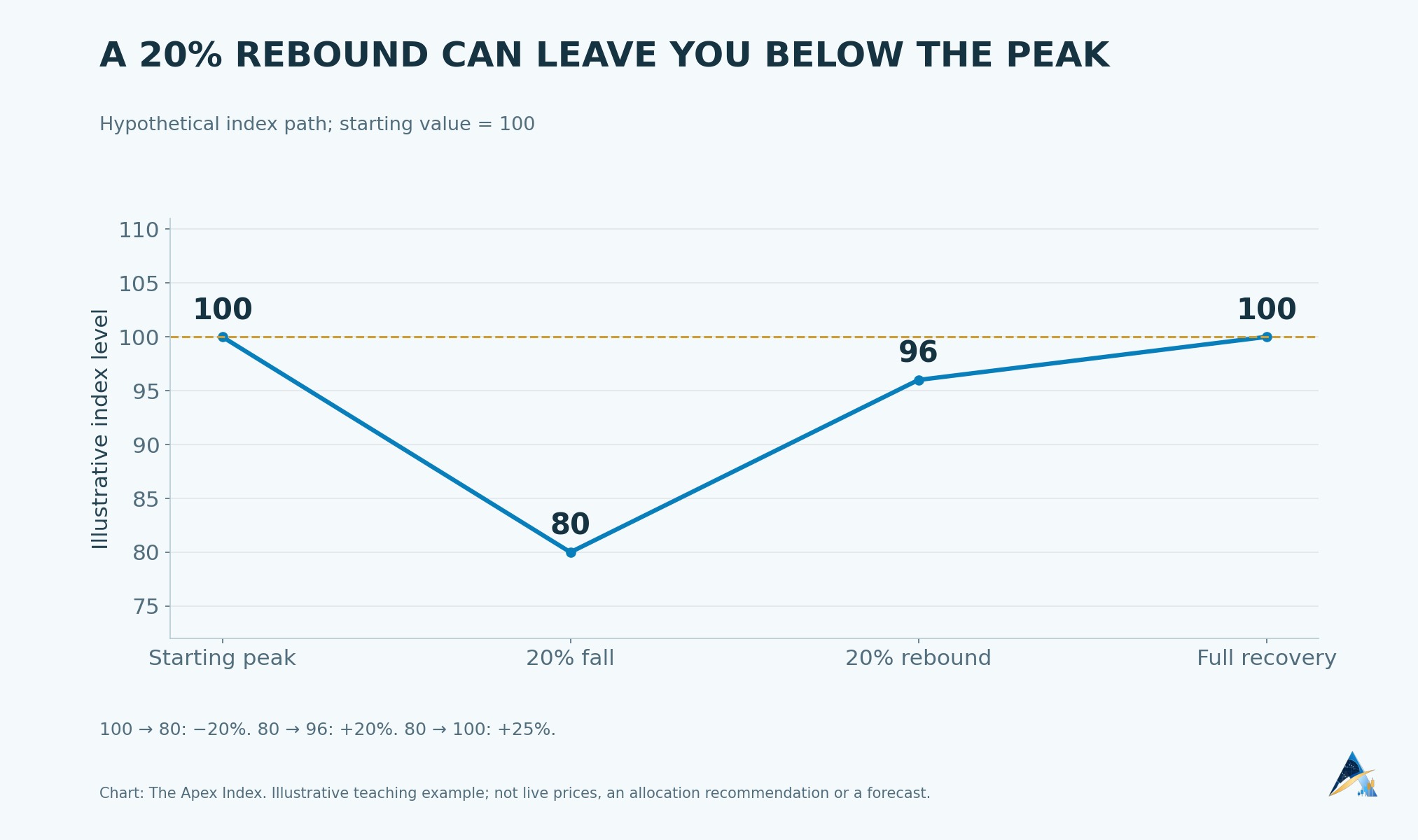
Measure a price change as the ending value divided by the starting value, minus one. A hypothetical index falling from 100 to 80 loses 20%. If it then climbs from 80 to 96, it gains 20% from the low but remains 4% below the original peak. Both statements are true.
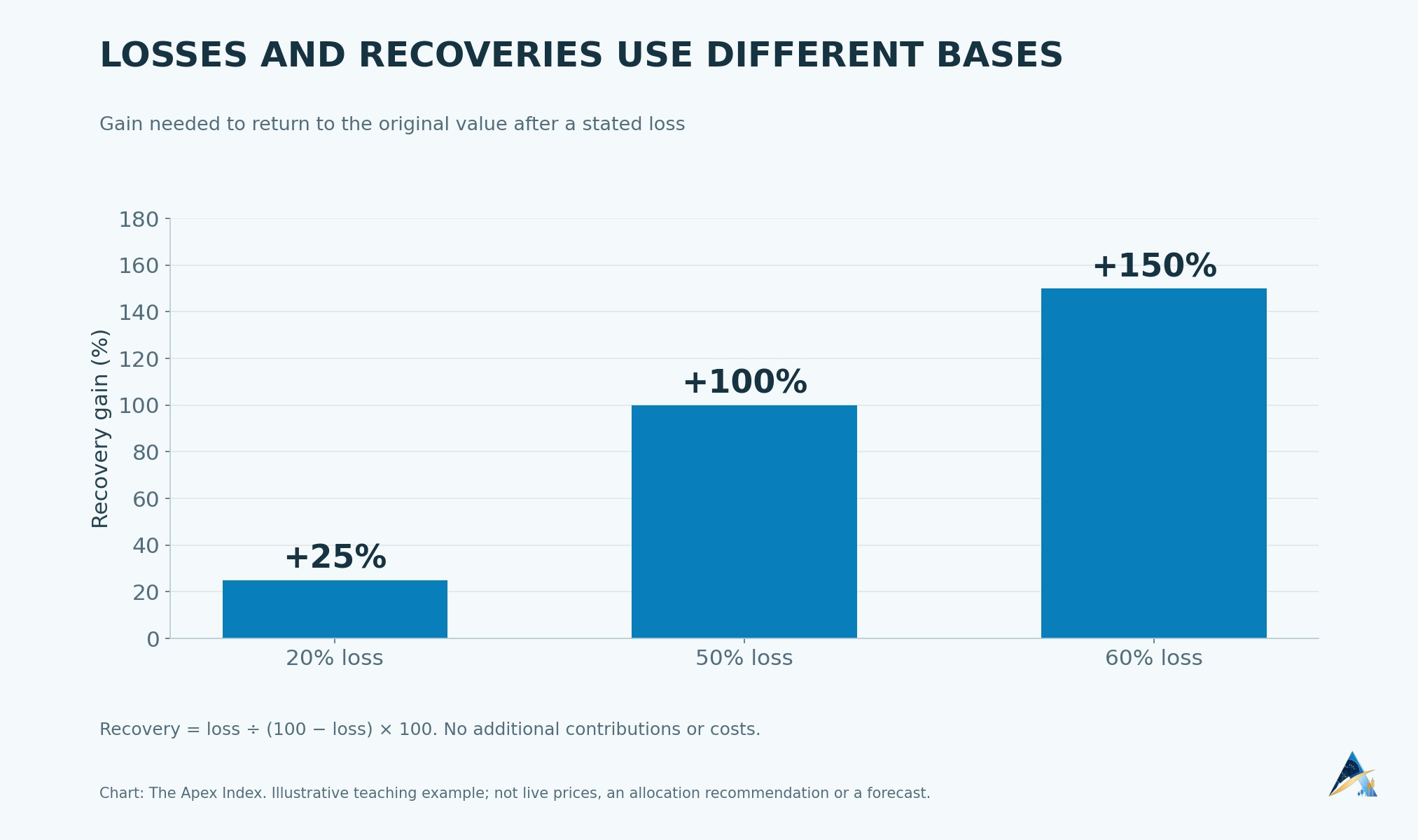
Drawdown is the decline from a previous high. Recovery is the gain needed to return to that high. They use different denominators. After a 20% loss, a 25% gain restores the starting value. After a 50% loss, recovery requires a 100% gain. This asymmetry becomes increasingly important as losses deepen.
A percentage return also needs a clearly defined series. An index's price return excludes dividends; its total return includes reinvested distributions. An individual share chart may be adjusted for stock splits and dividends. Comparing an adjusted series with an unadjusted one can make two investors appear to disagree when they are measuring different things.
Inflation adds another distinction. A portfolio can rise in currency terms while losing purchasing power. Currency conversion also matters when an investor buys foreign assets. The local stock market's return and the return measured in the investor's spending currency need not match. A bull-market headline is therefore only the beginning of the measurement.
Stock-market regimes are about more than the index
A stock represents a claim on a business, but its market price reflects expectations about profits, financing costs and the value investors place on uncertain future cash flows. A bull market can develop because earnings improve, because interest rates fall, or because investors become willing to pay a higher multiple for the same earnings.
Those drivers have different implications. Improving profits may provide support for valuations. Expanding multiples can leave the market more vulnerable if optimism changes. A bear market can reverse either process: earnings estimates fall, valuation multiples contract, or both happen together. Strong companies can decline when investors reduce exposure to the whole market.
Breadth asks how many securities participate in a move. A capitalization-weighted index can rise while many smaller constituents fall if its largest companies do most of the work. An equal-weighted version, sector indices and the number of advancing securities can reveal that difference. They offer additional evidence, rather than a mechanical prediction of the next reversal.
The S&P 500, for example, is not the entire global equity market. Technology shares, banks, emerging markets and smaller companies can occupy different regimes at the same time. An investor whose holdings differ from the headline benchmark should not assume the benchmark describes their own experience.
Crypto can magnify the same forces
Bitcoin and other crypto assets react to liquidity, risk appetite, regulation, adoption and the structure of trading. Their markets also include substantial derivatives activity. When leveraged positions face liquidation, forced buying or selling can accelerate a move that began for another reason. Rising prices can encourage additional leverage, which makes a later reversal more disruptive.
A crypto bull market can spread from larger assets to smaller tokens as traders pursue returns. That does not make every token economically useful or financially sound. Token issuance, concentrated ownership, unlock schedules and trading depth can matter as much as the market's overall direction. A token can collapse during a broader advance.
The reverse is also possible. Network usage or development can improve while the token's price falls. A successful product does not automatically produce demand for a particular token, and transaction activity does not necessarily accrue value to holders. Investment claims need to explain the connection rather than rely on a rising-market narrative.
Crypto's continuous trading adds another practical difference from exchange-listed stocks. Prices can move while traditional exchanges are closed, and execution may vary substantially between venues. A reported rebound in one token is not proof that the whole digital-asset market has recovered. Compare consistent instruments and avoid treating market capitalization as cash actually invested.
Commodities have their own cycles
Commodity prices reflect physical supply, consumption, inventories and transportation, as well as financial positioning. A drought can push agricultural prices higher while stocks are falling. A slowdown can weaken industrial metals while demand for monetary protection supports gold. There is no requirement for all assets to share a regime.
An oil bull market may be good for producers but costly for airlines, manufacturers and households. A copper bear market can signal weaker industrial demand, expanding supply, or both. Understanding the cause matters because the same price direction can have different consequences for corporate earnings, inflation and national trade balances.
Most financial investors do not receive barrels of oil or tons of copper. They use funds, futures or shares in producing companies. The CFTC explains that futures are contracts to buy or sell a commodity or financial instrument at a future date. Their prices and financing arrangements differ from owning the physical asset.
A commodity fund that rolls futures can have a different return from the spot price. Contracts may trade above or below nearby maturities, and replacing an expiring position changes the economics. A mining company's share price also reflects operating costs, debt and management decisions. Calling the underlying commodity bullish does not settle the outlook for either investment.
Bonds and currencies complicate the labels
For a conventional fixed-rate bond, a rise in required yield generally means a fall in market price. A bond-price bull market can therefore coincide with declining yields. Headlines describing a bull market in yields mean something different. Always check whether the series measures a price, a yield or a total return.
Government bonds, investment-grade corporate debt and lower-quality credit respond differently to shocks. Falling interest rates may support government-bond prices while fear of default weighs on corporate bonds. Credit spreads capture compensation beyond the relevant government yield. A bond portfolio can therefore suffer even when the central bank cuts its policy rate.
Currencies are quoted in pairs. If one strengthens against another, the other weakens in that pairing. A currency can gain against some counterparts and lose against others. Describing it as universally bullish without naming the comparison hides information that matters to exporters, borrowers and investors holding foreign assets.
A recovery is not a straight line
A bear market can contain powerful rallies. Investors cover short positions, valuations attract buyers, or a policy announcement changes expectations. None of those forces guarantees the original decline is finished. Bull markets likewise contain setbacks, including substantial corrections. A regime describes a broader pattern, not a promise of uninterrupted daily movement.
The second illustration uses a hypothetical index to separate three different questions: how far it fell, how much it recovered from the low, and whether it regained its old high. It is a teaching example rather than a chart of an actual current market. Its purpose is to make the competing percentage descriptions visible.
Markets also anticipate economic developments. A stock-market recovery can begin before employment or output improves because prices incorporate expectations about the future. Conversely, an economy can still be growing when shares begin falling. A market regime is not interchangeable with an official recession determination or a forecast of the next economic release.
Investors often recognize a turning point only later. Waiting for every economic indicator to confirm a recovery can mean buying at a substantially higher price. Acting before confirmation can mean being wrong. That uncertainty is why a portfolio plan should not depend on identifying the exact bottom or top in advance.
Put the market story beside the balance sheet
A rising price can hide financing problems for a while. Companies may issue shares or refinance debt more easily when investors are enthusiastic. In a downturn, the same business may face a higher borrowing cost or lose access to funding altogether. Look at debt maturities, cash generation and the amount of financing required before profitability, rather than assuming a previous high is a fair-value target.
The equivalent questions in crypto concern treasury assets, incentive spending and token supply. A project paying users with newly issued tokens may show impressive activity while creating selling pressure for holders. Commodity producers face a similar distinction between a strong selling price and the actual cash left after operating costs and new investment. Broad market conditions influence those businesses without eliminating their individual economics.
Write down the reason for owning an investment before deciding how a market regime changes the position. A thesis based on earnings growth needs an earnings review. A holding intended to diversify a portfolio needs a portfolio review. An asset bought only because its chart was rising has a different justification altogether. Keeping those reasons separate makes a decision easier to examine later, particularly when a dramatic headline makes an ordinary fluctuation feel like an emergency.
What should investors actually do with the labels?
Begin with the money's purpose. Funds needed for a near-term expense have a different role from long-term retirement capital. A bull market does not make a volatile asset suitable for an upcoming payment, and a bear market does not automatically invalidate a diversified investment meant to be held through several economic cycles.
Review concentration and leverage next. A portfolio that drifted toward one winning sector may carry more risk than its owner intended. Borrowing against assets can force a sale when prices fall, removing the option to wait. The important question is whether the portfolio can survive an adverse outcome, not whether a persuasive commentator sounds confident.
Buying after a decline can lower the purchase price, but it is not automatically bargain hunting. A weaker business may deserve a lower valuation, and a token may never recover. Distinguish a change in market sentiment from a permanent impairment of the investment. Check financing needs, competitive position, asset custody and the ability to exit.
Rebalancing offers a more disciplined response than treating every market label as a trading signal. Investors compare current weights with their chosen allocation and adjust when the difference becomes meaningful. Taxes, transaction costs and available cash affect the decision. The appropriate action follows the plan and the investor's circumstances, rather than a universal instruction to buy dips.
Finally, separate observation from prediction. You can establish that an index has fallen 20% from a particular peak. You cannot establish from that fact alone how much further it will fall. Bull and bear are useful words when they clarify the asset, period and calculation. They become dangerous when they replace the work of understanding what you own.