

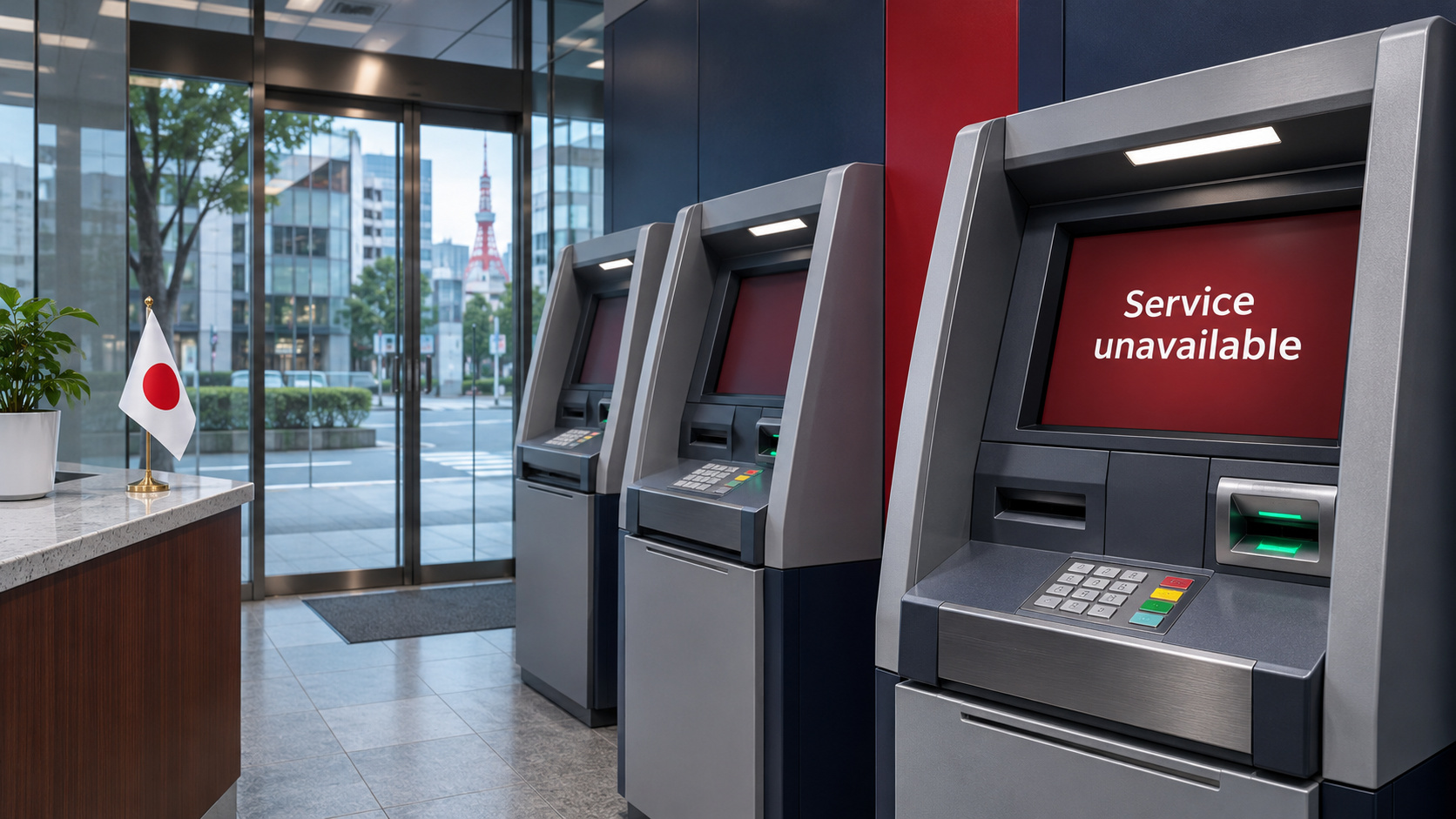
A shared banking-system failure stopped transactions across 128 Japanese community lenders and 3,430 branches on November 6, leaving customers unable to use ATMs or complete transactions at counters. Services were fully restored at 10:05 UTC after a disruption lasting about five and a half hours.
The affected institutions were shinkin banks, Japan's cooperative community lenders, in the Tokai region and farther west. Eastern Japan's shinkin institutions continued operating normally. The incident affected a shared network, rather than every bank in the country.
A system update is linked to the failure
The Shinkin Joint Center, which provides the shared transaction system, attributed the problem to an equipment failure associated with an ATM system update carried out in western Japan the previous month. Its latest account said the failure was not caused by unauthorized access from outside the network, with a detailed investigation to follow.
The disruption began at 04:30 UTC during Japan's banking day. All ATMs at the 128 affected institutions became unavailable, and counter transactions stopped across the 3,430 branches.
That left customers facing the same obstacle through several different channels. Going into a branch did not necessarily solve a problem encountered at an ATM because the counter services also depended on the unavailable shared system.
Banks warned that online transactions had stopped
Osaka City Shinkin Bank's initial notice told customers that the shared online system was experiencing a failure and all online transactions had stopped.
The bank listed counter services, ATMs, internet banking and ATM transactions using other banks' cash cards among the affected services. Its warning covered transactions involving account processing, making the problem broader than an interruption to cash withdrawals alone.
For customers who needed to move money urgently, the bank gave a practical alternative. Translated from Japanese, its notice said:
Customers needing urgent transfers and similar transactions are asked to use financial institutions other than shinkin banks.
That advice applied while the shared service was unavailable. It directed urgent business away from the affected cooperative network rather than asking customers simply to try a different branch of the same bank.
Recovery happened in stages
The restoration was gradual. By 09:00 UTC, ATM deposits and withdrawals were available again, according to the center's account carried by the Asahi broadcasting network. Transfers to other banks and payment-remittance services remained unavailable at that stage.
Full restoration followed at 10:05 UTC. From the reported starting time of 04:30 UTC, that puts the interruption at five hours and 35 minutes.
Osaka City Shinkin Bank subsequently posted a separate update confirming that the problem had been resolved. In an English translation, it said:
The disruption to the Shinkin shared online system that occurred today has been resolved.
The bank apologized to customers for the inconvenience. The later notice replaces its earlier warning as the bank's current service-status update.
One failure reached thousands of branches
The scale came from the shared infrastructure. The participating institutions use the center's systems to provide routine banking services, so a technical problem could reach many lenders at once even though they operate under separate names.
Friday's disruption affected both the physical and online sides of banking. Customers at counters, people trying to deposit or withdraw cash, and users attempting account-related transactions were all caught in the interruption described by the banks and the system operator.
The center's initial recovery brought cash services back before the remaining transfer functions, showing why a working ATM screen alone was not the whole recovery picture. The final restoration announcement covered the broader system, while the operator said further investigation would examine the equipment failure linked to October's update.
The bank's messages also distinguished between the initial loss of service and the later confirmation of recovery, giving customers a clear change in status after the prolonged interruption.