

Hedge funds have been cutting their U.S. stock exposure as the AI trade gets harder to stomach. Goldman Sachs's prime-brokerage desk recorded $20 billion in technology-stock selling over two weeks, adding to a broader retreat from American equities.
The figure comes from a bank note reported on October 26. It measures selling handled by Goldman's desk, rather than the market value erased from technology companies or a count of every hedge fund's trades.
U.S. equities had been net sold for three consecutive weeks and in four of the previous five, according to the note seen by Reuters. Single stocks also saw the biggest overall reduction in positions since late July.
The $20 billion tech retreat was approaching the $23 billion Goldman recorded during July's unwind. The comparison helps explain the attention on fund positioning: a lot of risk was being taken off in a short period.
Funds are shrinking their bets
The trading-desk term is de-grossing. Funds reduce the total size of their positions, which can involve selling shares they own and closing bets against other stocks. It describes money being taken out of positions on both sides of a portfolio.
The losses were particularly sharp for strategies that follow market trends. In the week covered by the October 26 note, systematic long-short funds fell 2%, their worst weekly performance since 2024. Fundamental long-short strategies, which rely on company analysis, lost another 1.1%.
Both groups were still ahead for the year at that point. Goldman put the systematic strategies' gain at 18.7% and fundamental long-short funds' return at 8.8%. Those were the note's figures, before the final trading days of October.
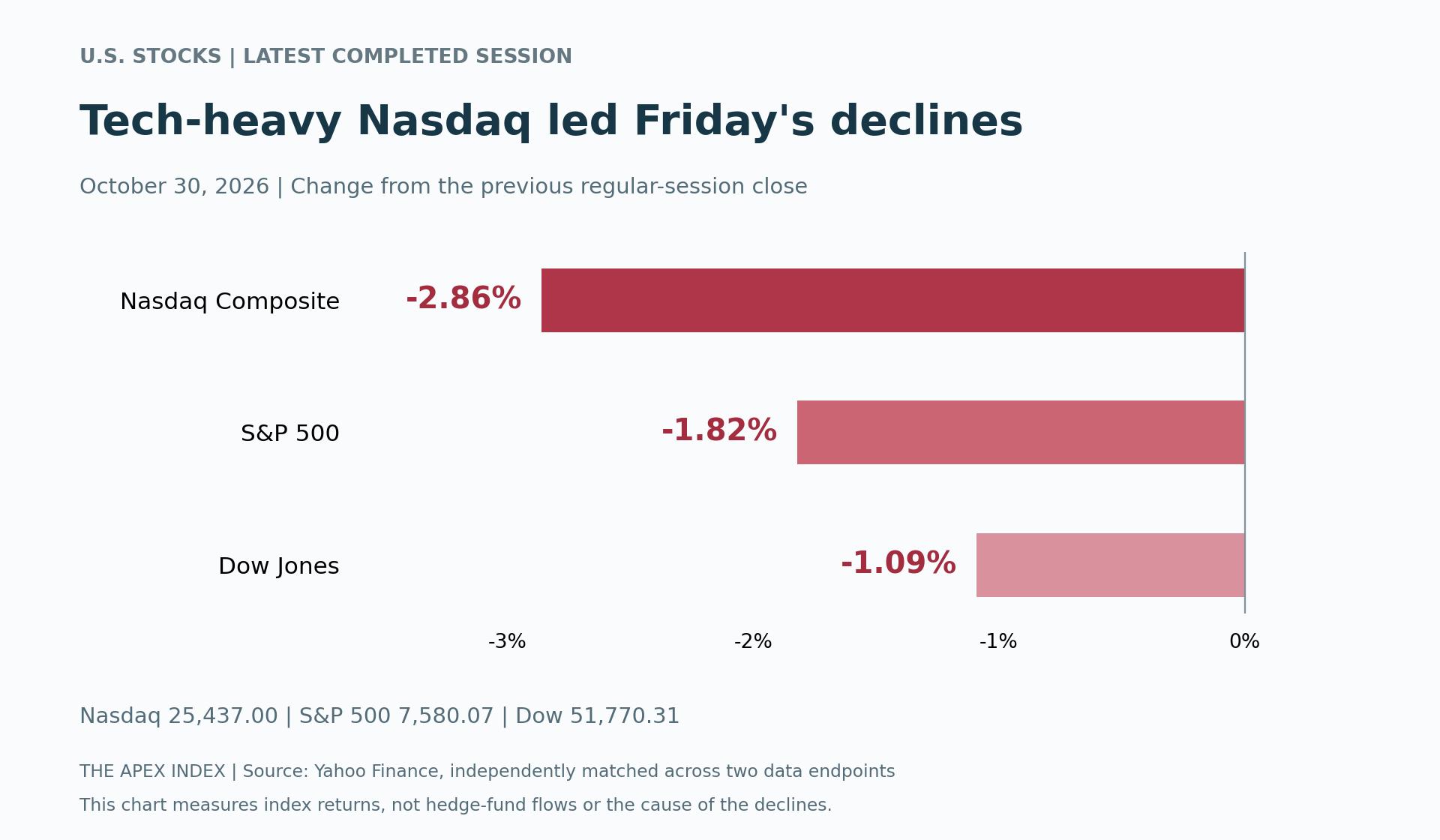
The pressure has continued to show up in stock prices. Friday's completed session left the Nasdaq Composite down 2.86%, the S&P 500 down 1.82% and the Dow down 1.09%, as Apex's market coverage reported. The Nasdaq closed at 25,437.00.
The question is who can pay for the AI build-out
Goldman's public discussion of the market points to a growing split between demand for AI and the cost of supplying it.
In an October 30 transcript, Lee Coppersmith of the bank's equity derivatives sales team said demand remained strong, but competition was getting tougher and investors were paying closer attention to financing.
The interview was recorded on October 29. He said investors were buying fewer call options, which can profit from rising share prices, while purchases of protective put options had picked up. Both institutional and retail enthusiasm for bullish options had cooled.
Coppersmith put average retail trading volumes roughly 20% below late-June levels. He said leveraged exchange-traded funds were still attracting some dip buying, even as investors showed less appetite for bullish options. His desk's observations point to a change in how people are trading, with some buying continuing alongside the reduction in risk.
That doesn't leave every investor reading the selloff the same way. Macro investor Jordi Visser pushed back against crash warnings in a Sunday post:
Read X and you'd think we were headed for a crash. October saw the largest hedge fund degrossing in over a decade.
Visser argued that investors were adapting to a market shaped by huge capital needs, hardware shortages and sharp rotations between stocks. His assessment challenges the idea that forced selling necessarily means demand for AI is collapsing.
Coppersmith also described opportunities away from the most crowded part of the trade. Asked where he would look next, he said:
I think the easiest place to go hunt right now is particularly outside of the AI space. We like biotech here.
He pointed to the possibility of lower rates, more mergers and acquisitions, and AI-assisted drug discovery attracting investment to that sector.