

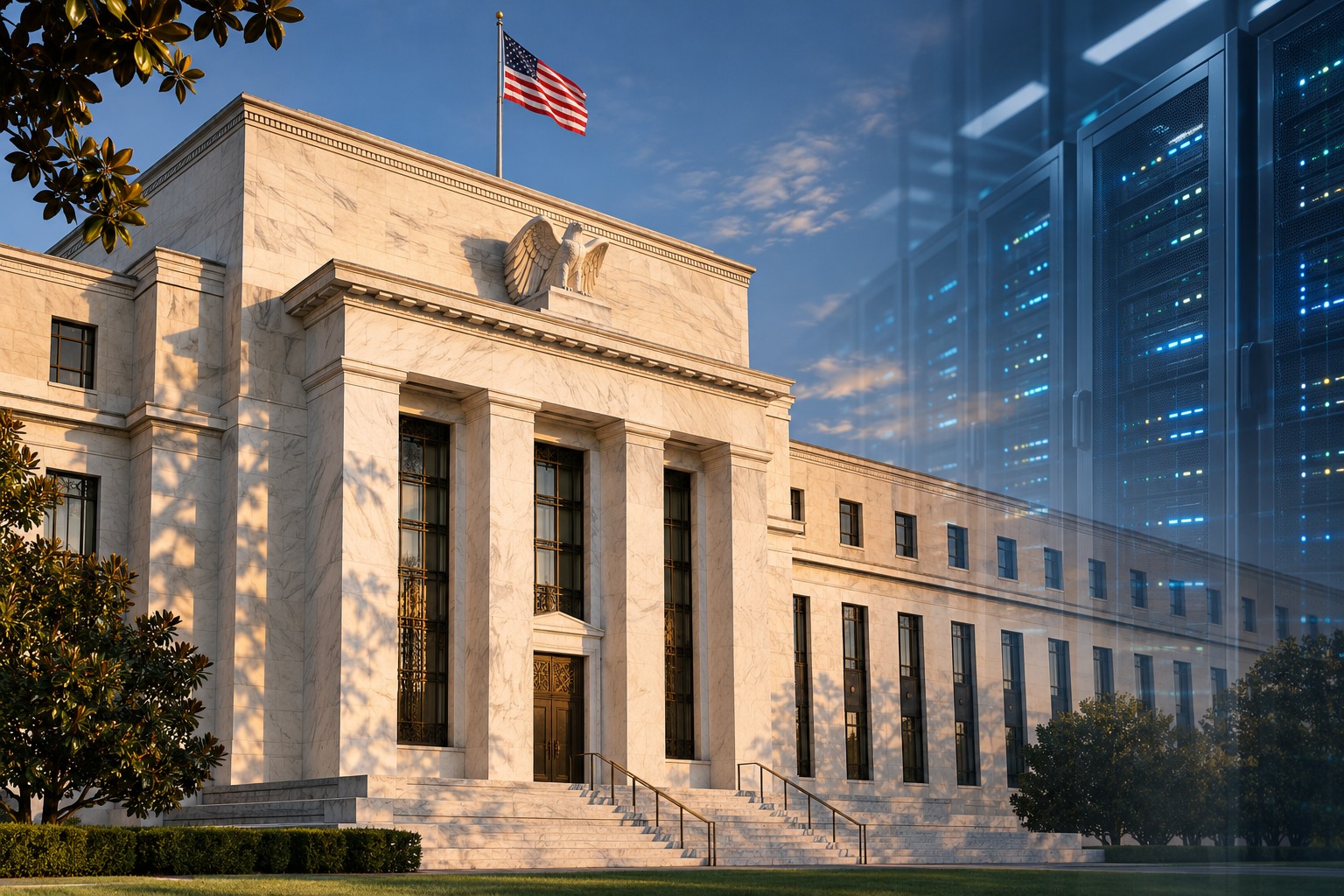
Federal Reserve Chair Kevin Warsh says America's AI boom could end with falling stock prices, a slowing economy and higher unemployment if the technology fails to deliver the returns investors expect.
Speaking in San Francisco on Monday, Warsh laid out several possible paths for AI, including one where heavy spending produces lasting growth and another where workers lose out even as output rises. The worst of the three would leave the economy recovering from a setback without the productivity gains that helped justify the investment.
When the AI payoff doesn't arrive
In his remarks to the Productivity and Jobs Task Force Conference, Warsh said Fed staff had begun using economic models to work through different outcomes over the next several years. He called them illustrative scenarios rather than forecasts.
The downside case starts with money already committed and stock prices already lifted by expectations of what the technology will do.
After significant capital investment and stock market gains, expected returns could turn down and equity valuations could fall, leading to an economic slowdown and a more notable rise in unemployment.
Warsh added that the economy would eventually recover in that scenario, but without the productivity gains.
That possibility matters because the economic payoff is still unsettled. He said productivity growth had been reasonably strong in recent quarters, yet had not made a clear, lasting break above its previous trend. Better results for a stretch of time would not, on their own, establish that the economy had moved onto a permanently faster growth path.
He used the term "super intelligence," or SI, for the technology at the center of the discussion. Its potential advantage, he argued, goes beyond helping people complete existing tasks. It could speed up the creation of ideas themselves, changing how quickly innovation happens.
That is where he sees the opportunity for growth to run substantially above its long-term average, provided the technology broadens the generation of new ideas.
Growth can rise while workers struggle
There is also a less straightforward outcome between a broad economic success and a disappointing investment boom. AI could raise output while leaving more people looking for work.
Warsh said technology might replace some jobs instead of making the people doing them more effective. The economy would still grow faster than its long-term average, but workers could have trouble moving into other roles.
But widespread automation, combined with labor market frictions, could push the jobless rate above levels consistent with full employment.
His most favorable scenario looks different: productivity rises, the gains reach both workers and the owners of capital, and the US stays close to full employment while real GDP grows persistently faster than its historical average.
The difference between those outcomes gives the central bank plenty to consider. Its task is to assess the scale of the change, how broadly it spreads and when it arrives. Warsh also raised the possibility of hostile actors using the technology to harm the economy, pointing to vulnerabilities in critical infrastructure.
The Fed brings businesses into the discussion
Monday's conference was organized by the Fed Board and the San Francisco Fed. The agenda brought together business leaders, economists and people working on adoption in areas including manufacturing and healthcare.
Scheduled participants included Stripe's Patrick Collison, Palo Alto Networks' Nikesh Arora and Affirm's Max Levchin. A later discussion paired Marc Andreessen with former Commerce Secretary Gina Raimondo. The productivity and jobs group is one of five task forces Warsh has convened as chair.
The debate also comes while interest rates remain elevated. At its October 28 meeting, the Fed held its benchmark target at 3.75%-4%, describing productivity growth as strong, capital investment as robust and inflation as elevated.
Warsh's questions on Monday concerned what follows that investment: whether it raises living standards, how long any acceleration lasts and whether the US benefits sooner than other countries. He said the Fed's responsibility was to prepare for the economic effects, rather than advocate for or oppose the technology.