

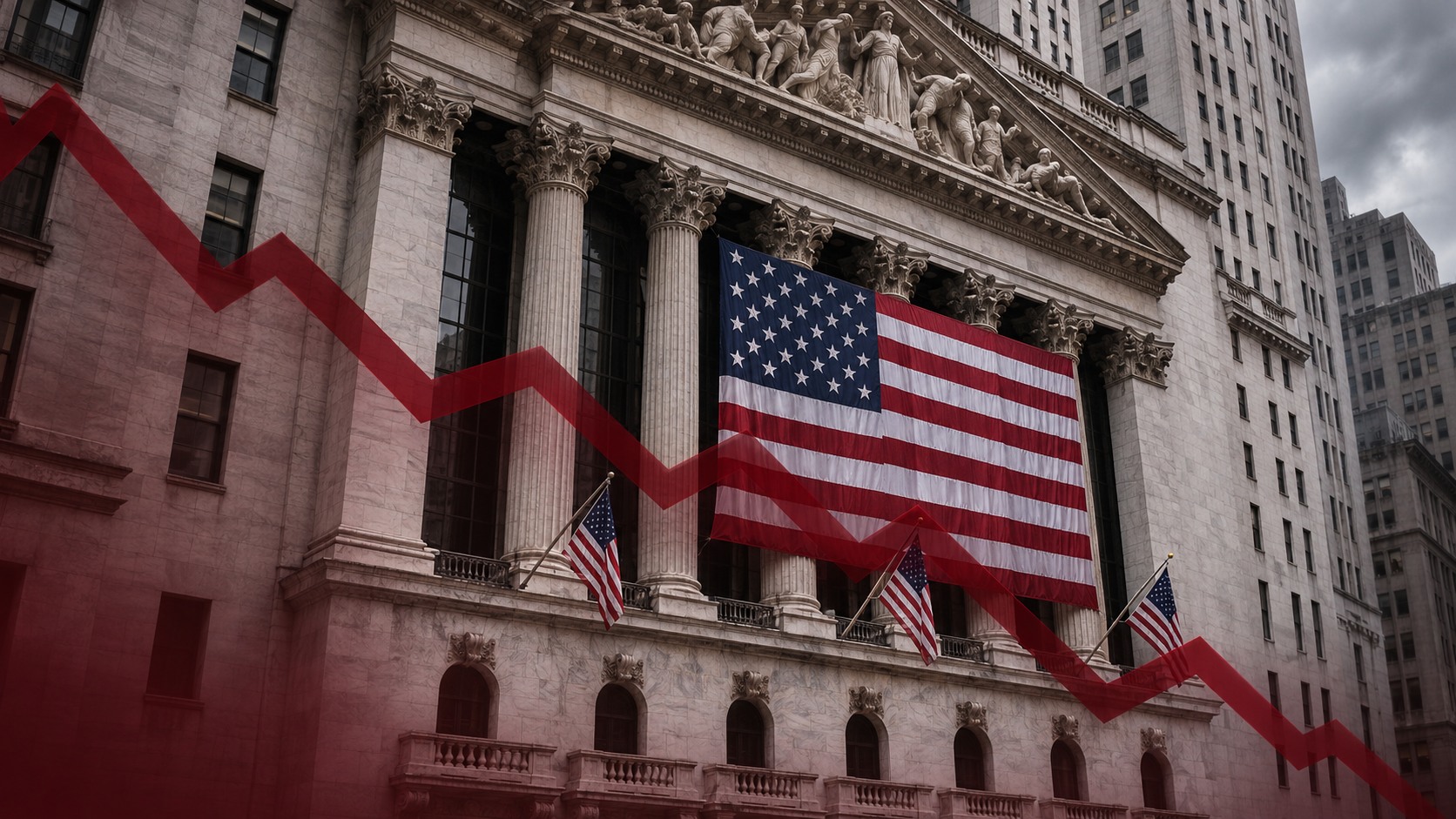
Wall Street's bad week got worse on Friday. The Dow Jones Industrial Average was heading for its steepest weekly loss since April 2025, the Nasdaq Composite had lost all its gains for 2026, and the S&P 500 had slipped roughly 10% below its intraday record.
Technology shares were taking the hardest hit as investors sold AI names again. Anthropic's blockbuster debut on Thursday had offered an early burst of excitement, but the stock's second session brought another sharp retreat. Nvidia and AMD were also falling heavily.
As of the time this article was written, the site's TradingView feed showed the Dow at 48,880.22, down 0.44% on the day and 6.88% over the past week. That put the blue-chip average on course for its worst week in about 19 months.
The Nasdaq was down 3.23% at 23,107.02, leaving it 1.59% below its year-start level. Its weekly loss had reached 9.06%. The S&P 500 fell 1.89% to 7,039.87 and was down 7.58% over the week.
The Nasdaq's gains have gone
The gap between the indexes shows how hard the tech trade has been hit. While the Dow and S&P 500 still had modest gains for 2026, the Nasdaq had turned negative. Stocks that had helped carry the rally were now dragging it down.
Nvidia was trading at $136.04, down 6.81%, while AMD fell 10.97% to $435.54. Anthropic slid 11.42% to about $86.08, bringing it much closer to its $83 IPO price.
As previously reported by Apex in the article below, Anthropic closed its first session at $97.17 after opening at $111.50 and touching $115.10. That first-day pullback had already left buyers at the opening price with losses, despite a closing gain of 17.1% over the offer price.
Friday's selling extended that reversal. A company able to raise tens of billions of dollars at its IPO was still finding out how much support its shares could hold once public trading began.
For the broader market, the S&P 500's fall to 7,039.87 put it about 10.26% below its record intraday high of 7,844.52. Google Finance independently showed the same record high. A decline of 10% is commonly described as a correction, though the reference here is the intraday peak rather than a record closing level.
The Fed is adding pressure to the AI trade
The selloff comes with investors facing the prospect of higher borrowing costs alongside doubts about the returns from enormous AI investments. Minutes from the Federal Reserve's October 27-28 meeting, released this week, show officials were already watching both risks closely.
The minutes said almost all participants thought further rate increases would likely be appropriate under their baseline economic outlooks. Some were considering a larger move if the inflation figures went the wrong way:
A couple of participants noted that an increase of more than 25 basis points could warrant consideration at the next meeting if incoming inflation data were unfavorable.
Higher rates raise financing costs and can reduce what investors are willing to pay today for profits expected years from now. That leaves expensive growth stocks exposed when confidence in future earnings weakens.
Officials also questioned whether the AI investment boom would deliver the returns investors expected:
Several participants also noted risks that the AI investment surge could be excessive, leading to lower-than-expected returns, and a couple of participants noted that it could be crowding out other types of investment.
The minutes described rapid growth in AI-related debt and concerns about complex financing structures. They also recorded the view that the financial system remained resilient, with well-capitalized banks able to withstand losses under the severe scenarios considered.
The Fed held its benchmark target range at 3.75%-4% at that meeting. Its next decision is scheduled for December 8-9, giving investors another inflation-sensitive policy meeting to navigate while the market's biggest growth trade is under pressure.