


DBS says 88% of large businesses in its latest survey are deploying or piloting tokenized money, as finance teams look for better ways to manage cash and make payments across borders.
The sample matters. The bank commissioned EY to survey 422 business and finance leaders at organizations with more than $500 million in annual revenue across 11 markets. Those responses describe this group of large companies, rather than every business or the share of corporate assets held in tokens.
The report, The Great Rewiring: Money in a New Order, was released on October 28. Participants included chief financial officers, finance heads and senior treasury executives. Reuters reported that the fieldwork took place in June and July.
What the 88% actually includes
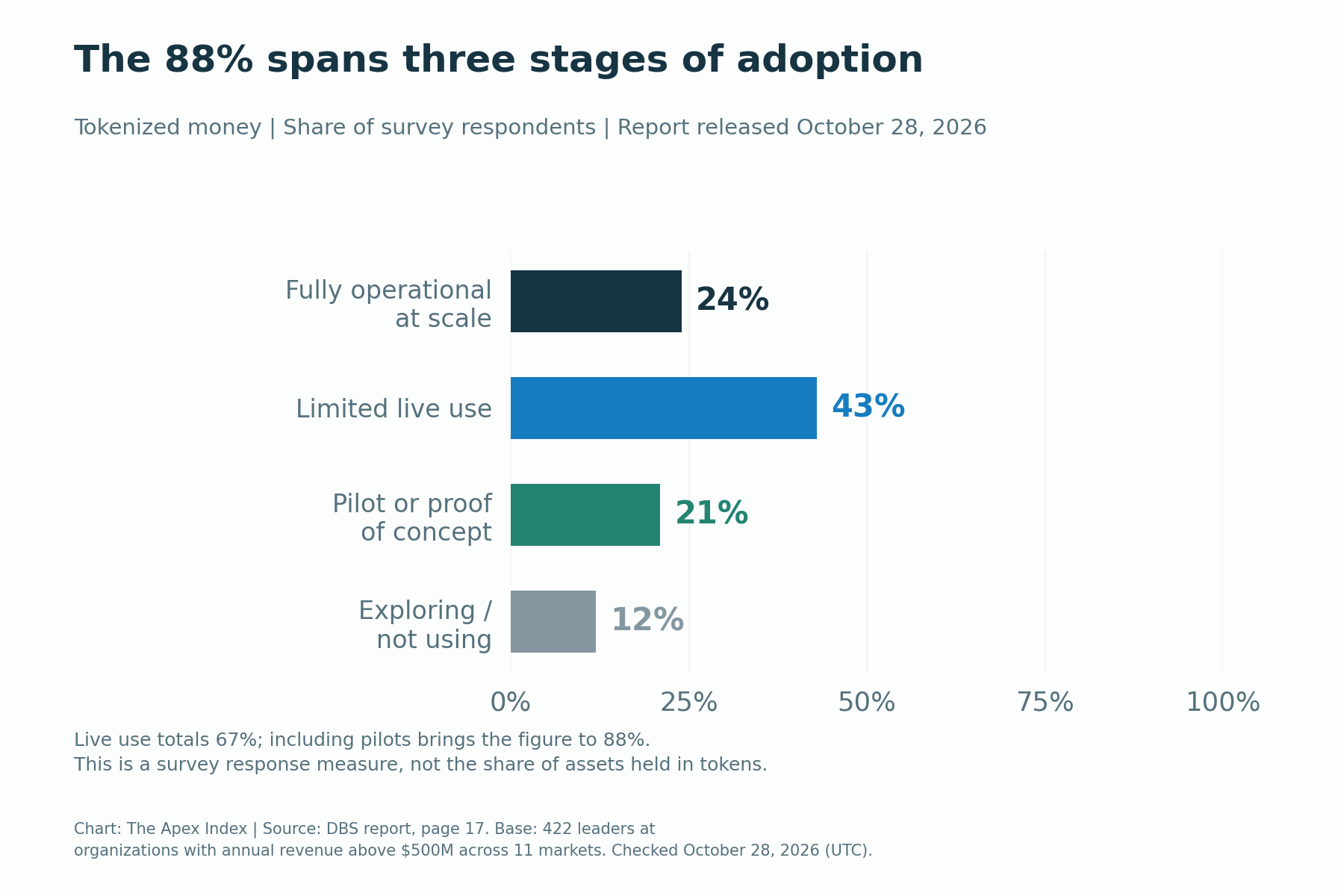
Only 24% of respondents said tokenized money was fully deployed and operational at scale. Another 43% reported limited live use in selected locations, while 21% were running pilots or proofs of concept. The remaining 12% were exploring the technology or not using it.
That makes 67% with some live use, plus the pilot group that brings the headline figure to 88%. A company testing a payment process is at a different stage from one relying on it across its operations.
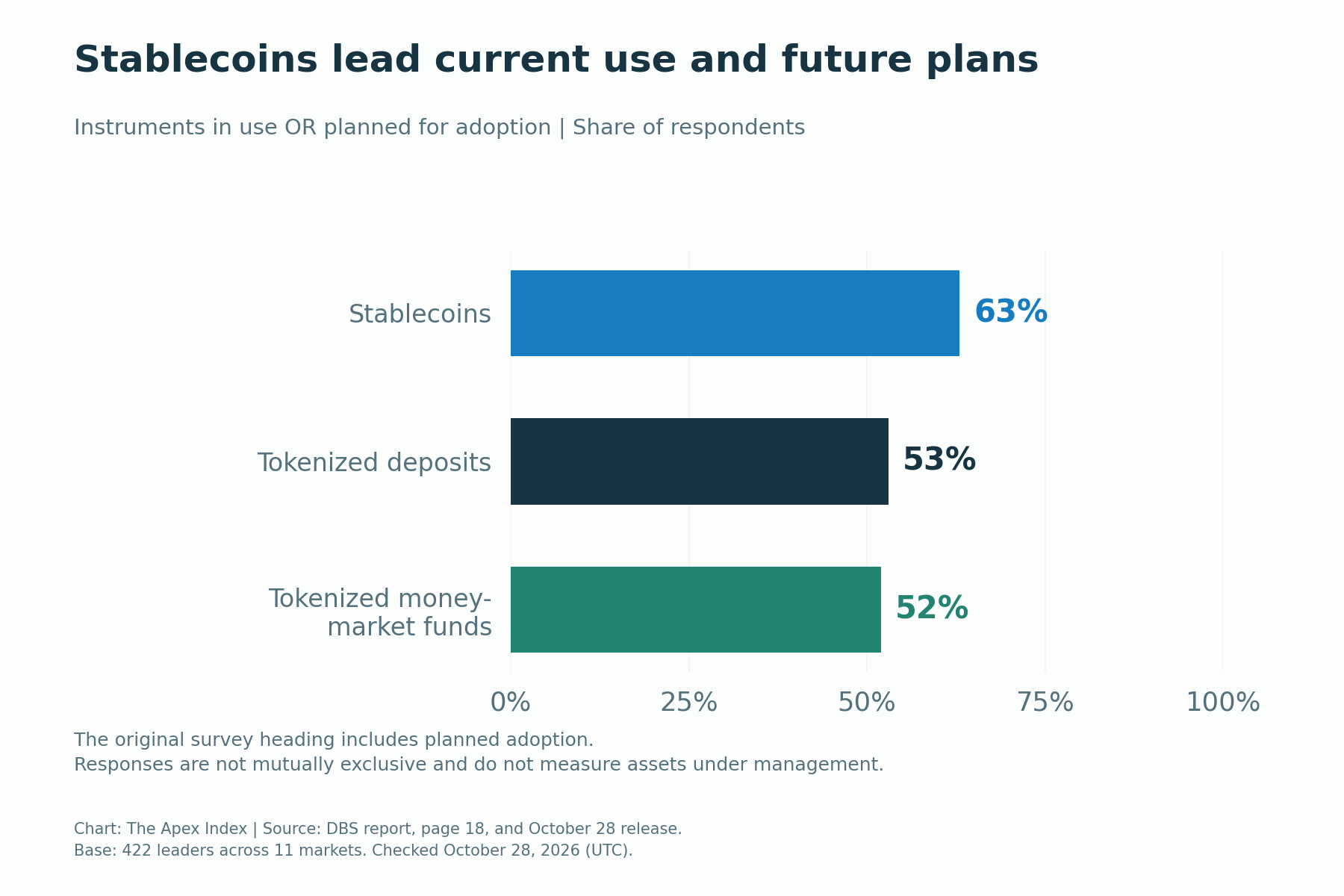
The instrument breakdown also needs a careful reading. The underlying chart combines instruments already in use with those companies plan to adopt: stablecoins led at 63%, followed by tokenized deposits at 53% and tokenized money-market funds at 52%. Those figures should not be read as three separate measurements of completed adoption.
These are different financial products. Stablecoins are tokens designed to maintain a reference value, often against a currency. Tokenized deposits represent bank-deposit claims, while tokenized money-market funds represent investment interests. Their backing, redemption terms and legal protections depend on the product and jurisdiction.
Companies want better control of their cash
The push comes as businesses deal with changing trade routes, currency swings and less predictable settlement. More than three-quarters said they had adapted operations and expanded into new markets in response to supply-chain changes. Southeast Asia was the leading destination for expansion.
Currency choices are changing, too. Some 78% said they had diversified beyond traditional settlement currencies by adding exposure to others that support more trade routes. Just 2% were not considering other currencies.
In comments to Reuters on October 28, Lim Soon Chong, the bank's group head of global transaction services, explained why stablecoins were attracting attention:
"Stablecoins, as you know, offer better fungibility across payment intermediaries, not just across banks."
The hoped-for benefits are partly ahead, rather than already delivered. For traceability and auditability, 24% said they were already seeing improvements and 48% expected them in the next one to two years.
The demand for digital payment tools is developing alongside tokenized investments. As previously reported by Apex, Janus Henderson and Centrifuge launched JQQQ on Stellar on October 27, offering eligible investors indirect exposure to a Nasdaq-100-tracking product through tokenized fund shares. U.S. persons are excluded.
The systems still have to work together
Survey participants identified regulatory uncertainty, data security, operational risk, limited expertise and integration complexity as barriers. Some 64% wanted banks to provide a single point of integration into tokenized money systems, while 63% wanted support with pilots and implementation.
In the bank's announcement, Lim warned:
"However, many emerging settlement networks are developing in parallel. For companies, fragmentation may add complexities and compliance obligations."
Researchers have raised a similar concern. A February study from the Cambridge Centre for Alternative Finance and Financial Innovation for Impact identified unresolved interoperability between networks as a barrier to scale. Its comparison of stablecoin regulation across five jurisdictions also found differences in reserve and localization requirements, leaving companies to navigate rules as well as technology.