


I believe the crypto market and industry will face a serious risk if Democrats take back the House and Senate. I also believe parts of this industry have spent years making that outcome more dangerous than it needed to be. We tied too much of our future to political access, famous people and businesses that ask us to trust them with everything.
That's a strange place to end up for a movement built around reducing trust in powerful intermediaries. I love crypto. I believe in what Bitcoin made possible. That doesn't require me to defend every exchange, every token or every politician who discovers a passion for financial freedom when there's money to collect.
I'm looking at what a Democratic sweep could mean for people who actually use and build this stuff. The risk I see is a political backlash that reaches ordinary users and useful businesses alongside the people who actually deserve scrutiny.
The Democratic risk is real. Look at the votes.
Start with the House's May 2024 vote on FIT21, the market-structure bill. Among Democrats, 133 voted no and 71 voted yes. Republicans voted 208 to three in favor.
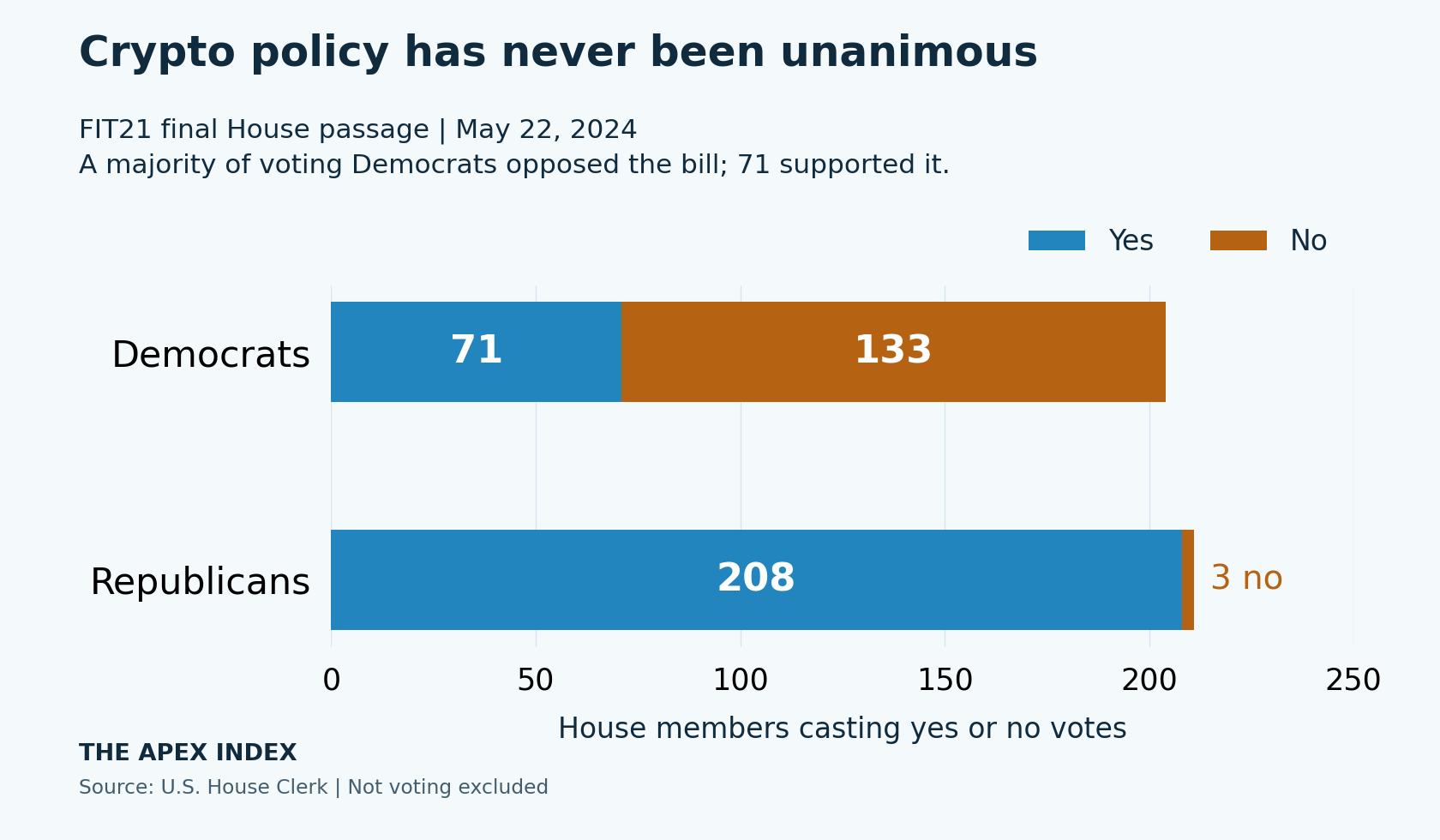
That split helps explain why I worry about Democratic control. A party with substantial opposition to a major crypto framework would have more power to determine which proposals get hearings, which get rewritten and which never reach the floor. Businesses trying to plan around federal rules would have another reason to wait.
But I won't pretend those 71 Democrats disappeared. The July 2025 House vote on the GENIUS Act, the stablecoin bill, included 102 Democratic yes votes and 110 no votes. Its Republican tally was 206 yes and 12 no. The Clerk records a much closer Democratic split on that legislation.
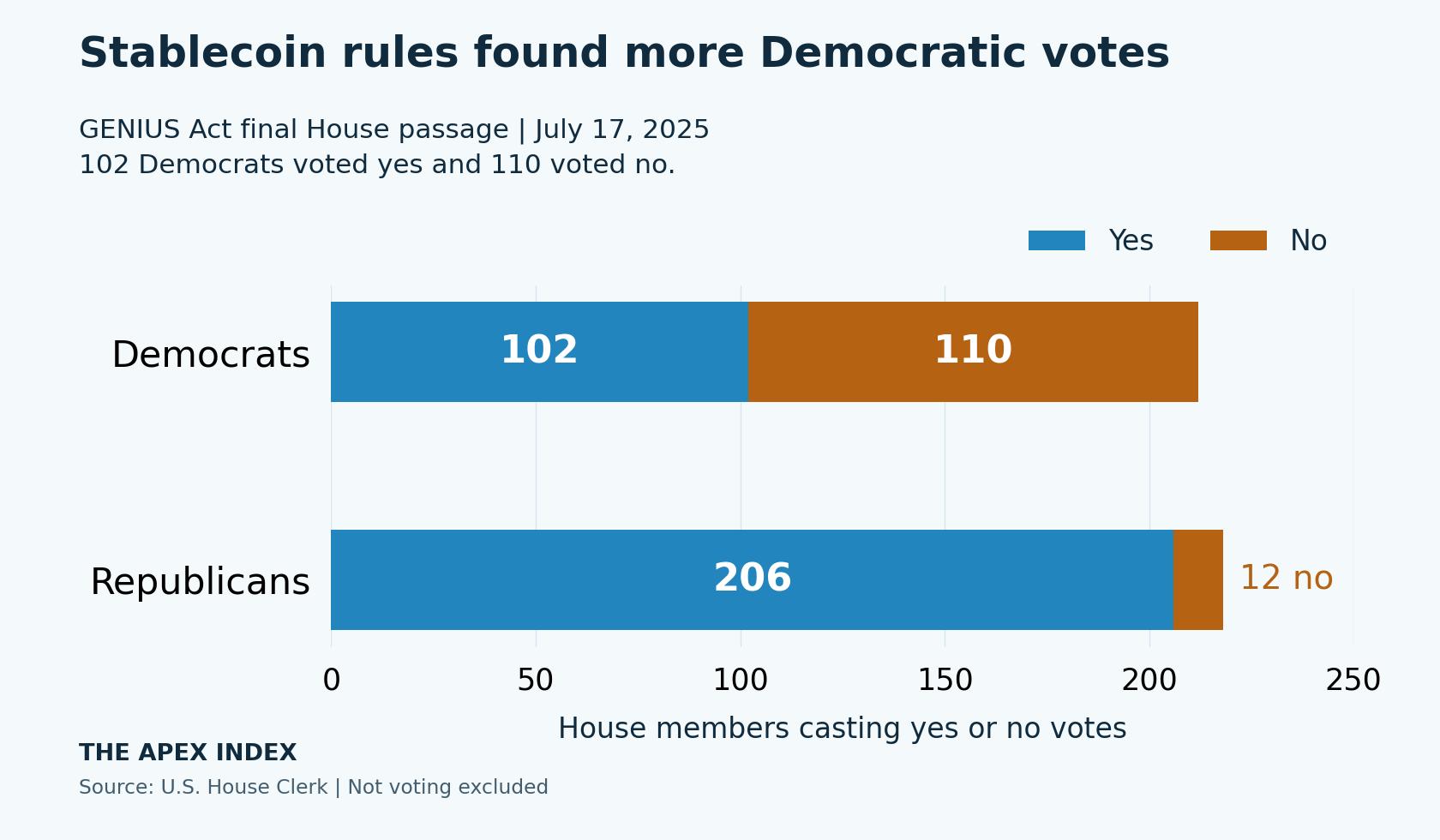
So I reject the lazy version of the argument that Democrats all hate crypto. Different bills produced different coalitions. A vote against a particular framework can reflect objections to its safeguards, its treatment of financial interests or its division of regulatory authority. Those objections deserve an answer.
The more recent Senate fight still worries me. As Apex previously reported, every Democrat who voted opposed advancing the CLARITY Act in September. Four Republicans also voted no, including Thom Tillis, whose vote preserved a procedural route to reconsideration. Democratic opponents argued that ethics and enforcement provisions remained inadequate.
My concern is that the next majority could treat delay as the safest political choice. For an industry waiting on workable rules, delay has a cost even when nobody announces a ban.
Trump doesn't get a free pass from me
I'm tired of the idea that supporting crypto means defending whatever Donald Trump does with it. I want clear rules, room to build and protection for people who hold their own assets. A president's commercial token venture doesn't become a public service because its buyers also like Bitcoin.
The official TRUMP website advertises an allocation of 80% for creators and CIC Digital, 10% for liquidity and 10% for public distribution. Those are allocation categories, not a measurement of today's wallet ownership. The same site says Trump-affiliated CIC Digital and Fight Fight Fight collectively own 80%, subject to an unlocking schedule, and receive trading revenue.
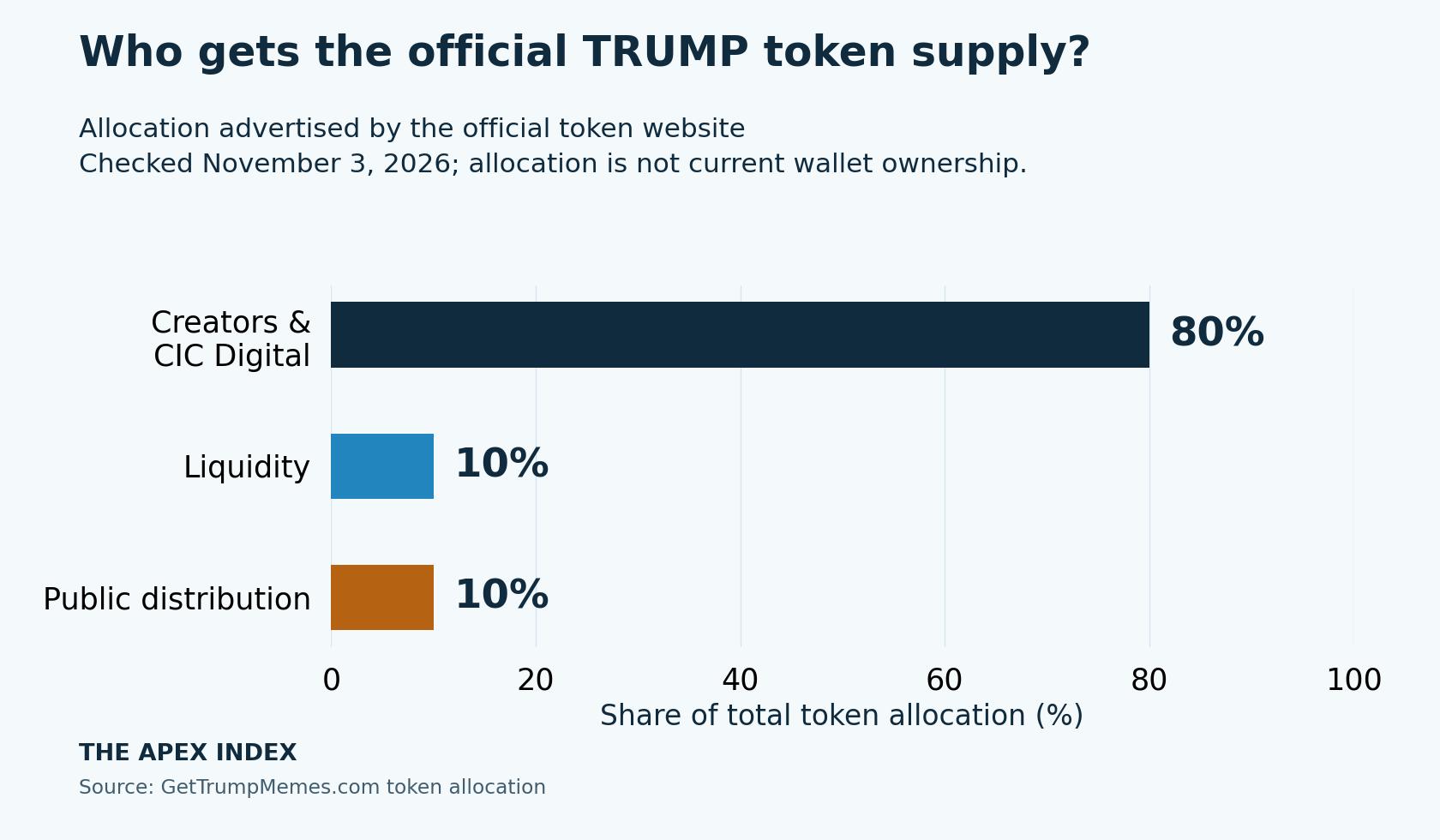
I find that concentration deeply uncomfortable. The public figure who helps shape the industry's political environment also has commercial interests tied to a token carrying his name. You don't need to invent a criminal conviction to see why that invites questions about conflicts, access and who benefits.
I think this is a poor standard for a president and a terrible example for an industry asking the public to trust its intentions. If a Democratic president did the same thing, my objection would be identical.
Then there's enforcement. In May 2022, the SEC announced that its Crypto Assets and Cyber Unit would grow to 50 dedicated positions. In February 2025, under Trump's administration, the agency replaced it with the Cyber and Emerging Technologies Unit, described in its announcement as approximately 30 fraud specialists and attorneys.
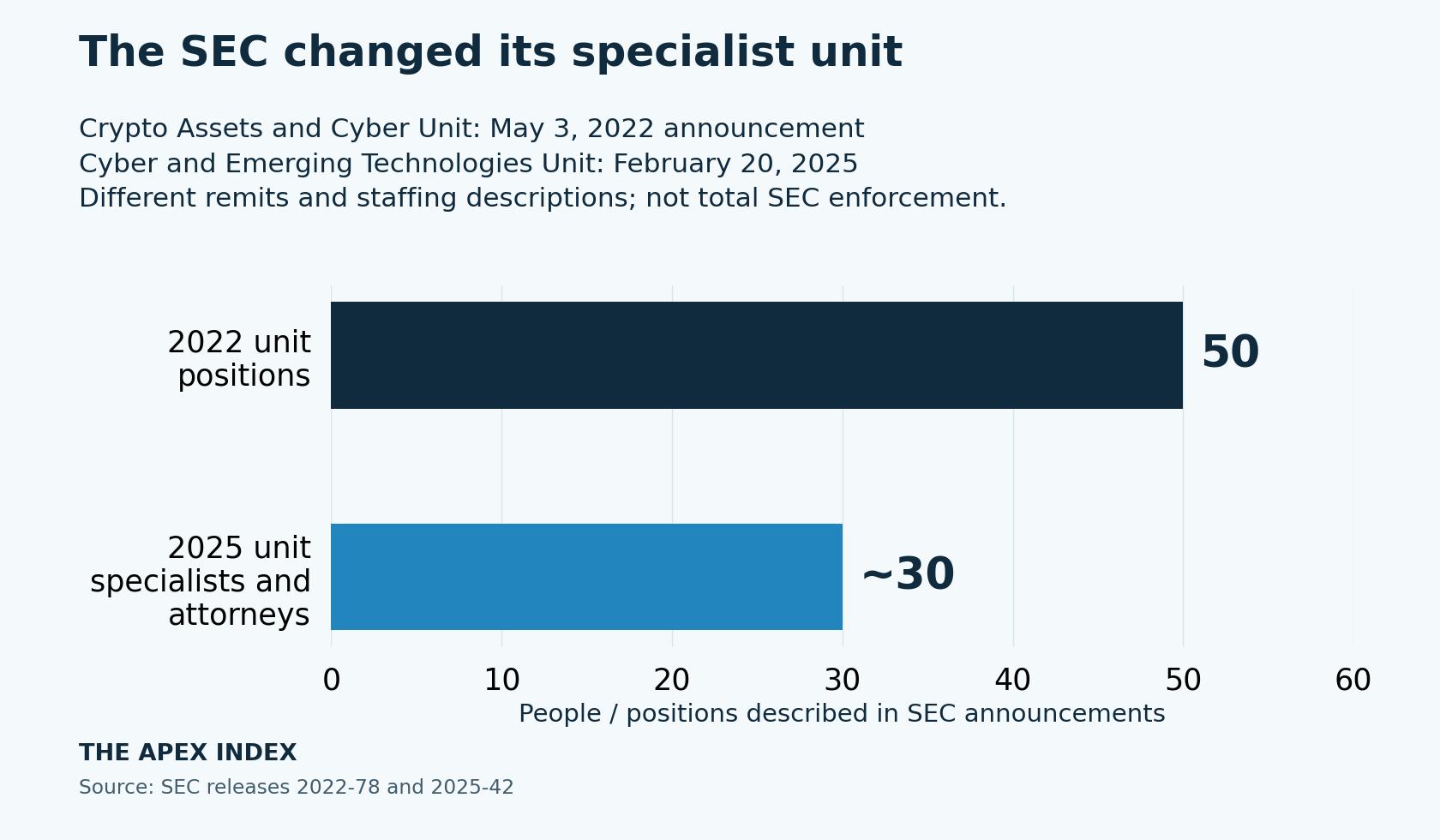
Those descriptions cover different mandates and staffing measures. They don't establish a precise cut in the SEC's entire ability to investigate crypto fraud. The replacement unit explicitly retained fraud involving blockchain technology and crypto assets among its priorities.
Still, I want to know whether the people chasing actual theft and deception have enough expertise and resources. I can oppose treating every disputed token classification like misconduct while demanding serious action against people who steal. Investors shouldn't have to choose between regulatory overreach and weak protection from fraud.
Binance has handed critics a powerful argument
The latest Binance account makes this debate painfully concrete. As Apex reported, the exchange's November 3 initial findings describe fake job interviews, malicious software and compromised internal AI tools leading to the October 29 wallet breach. Binance put impacted assets at $6.34 billion and frozen or intercepted funds at $2.85 billion, subject to reconciliation and market prices.
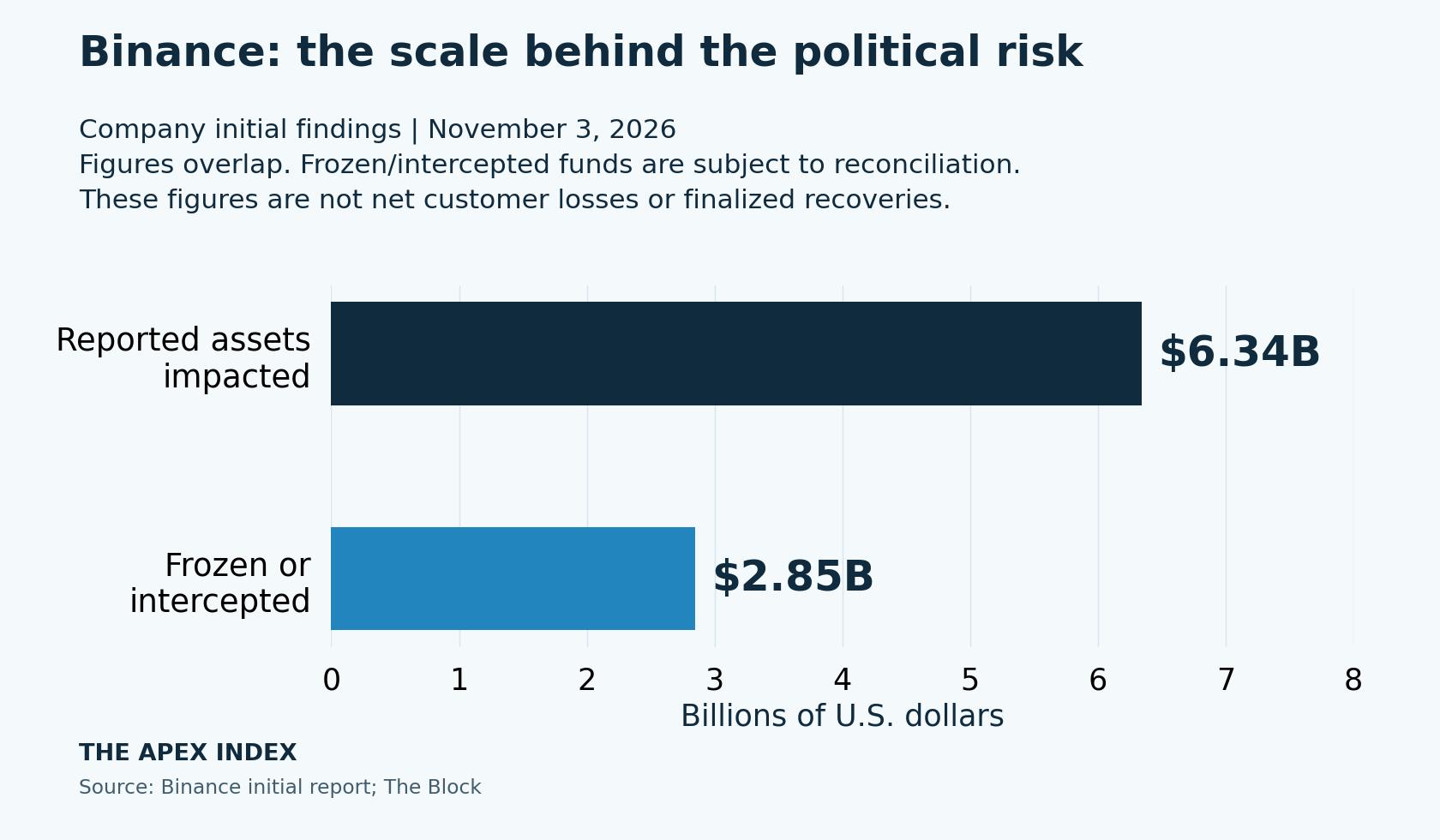
These are company findings, with independent review still to come. Frozen or intercepted funds aren't the same as completed recoveries. Binance says it will absorb the financial impact rather than pass it to users. That commitment matters. So does understanding how its controls failed.
I expect Democratic critics to use this breach as ammunition. An exchange reporting billions in stolen assets gives anyone arguing for tougher oversight an obvious example to put in front of a committee.
And what exactly would industry leaders say in response? That the technology is revolutionary? That adoption is growing? Neither answers a customer asking whether their assets are safe inside a business they don't control.
The crucial distinction is between an exchange's custody systems and Bitcoin's underlying network. This breach concerns Binance's systems; it doesn't establish that Bitcoin's consensus rules were broken. I worry that distinction will disappear in political speeches, leaving self-custody and open networks to carry the blame for failures at centralized businesses.
We drifted away from the reason this mattered
Satoshi's whitepaper opens with a proposal that still gives me a better standard than any campaign endorsement:
"A purely peer-to-peer version of electronic cash would allow online payments to be sent directly from one party to another without going through a financial institution."
That's what I mean when I talk about the Satoshi gospel: reducing dependence on institutions that can fail, block access or demand our trust.
Look at how much of the industry's pitch now depends on getting powerful institutions to approve of us. We celebrate access to politicians, access to banks and access to bigger pools of money. Some of that can make useful products available to more people. I understand the commercial logic.
What I detest is treating that access as the purpose. An industry that celebrates permissionless ownership should be embarrassed when its answer to political risk is finding a friend with enough influence to protect it. That leaves everyone exposed when the friend loses power.
Self-custody carries responsibilities, too. People lose keys, sign malicious transactions and make mistakes without a help desk that can reverse them. I won't sell independence by pretending it removes risk. I want people to understand the trade-off instead of being pushed toward whichever arrangement generates the most fees.
What I would watch as a trader
A Democratic sweep wouldn't automatically rewrite securities law, replace the president's regulators or shut exchanges. Congress could change committee priorities, conduct investigations and pursue legislation. A bill would still have to pass both chambers and become law, with Trump able to veto it and an override requiring two-thirds in each chamber.
That's why I'd watch actual proposals and votes rather than trade every hostile remark as an immediate change in law. The market can reprice political risk before a rule exists, but a frightening headline and a binding restriction have different consequences.
I'd also separate the exposures. An exchange business depends on licenses, banking relationships, customers and reliable custody. A leveraged trader depends on margin, liquidity and funding costs. Someone holding Bitcoin in a wallet they control has another set of risks. Calling all three positions "crypto exposure" hides information that matters when conditions turn.
My concern is that investors could demand a bigger discount for businesses whose prospects rely heavily on continued political goodwill. That's a possible repricing, since of course I can't honestly attach a percentage loss to an election outcome without a defensible model.
Democrats should have to explain how their proposals protect users while preserving lawful access and the ability to build. Republicans should have to explain why their support for crypto so often gets tangled up with the president's commercial interests. Industry leaders should have to explain why ordinary holders are expected to defend every compromise made in their name.
I want a market where honest builders can work, thieves face consequences and holding your own money doesn't depend on having the right party in office.