

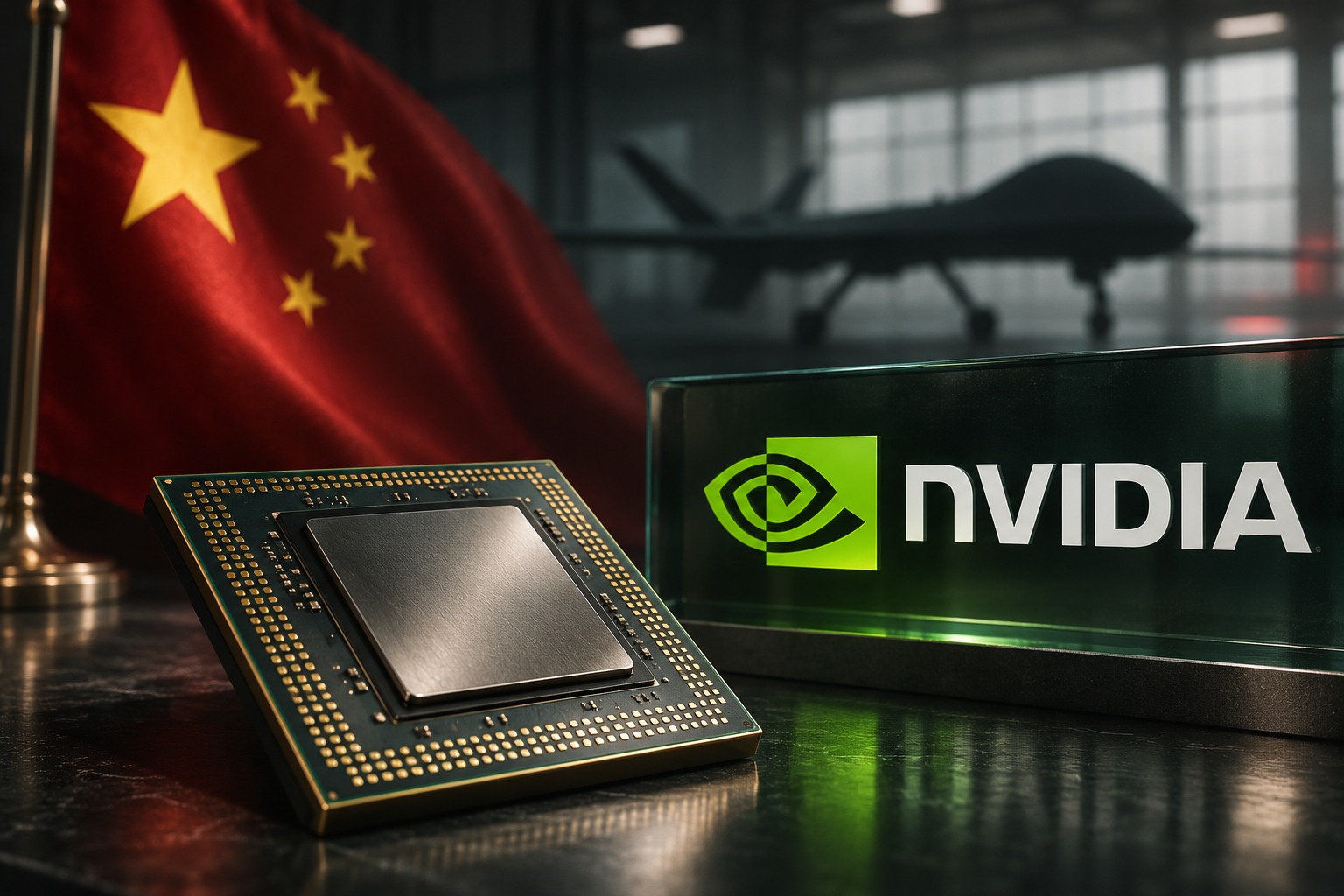
China's military is seeking advanced Nvidia chips as it develops AI-enabled weapons, targeting and command systems, a U.S. congressional advisory commission says. The finding puts military demand for American computing technology at the center of the debate over how effectively export controls are working.
The U.S.-China Economic and Security Review Commission's annual report, released Wednesday, cites research based on People's Liberation Army procurement documents. It places those efforts within Beijing's push for what the PLA calls “intelligentized warfare,” using AI across military operations.
Procurement records underpin the Nvidia claim
The report's security chapter cites an April 2026 assessment by the Center for Security and Emerging Technology that the PLA was actively seeking Nvidia's advanced chips for its AI-enabled military capabilities. That research examined procurement documents from several preceding years.
The commission states:
China is seeking to evade U.S. export controls to gain the most advanced semiconductors that underpin its intelligentization drive.
The evidence concerns military efforts to obtain the technology. It does not establish that Nvidia directly supplied the PLA or identify a completed Nvidia sale for a particular weapons system.
The report describes AI-enabled target recognition, firepower allocation and command decision-support systems appearing in Chinese military exercises. It also points to crewed aircraft and uncrewed systems working together.
Among the platforms it discusses are the Atlas AI-enabled drone swarm system, autonomous underwater vehicles used for mine-clearing and reconnaissance, and the Jiutian drone mothership, designed to deploy and coordinate smaller aerial drones.
China still faces a hardware and software gap
A separate technology chapter explains why access to foreign computing hardware remains important. It identifies Huawei's Ascend processors and Cambricon's Siyuan chips among China's efforts to build alternatives to Nvidia and AMD.
The commission says China has not closed several difficult gaps, including the most advanced chip fabrication, memory, manufacturing equipment and the software ecosystem supporting Nvidia's products.
That software advantage matters because replacing a processor can mean changing the tools developers use to make it work. The report says competing platforms may require companies to adapt models, replace software dependencies, retrain staff and rework existing processes.
Its assessment of Nvidia's CUDA platform is clear:
By enabling GPUs to operate near their maximum computing capacity, CUDA has become a de facto industry standard and a key advantage for Nvidia.
Overseas computing access complicates enforcement
The commission also highlights Chinese companies accessing advanced Nvidia chips through data centers in Southeast Asia. Its concern extends beyond where a processor is physically shipped to who can use the computing power remotely.
The report says earlier restrictions have not fully prevented Chinese entities from gaining remote access through AI data centers in other countries. That leaves enforcement focused on the customer and the way computing services are used, as well as the location of the equipment.
China's own military AI effort also faces a data problem. PLA researchers have identified a shortage of sufficiently varied real-world training data for unmanned systems, which can limit their ability to recognize objects and operate reliably in different conditions.
The commission wants tighter conditions on exports
The report's recommendations ask Congress to condition advanced AI chip exports to China on an auditable certification that they will not divert manufacturing or AI capacity away from the U.S. market.
The proposed requirement would cover advanced wafer fabrication, high-bandwidth memory and advanced packaging, rather than looking only at finished chips. Exporters would submit capacity-allocation information to the Bureau of Industry and Security, with penalties for false certifications.
The commission also wants disclosure when U.S. government services and commercial products rely on Chinese-developed AI models. These are recommendations for lawmakers, requiring further action to become binding requirements.
The findings arrive as Congress prepares to question Nvidia's former leader and the official overseeing export controls. As previously reported by Apex in the article linked above, Jensen Huang and Commerce Secretary Howard Lutnick have agreed to Senate Banking Committee appearances. Jensen is separately scheduled for House questioning on December 1.