

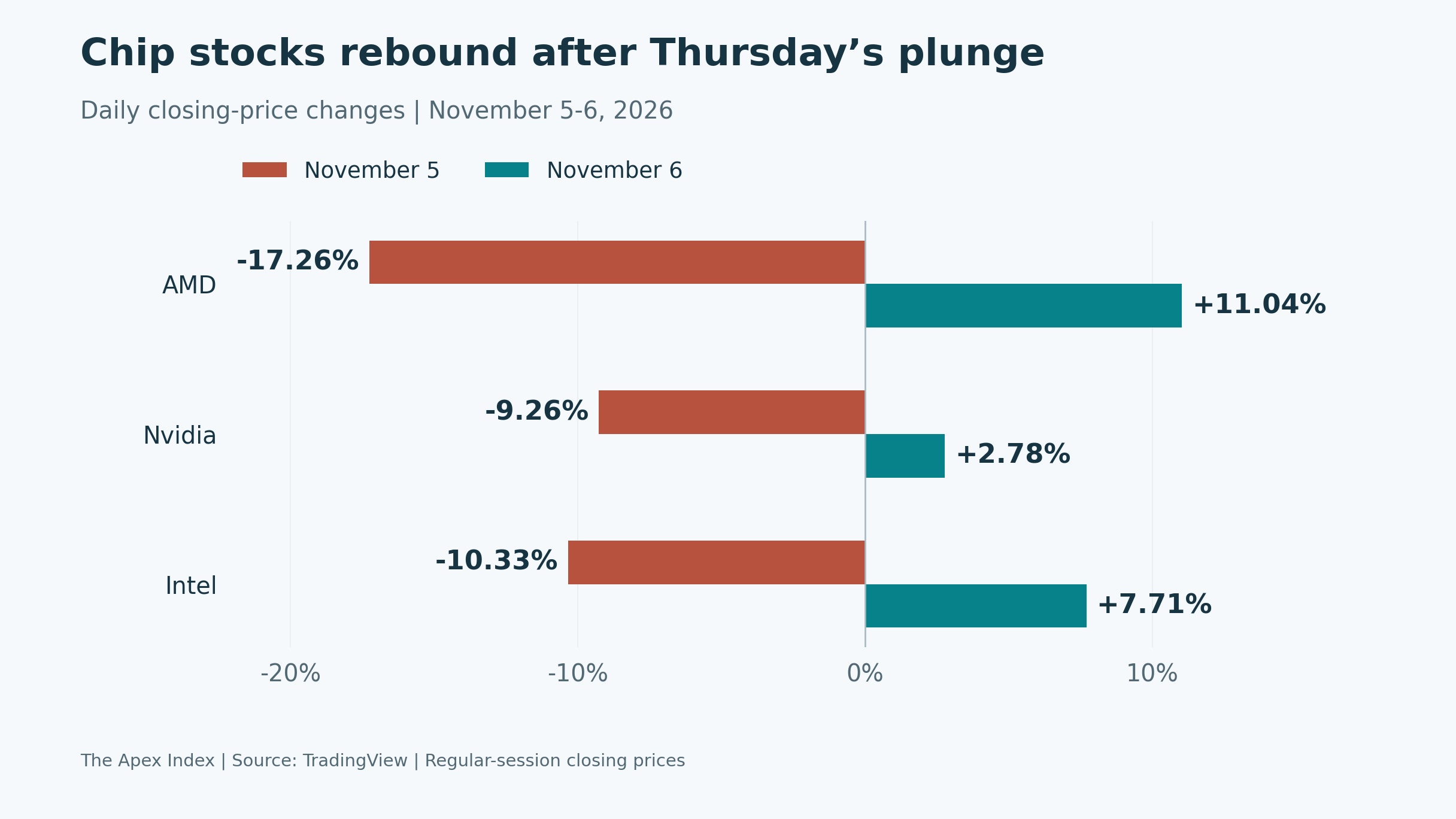
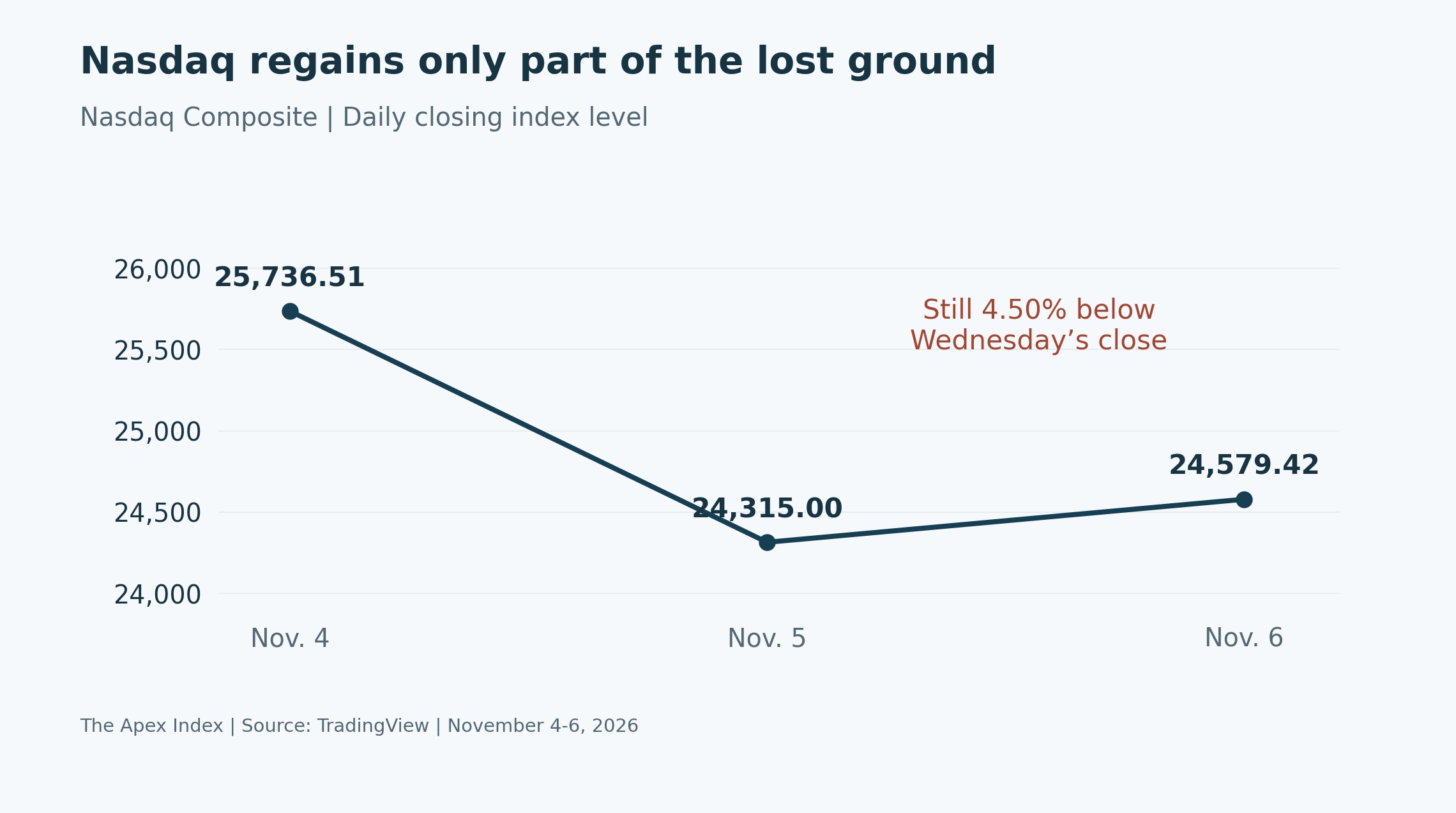
AMD jumped 11.04% and Nvidia recovered 2.78% on November 6 as buyers returned to chip stocks after Thursday's post-midterm selloff. The Nasdaq Composite gained 1.09% to 24,579.42, clawing back some ground after a 5.52% plunge the previous day.
The bounce was strongest in AMD, which closed at $449.04 after falling 17.26% on Thursday. Nvidia finished at $186.64, while Intel rose 7.71% to $56.28. All three still ended below their Wednesday closing prices.
A rebound with plenty of ground to recover
TradingView's data shows how uneven Friday's recovery was. The S&P 500 added 0.31% to 7,376.86, but the Dow Jones Industrial Average fell 237.33 points, or 0.46%, to 51,285.73.
That left the Nasdaq 4.50% below Wednesday's close across the two sessions. AMD remained down 8.13% over the same stretch, and Nvidia was down 6.74%. Friday's gains reduced the damage without bringing prices back to where they stood before the plunge.
Thursday had taken the Nasdaq from 25,736.51 to 24,315.00 and knocked 4.36% off the S&P 500. The sharp reversals came in the first trading sessions after Tuesday's U.S. midterm elections, with AI infrastructure and the companies supplying it under scrutiny.
AMD's earnings give buyers something concrete
AMD's November 3 results provide the company backdrop to its outsized recovery. Revenue reached a record $13.4 billion, up 45% from a year earlier. Data center sales rose 97% to about $8.5 billion, driven by EPYC processors and the launch of Instinct MI450-series graphics processors.
CEO Lisa Su said:
Demand for our Instinct and EPYC products continued to strengthen, and we expect growth to accelerate further in the fourth quarter as we scale Helios and ‘Venice’ production.
The growth was not uniform across the business. Gaming revenue fell 40% to $773 million, while client revenue rose 7% to about $2.9 billion. Embedded revenue increased 29% to about $1.1 billion.
AMD reported diluted earnings of $1.46 a share under generally accepted accounting principles and adjusted earnings of $2.09. Its adjusted gross margin was 56%.
On a GAAP basis, AMD reported operating income of $2.8 billion and net income of $2.4 billion. Its operating margin expanded to 21% from 14% a year earlier, while gross margin rose to 54% from 52%.
For the fourth quarter, management expects revenue of approximately $17 billion, plus or minus 3%, with an adjusted gross margin of about 55%. The midpoint would represent roughly 66% annual revenue growth and 27% growth from the third quarter.
Chief Financial Officer Jean Hu said:
Our fourth-quarter outlook reflects accelerating revenue and earnings growth, driven by strong demand across our Data Center portfolio.
The company said Anthropic, Meta, Microsoft, OpenAI and Oracle Cloud Infrastructure were running models and workloads on its first Helios rack-scale systems.
AI demand meets a tougher political backdrop
The election has added a separate concern around the infrastructure needed to keep that demand growing. As Apex previously reported, OpenAI's November 5 community commitment followed Democratic midterm victories by candidates campaigning for tighter controls on data center projects.
OpenAI promised to pay the electricity and supporting infrastructure costs of future campuses it owns and operates, with financial assurances intended to protect other power customers if a project is delayed, reduced or canceled. The ownership condition limits which facilities the commitment covers.
Financing is still moving, too. Apex earlier reported that OpenAI had secured roughly $11 billion at a $1.25 trillion valuation, while Anthropic was pressing ahead with plans for an IPO before Thanksgiving.
For AMD, the next company-specific test is delivering its fourth-quarter forecast. That means turning the Helios and Venice production ramp into the revenue management has projected while keeping margins near its target.