

Alphabet plans to spend about $200 billion on infrastructure this year, largely to support AI, while Google works out how to make chatbot-style answers pay like traditional search. Its own AI products could shift activity away from the ad formats that have made Google so profitable.
Search is attracting more activity, but revenue growth is slowing. Google Search & other revenue increased 12% in the third quarter, down from roughly 17% in the previous quarter. Growth in paid clicks slowed to 8% from 13%.
The Verge reported November 4 that Chief Business Officer Philipp Schindler acknowledged AI Mode queries were monetizing at a lower rate than traditional searches. He also identified currency effects as the biggest reason for the revenue-growth slowdown, alongside changes in spending by advertisers in particular industries.
More searches, a harder sale
The risk is that Google moves people from familiar, well-monetized searches into conversations that bring in less money. AI Mode turns a search into a back-and-forth exchange, while AI Overviews place generated summaries inside ordinary results.
Someone researching which running shoes to buy may want a conversation. Someone already searching for a specific pair may be ready to click a shopping ad. Those are different opportunities for an advertiser, and a larger number of questions does not automatically create the same volume of purchase-ready traffic.
Nate Elliott, an eMarketer principal analyst covering AI and advertising, told The Verge:
"This is the first major disruption that Google is facing to its core business in decades."
Google argues that most AI Mode queries are additional activity, rather than replacements for existing searches. Schindler described many as early-stage purchase research and said the company's advertising experiments were showing promise.
That distinction is central to the business case. Additional conversations can expand Google's audience and create more places for ads. Replacing higher-earning searches with lower-earning exchanges would put pressure on the economics of its existing business.
Advertising still supplies most of the revenue
Alphabet's October 28 results show the size of the business at stake. Google advertising generated $82.012 billion of the company's $127.577 billion in third-quarter revenue. Search & other alone contributed $63.350 billion.
CEO Sundar Pichai offered a positive reading of the increase in usage:
"Our AI investments are driving overall Search query growth, including commercial queries. In fact, our year-over-year query growth rate is the highest it’s been in the last five years."
Advertisers are also still getting results. Tinuiti's same-store clients increased Google paid-search spending 14% year over year in the third quarter while maintaining their return-on-ad-spend targets, according to its research executive Andy Taylor.
"We’re still seeing a good return, and we’re not seeing performance take a hit," Taylor said.
However, Taylor said advertisers cannot separately target Google's AI advertising inventory or break out its performance. Strong overall returns therefore leave the contribution from AI ads unresolved.
The spending bill is already arriving
The investment has an immediate cash cost. In the third quarter, Alphabet generated $42.290 billion in operating cash flow and spent $51.355 billion on property and equipment, producing negative free cash flow of $9.065 billion. Free cash flow was also negative in the second quarter.
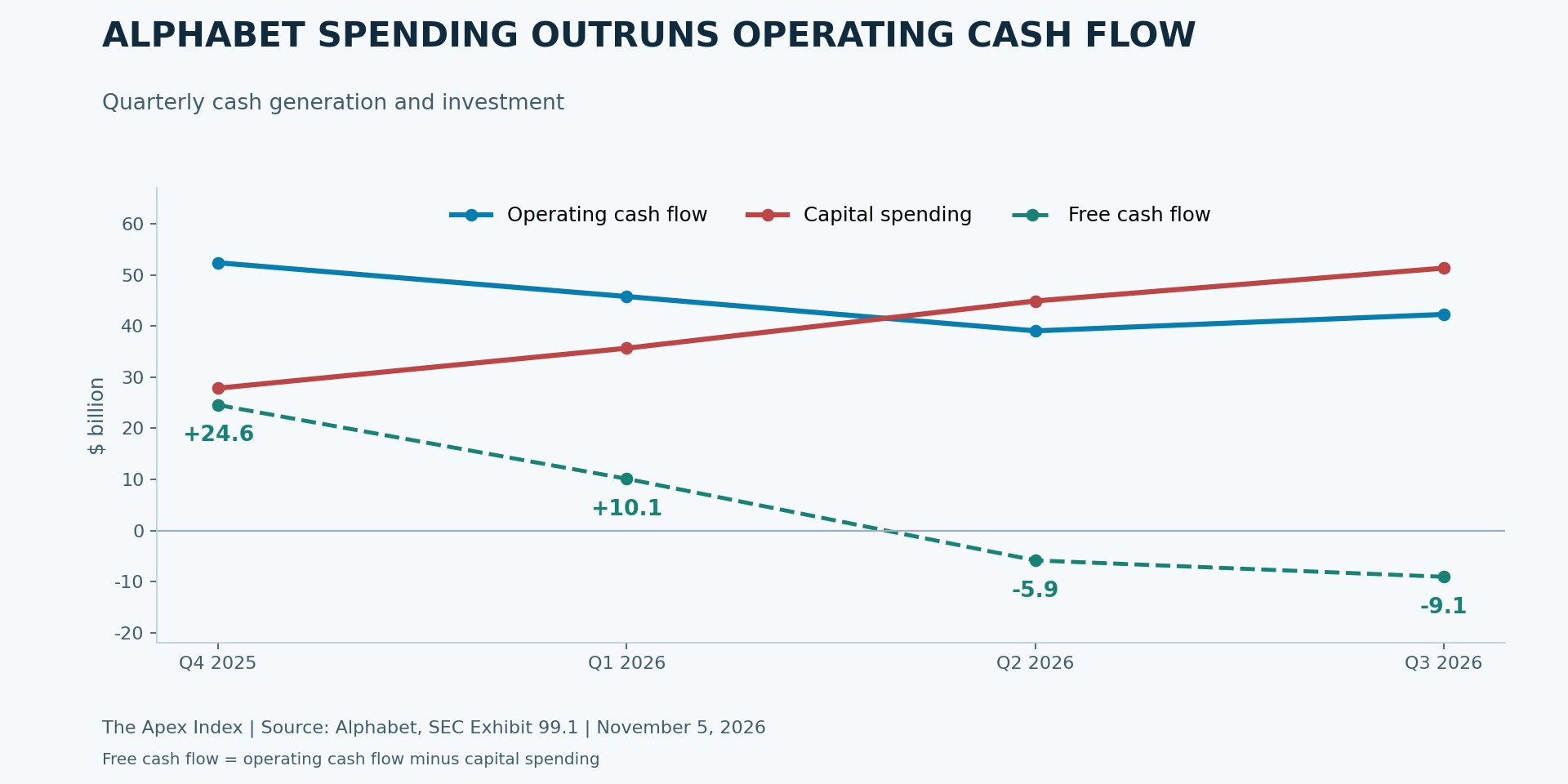
Capital expenditure reached about $132 billion in the first nine months, compared with $63.6 billion a year earlier, according to the company's filing. These investments include servers, networking equipment and data centers supporting the wider business.
There is growth outside advertising to help justify the buildout. Google Cloud revenue rose 103% to $30.709 billion in the third quarter, while its operating income increased to $11.121 billion from $3.594 billion. Alphabet said demand for AI infrastructure and solutions, alongside sales of its TPU systems, contributed to that expansion.
Google is expanding ads in AI Overviews and AI Mode, including internationally and across multiple turns of U.S. conversations. It has also discussed bringing advertising to the standalone Gemini app, without announcing when.